Protein Production
Soybean seed is protein-rich, creating substantial nitrogen demand as the crop develops and fills seed.
Trademark Notice: All products featured on this website are registered trademarks of Verdesian Life Sciences.
A super-concentrated, multi-strain Bradyrhizobium japonicum soybean inoculant designed to deliver high-quality rhizobia to seed, support consistent nodulation and help build the biological nitrogen-fixation system required by productive soybean crops.
Current Verdesian positioning emphasizes high rhizobia concentration, multiple strains, consistent on-seed delivery and operationally efficient treatment options—including compatible FlexConnect® closed-transfer configurations in markets where they are available.
*Published manufacturer reference. Product registration, viable-count specifications, strain declarations, rates, seed-treatment compatibility, treatment-to-planting intervals, package formats and FlexConnect® availability can differ by country. Always follow the current local label.
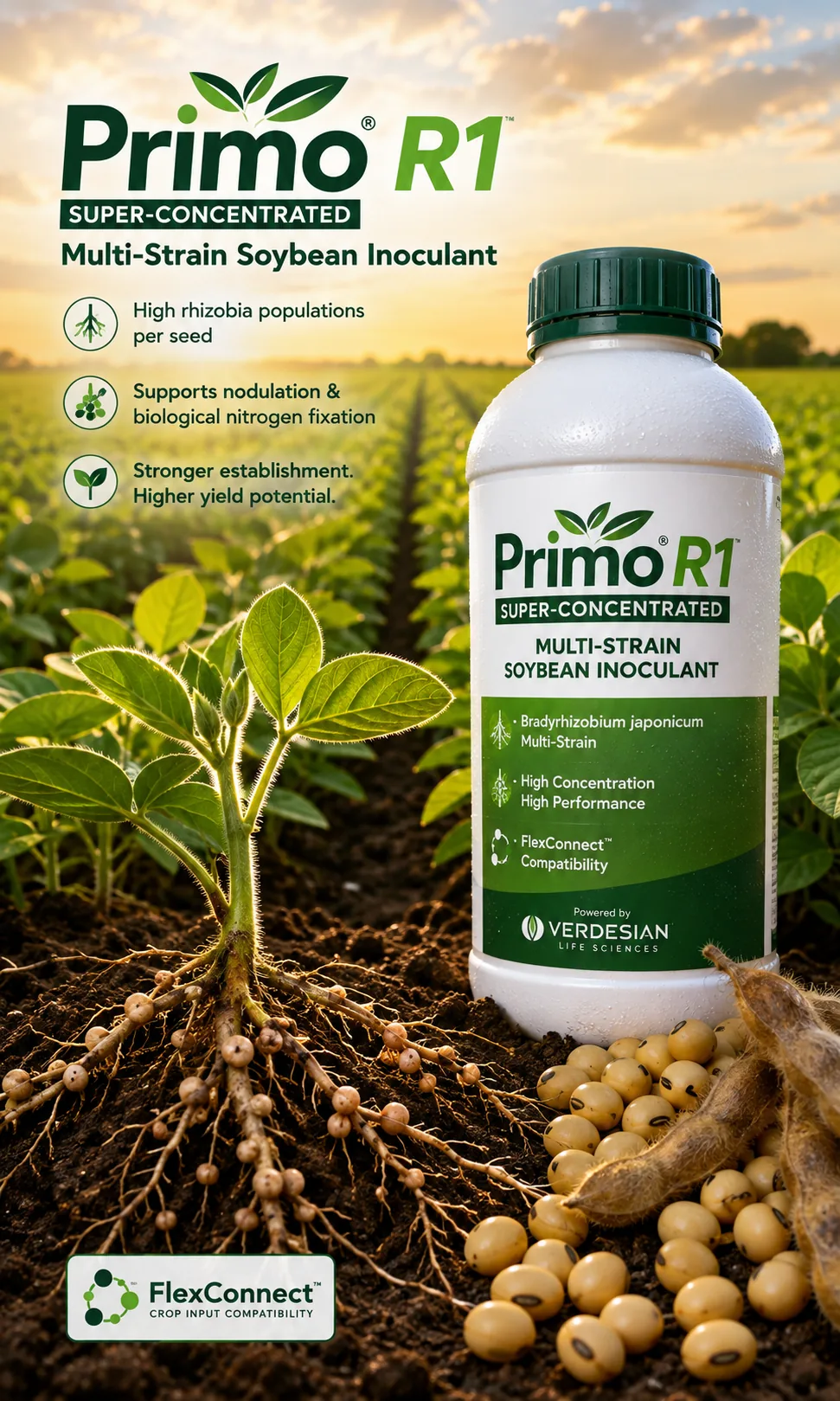
Soybeans require substantial nitrogen to build leaves, stems, roots, pods, seed protein and final yield. A major proportion of that nitrogen can be supplied through the crop's symbiotic relationship with compatible rhizobia bacteria.
Primo R1 is designed to place a high population of soybean-specific rhizobia directly onto seed. Following germination, compatible bacteria colonize the developing root system and initiate the biological processes that lead to nodule formation.
Inside functioning nodules, rhizobia and the soybean plant form a mutually beneficial relationship: the plant supplies energy-rich carbohydrates to the bacteria, while the bacteria fix atmospheric nitrogen into biologically useful nitrogen compounds.
Current manufacturer information describes Primo R1 as a super-concentrated, multi-strain Bradyrhizobium japonicum inoculant designed to provide the type and number of rhizobia needed to establish an effective soybean nodulation system.
Nitrogen is a structural and metabolic foundation of soybean production, contributing to proteins, enzymes, chlorophyll, nucleic acids and the photosynthetic machinery that supports growth and seed production.
Soybean seed is protein-rich, creating substantial nitrogen demand as the crop develops and fills seed.
Nitrogen is a major component of chlorophyll and photosynthetic proteins needed to capture light energy.
Nitrogen contributes to nucleic acids and proteins required for cell division and tissue growth.
Nitrogen demand remains important as soybean plants transition from vegetative development into pod and seed production.
Verdesian's current soybean inoculant information notes that soybean production requires approximately four to six pounds of nitrogen per bushel of harvested soybeans. This illustrates why effective biological nitrogen fixation can be so important to soybean crop performance.
This figure is an agronomic context reference, not a Primo R1 application-rate calculation.
Compatible soybean rhizobia interact with emerging soybean roots through a highly specialized biological signaling relationship.
Root tissues develop nodules that create the biological environment in which effective rhizobia can function.
Functioning rhizobia convert atmospheric nitrogen into nitrogen compounds that can enter the plant's nutritional economy.
The soybean provides carbohydrates generated through photosynthesis and develops specialized nodules where compatible rhizobia can live and function.
Biological nitrogen fixation therefore carries an energetic cost to the plant but provides access to atmospheric nitrogen that would otherwise be unavailable directly to soybean metabolism.
Effective rhizobia use the nitrogenase biological system within functioning nodules to convert atmospheric nitrogen gas into forms that enter the plant's nitrogen metabolism.
The productivity of this relationship depends on successful infection, nodule development, rhizobia effectiveness and suitable crop conditions.
Primo R1 is formulated around Bradyrhizobium japonicum, a rhizobia species associated with soybean nodulation.
Current Verdesian information specifically identifies Primo R1 as a multi-strain inoculant for more consistent performance.
The concentrated formulation is positioned around putting a high viable rhizobia population onto each treated soybean seed.
Manufacturer positioning emphasizes delivering high-quality rhizobia capable of competing with less effective background soil populations.
The number of viable soybean-compatible rhizobia delivered to each seed is one of the fundamental performance considerations for an inoculant.
Current Verdesian product positioning for Primo R1 states that the published program delivers greater than 2.6 million colony-forming units of rhizobia per seed.
The manufacturer also describes Primo R1 as delivering up to twice the rhizobia per soybean seed compared with selected competing products used in its comparison.
These figures are manufacturer product-positioning references and should not be interpreted as universal viable counts under every storage, treatment or planting situation.
Manufacturer guidance notes that flooding can affect background rhizobia populations and their reliability.
High temperature conditions can influence survival of biological organisms in soil and on treated seed.
Cold conditions can affect microbial activity, root development and the timing of early symbiotic establishment.
Manufacturer guidance identifies soil pH as another factor that can influence background rhizobia populations.
A field may contain residual soybean rhizobia from previous soybean crops, but population size and nitrogen-fixing effectiveness are not necessarily uniform across soil zones or seasons.
This is one reason inoculation is often used as a relatively simple way to deliberately place a known soybean-compatible inoculant close to every planted seed.
Previous soybean production can leave soybean-compatible rhizobia in the field, but their abundance, spatial distribution and biological effectiveness may vary.
Verdesian's current guidance recommends regular soybean inoculation rather than assuming that historical background populations will always provide the optimal type and number of rhizobia.
On-seed inoculation places the desired bacteria immediately adjacent to the germinating soybean root rather than relying entirely on indigenous or residual populations being present in sufficient numbers.
The economic value of this strategy remains farm-, season- and yield-dependent and should be evaluated locally.
Uniform application matters because the purpose of an on-seed inoculant is to place viable rhizobia close to every germinating soybean seed. Always follow the current local label and seed-treatment-equipment instructions.
Verify local registration, label rate, expiration or use-by information, storage requirements and compatibility with the planned seed-treatment package.
Determine seed units or seed weight accurately so the inoculant can be metered according to the approved rate.
Calibrate the treatment system to achieve consistent inoculant coverage across the treated seed lot.
Handle treated seed according to temperature, compatibility, storage and treatment-to-planting restrictions for living rhizobia.
Current U.S. Verdesian product information lists 0.625 fluid ounce of Primo R1 per 140,000 soybean seeds.
The same manufacturer information lists 1.25 fluid ounces per hundredweight of soybean seed.
In markets where compatible packages and application equipment are available, Primo R1 can be used with Verdesian's FlexConnect® closed-transfer soybean inoculant system.
FlexConnect® is designed so compatible inoculant packages can be connected to treatment equipment without first transferring the inoculant into a separate open mixing tank.
Verdesian positions the system around proportionally metered product, reduced unnecessary operator handling, reduced cleanup and consistent delivery of high-quality inoculant to treated seed.
Current U.S. manufacturer information lists a 40-unit bladder configuration for traditional application.
A larger 500-unit bladder is also listed for traditional treatment configurations in the current U.S. portfolio.
Current manufacturer information lists 200- and 800-unit bladder sizes for FlexConnect®-compatible application.
Package sizes are manufacturer U.S. references and may not represent available or registered commercial configurations in Atlas EMEA markets.
A high-concentration biological inoculant provides maximum value only when the product is metered and distributed consistently across the seed lot.
Verdesian positions Primo R1 and FlexConnect® around consistent inoculant delivery to every treated seed.
Even with a closed-transfer system, seed-treatment equipment must be correctly calibrated and maintained.
Operators should verify seed throughput, metering output, coverage and treatment consistency according to equipment and label instructions.
Primo R1 is applied to seed so compatible rhizobia are positioned close to the developing root immediately after germination.
As roots expand through the soil, successful infection events can lead to nodule formation along the root system.
Effective nodulation is only one component of a productive root system. Soil structure, compaction, moisture, oxygen, temperature, pH, phosphorus, potassium and other nutrients also influence root growth and nodule function.
Lift plants with surrounding soil rather than pulling them sharply, which can strip nodules from roots.
Gently remove soil so nodules can be observed without unnecessarily damaging fine roots.
Assess the presence and distribution of nodules across the root system rather than counting only one easily visible cluster.
Nodule appearance can provide useful agronomic clues, but interpretation should be made with appropriate local soybean and inoculant guidance.
Phosphorus supports root growth, energy transfer and numerous metabolic processes associated with productive crop growth and nodulation.
Potassium contributes to water regulation, enzyme function, photosynthesis and carbohydrate movement.
Sulfur is required for sulfur-containing amino acids and proteins and interacts strongly with overall nitrogen metabolism.
Soybean productivity depends on appropriate micronutrient status as well as effective biological nitrogen fixation.
Current Verdesian FAQ information states that soybean inoculants such as Primo R1 can be used in conjunction with other fertilizers and pesticides.
However, rhizobia are living microorganisms. The fact that products can be used in the same seed-treatment program does not mean every concentrate can be mixed directly or that every treatment combination has the same permissible on-seed survival interval.
Compatibility should therefore be evaluated against the exact fungicide, insecticide, biological, polymer, micronutrient and seed-treatment package being used.
Biological inoculants can lose viability when exposed to unsuitable temperature conditions. Follow current storage and transport instructions.
Check lot identification, use-by information and product condition before treatment.
Where an on-seed planting window or compatibility interval applies, plan treatment logistics so seed is planted within that approved period.
Primo R1 is a biological product containing compatible soybean rhizobia. It does not function like a conventional bagged or liquid nitrogen fertilizer.
Its role is to help establish the bacteria required for symbiotic biological nitrogen fixation.
Once effective nodules become established, the symbiosis allows atmospheric nitrogen to be biologically fixed and incorporated into plant nitrogen metabolism.
Nodulation failure, severe stress or unsuitable field conditions can reduce the effectiveness of this process.
Extreme soil pH can affect soybean root development, nutrient availability and rhizobia populations.
Waterlogged or severely compacted soil can restrict oxygen and root development, affecting establishment of the symbiosis.
Both drought and excess moisture can stress soybean roots and influence early nodule formation.
Soil temperature influences germination, root growth, microbial activity and the rate of early soybean development.
Manufacturer positioning connects effective soybean inoculation with improved nitrogen supply and greater soybean yield potential.
That relationship is agronomically logical: a soybean plant cannot build high levels of biomass and protein-rich seed without adequate nitrogen.
Primo R1 should nevertheless be positioned as one component of a complete soybean production system rather than as a guaranteed-yield input.
| Stage | General soybean development context |
|---|---|
| Planting | Primo R1 is positioned on the seed so compatible rhizobia are available as roots begin developing. |
| VE | Emergence; cotyledons move through the soil surface and the young root system continues expanding. |
| VC–V stages | Vegetative growth develops rapidly and nodulation becomes an increasingly important component of crop nitrogen supply. |
| R1–R2 | Flowering begins as the plant transitions into reproductive growth. |
| R3–R4 | Pod development increases crop demand for photosynthate and nutrients. |
| R5–R6 | Seed filling creates strong nitrogen demand as protein-rich soybean seed develops. |
| R7–R8 | The crop progresses through maturity toward harvest. |
| Attribute | Published / product reference information |
|---|---|
| Product | Primo R1. |
| Product category | Super-concentrated soybean inoculant. |
| Crop | Soybean. |
| Rhizobia | Multi-strain Bradyrhizobium japonicum. |
| Primary application | On-seed soybean inoculation / seed treatment. |
| Primary agronomic objective | Nodulation and biological nitrogen fixation. |
| Manufacturer rhizobia-per-seed positioning | Greater than 2.6 million colony-forming units per seed under the published Primo R1 program. |
| Manufacturer competitive positioning | Up to twice the rhizobia per soybean seed compared with selected competing products in manufacturer comparisons. |
| Published U.S. seed-unit rate | 0.625 fl oz per 140,000 seeds. |
| Published U.S. seed-weight rate | 1.25 fl oz per hundredweight of seed. |
| Traditional U.S. package references | 40- and 500-unit bladder sizes. |
| FlexConnect® U.S. package references | 200- and 800-unit bladder sizes. |
| FlexConnect® positioning | Closed-transfer soybean inoculant application system designed for metered product delivery and reduced handling. |
| Compatibility positioning | Manufacturer FAQ states soybean inoculants such as Primo R1 can be used with other fertilizers and pesticides; exact treatment compatibility and on-seed survival must still be verified. |
| Local-use requirement | Current product label, registration, viable-count specification, rate, compatibility and storage instructions take precedence. |
Where soybean has not been grown recently, relying on an adequate population of compatible background rhizobia can create additional uncertainty.
Different soil zones, pH, drainage and historical stresses can lead to variable microbial populations across a field.
Manufacturer guidance identifies flooding as one factor that can weaken or reduce confidence in background rhizobia populations.
Historical extreme hot or cold conditions are also cited as factors that may influence background populations.
High-yield soybean crops have substantial nitrogen demand, increasing the importance of an effective biological nitrogen-fixation system.
High-volume seed treatment operations may value concentrated inoculant and closed-transfer options that support consistent metering.
Inoculation does not replace phosphorus, potassium, sulfur, micronutrients or other nutrients required by the soybean crop.
Primo R1 is not a substitute for registered seed-applied crop-protection products required for disease or insect management.
Inoculation cannot compensate for poor seed quality, severe compaction, inappropriate planting depth, unsuitable soil moisture or other major establishment problems.
Discuss soybean inoculation strategy, field history, nodulation, soil conditions and nitrogen-management objectives.
Review application calibration, seed throughput, compatibility, treatment sequence and operational requirements.
Explore registration status, package availability, commercial supply and portfolio positioning.
Evaluate Primo R1 within integrated soybean seed-treatment and biological nitrogen-management programs.
Providing seed-treatment and field context helps Atlas Crop Technologies route your request to the appropriate technical or commercial contact.
A multi-benefit nutritional seed lubricant combining talc/graphite, micronutrients and MAC® Technology to support planting performance, emergence and early crop vigor.
View Product → FoliarA fast-acting, non-chlorinated foliar potassium technology combined with Take Off® technology to support potassium uptake, water utilization and crop quality.
View Product → FertigationA water-soluble potassium-efficiency technology containing BioSF325™ for fertigation programs focused on potassium use efficiency and quality.
View Product →Tell us about your soybean program, seed volume, field history, seed-treatment system, existing seed treatments, market or distribution requirement. Our team will route your enquiry to the appropriate regional contact.
The information below provides general biological and product context. Current approved local product documentation remains authoritative for strain declarations, viable counts, rates, compatibility, storage, treatment intervals and legal use.
Primo R1 is a super-concentrated soybean inoculant produced by Verdesian Life Sciences.
Current manufacturer information describes it as a multi-strain Bradyrhizobium japonicum inoculant designed to provide high-quality rhizobia directly to soybean seed.
A soybean inoculant is a biological product containing viable soybean-compatible rhizobia.
These bacteria establish a symbiotic relationship with soybean roots and can form nodules where biological nitrogen fixation occurs.
Current Verdesian product information identifies Primo R1 as a multi-strain Bradyrhizobium japonicum soybean inoculant.
Verdesian positions the multi-strain formulation around more consistent performance.
This page does not infer strain identities or ratios that are not provided in the current public manufacturer product information.
Biological nitrogen fixation is the microbial conversion of atmospheric nitrogen gas into biologically useful nitrogen compounds.
In soybeans, this takes place through a symbiotic relationship between compatible rhizobia and soybean roots within specialized nodules.
Primo R1 is a biological rhizobia inoculant rather than a conventional nitrogen fertilizer.
Its nitrogen value comes from helping establish the bacteria involved in symbiotic biological nitrogen fixation.
Nitrogen is essential for chlorophyll, enzymes, proteins and other compounds required to build soybean biomass and protein-rich seed.
Verdesian's current soybean guidance cites approximately four to six pounds of nitrogen demand per bushel as agronomic context.
Soybean nitrogen can come from soil organic matter and residual mineral nitrogen, but a major source can be symbiotic biological nitrogen fixation by compatible rhizobia.
The soybean develops nodules that house compatible rhizobia and provides the bacteria with carbohydrates derived from photosynthesis.
Effective rhizobia then fix atmospheric nitrogen, supporting the plant's nitrogen nutrition.
A nodule is a specialized structure formed on soybean roots following successful interactions with compatible rhizobia.
Functioning nodules provide the controlled biological environment needed for nitrogen fixation.
Current Verdesian product positioning states greater than 2.6 million colony-forming units per seed under the published Primo R1 program.
Viable counts in practice depend on correct storage, application, compatibility and planting interval.
CFU means colony-forming unit and is a microbiological measure used to describe viable organisms capable of producing colonies under specified test conditions.
The seed is the starting point for inoculation. Delivering an appropriate population of viable compatible rhizobia near each emerging root increases the opportunity for successful early colonization and nodulation.
Verdesian's current manufacturer positioning states that Primo R1 can provide up to twice the rhizobia per soybean seed compared with selected competitive products used in its comparison.
This is manufacturer comparison positioning and should not be generalized to every inoculant on the market.
Fields may contain background rhizobia from previous soybean crops, but those organisms can vary in number and nitrogen-fixing effectiveness.
Primo R1 is positioned around delivering a high population of effective soybean rhizobia directly to seed.
Manufacturer guidance recommends regular inoculation because background rhizobia populations can vary with field conditions and may not always provide the desired type or quantity.
Local agronomic recommendations should be considered for each field.
Verdesian specifically references factors including:
Primo R1 is positioned as an on-seed soybean inoculant applied during the seed-treatment process.
Use calibrated equipment and the current locally approved application directions.
Current U.S. manufacturer information lists:
These are U.S. manufacturer reference rates. Do not use them in another market unless the current local label supports them.
In the U.S. soybean market, a standard seed unit is often expressed as a fixed number of soybean seeds. Primo R1 manufacturer guidance uses 140,000 seeds as the unit basis for its published U.S. rate.
Commercial seed packaging standards can differ by market.
Cwt means hundredweight, equal to 100 pounds in the U.S. measurement system.
The manufacturer publishes 1.25 fl oz/cwt as a U.S. rate reference.
Do not make a regulatory-use decision from a mathematical conversion alone.
The locally approved label determines the legal rate, viable-count requirement and use instructions in each market.
FlexConnect® is Verdesian's closed-transfer application system for compatible soybean inoculant packages.
It is designed to connect inoculant to seed-treatment equipment through a closed system and provide metered product delivery with less unnecessary handling and transfer.
Yes. Current Verdesian information lists specific Primo R1 package configurations that are compatible with FlexConnect®.
Availability depends on market, product package and treatment equipment.
Current U.S. manufacturer information lists:
These package configurations may not be available in every market.
The inoculant needs to reach the treated soybean seed at the intended rate so an appropriate population of viable rhizobia is available near the emerging root.
Seed-treatment equipment should therefore be correctly calibrated.
Manufacturer information states that soybean inoculants such as Primo R1 can be used alongside pesticides.
However, exact compatibility and permissible on-seed survival intervals depend on the specific fungicide formulation and treatment program. Confirm current compatibility guidance before use.
It may be used in seed-treatment programs containing compatible insecticides, but the exact combination must be checked against current product compatibility information.
Biological compatibility should be specifically verified rather than assumed.
Multiple living organisms, carriers, preservatives and other seed treatments can interact differently depending on the exact formulations.
Current Verdesian FAQ information states that soybean inoculants such as Primo R1 can be used alongside fertilizers.
This does not imply that concentrated fertilizer products should be mixed directly with live inoculant without validated compatibility.
Because Primo R1 contains living rhizobia, it should be stored and handled according to current manufacturer and local-label temperature, shelf-life and product-protection instructions.
Do not invent storage temperatures from general biological guidance; use the current supplied product documentation.
The permitted treatment-to-planting interval depends on the exact Primo R1 registration, other seed treatments, treatment conditions and current compatibility documentation.
Use the current locally supplied on-seed survival guidance rather than assuming a universal interval.
No. Manufacturer material discusses consistent FlexConnect® delivery during treatment operations extending over a 14-day period, but this should not be interpreted as a universal 14-day on-seed survival guarantee.
Treatment-to-planting intervals must come from current compatibility and label information.
Carefully dig representative plants rather than pulling them, wash soil gently from the roots and examine nodule presence and distribution.
Qualified local agronomic guidance should be used when interpreting nodule number, position and activity.
The core verified Primo R1 product positioning centers on soybean rhizobia, nodulation and nitrogen fixation.
Healthy nitrogen nutrition can support overall crop growth, but this page avoids inventing a specific root-mass claim for Primo R1 that is not stated in the current public manufacturer product detail.
Verdesian's soybean inoculant FAQ describes well-nourished, effectively inoculated plants as potentially making better use of phosphorus and potassium available to the crop.
This does not replace proper phosphorus or potassium fertilization.
Adequately nourished plants may be better able to tolerate some environmental stress, and Verdesian discusses this in its soybean inoculant information.
Primo R1 should not be described as drought protection and cannot compensate for severe water deficit.
No agricultural biological can guarantee a specific yield increase across every field and season.
Primo R1 is positioned around helping establish effective soybean nodulation and nitrogen fixation to support yield potential.
Primo R1 supports biological nitrogen fixation rather than supplying conventional fertilizer nitrogen.
Whole-season nitrogen-management decisions should follow local soybean agronomy, soil conditions, crop history and applicable fertilizer recommendations.
Current Primo R1 manufacturer positioning is specifically for soybean.
Other legumes require inoculants containing rhizobia matched to their particular crop-host relationship. Do not extrapolate Primo R1 use to other legumes without an approved label.
Legume inoculants are crop-specific because different host crops associate with particular compatible rhizobia.
Use an inoculant specifically registered and labeled for soybean.
No. Verdesian lists Primo R1 as its super-concentrated soybean inoculant, while Primo Liquid Inoculant for Pulse Crops is a different product developed for crops such as chickpea, pea, vetch and lentil.
No. Biological product registrations, strain specifications, viable-count requirements, approved rates, compatibility directions, packaging and labeling can differ between countries.
Contact Atlas Crop Technologies for current local information.
Include your country, soybean production area, crop rotation, approximate seed volume, seed-treatment equipment, existing fungicide or insecticide treatments, other biological products and intended treatment-to-planting interval.
Use the contact form on this page or email contact@fertilizercoatingproducts.com .
Include your company, country, expected seed-treatment volume, preferred package format and the nature of your commercial or distribution requirement.
Trademark Notice: All products featured on this website are registered trademarks of Verdesian Life Sciences.