Talc Lubrication
Talc helps manage seed-to-seed friction and supports smooth movement of treated seed through planting systems.
Trademark Notice: All products featured on this website are registered trademarks of Verdesian Life Sciences.
Planter lubrication, micronutrient nutrition and early-season biostimulant support in one convenient dry seed-applied technology.
SEED+GRAPHITE® combines an 80/20 talc-to-graphite seed-lubricant system, a targeted micronutrient package and exclusive MAC® Technology to support seed singulation, emergence, early vigor, stand establishment and resilience to challenging early-season conditions.
Published product information and rates referenced on this page are manufacturer guidance and may be market-specific. Registration, approved crops, rates, organic status, packaging and use directions can differ by country. Always follow the current locally approved label.
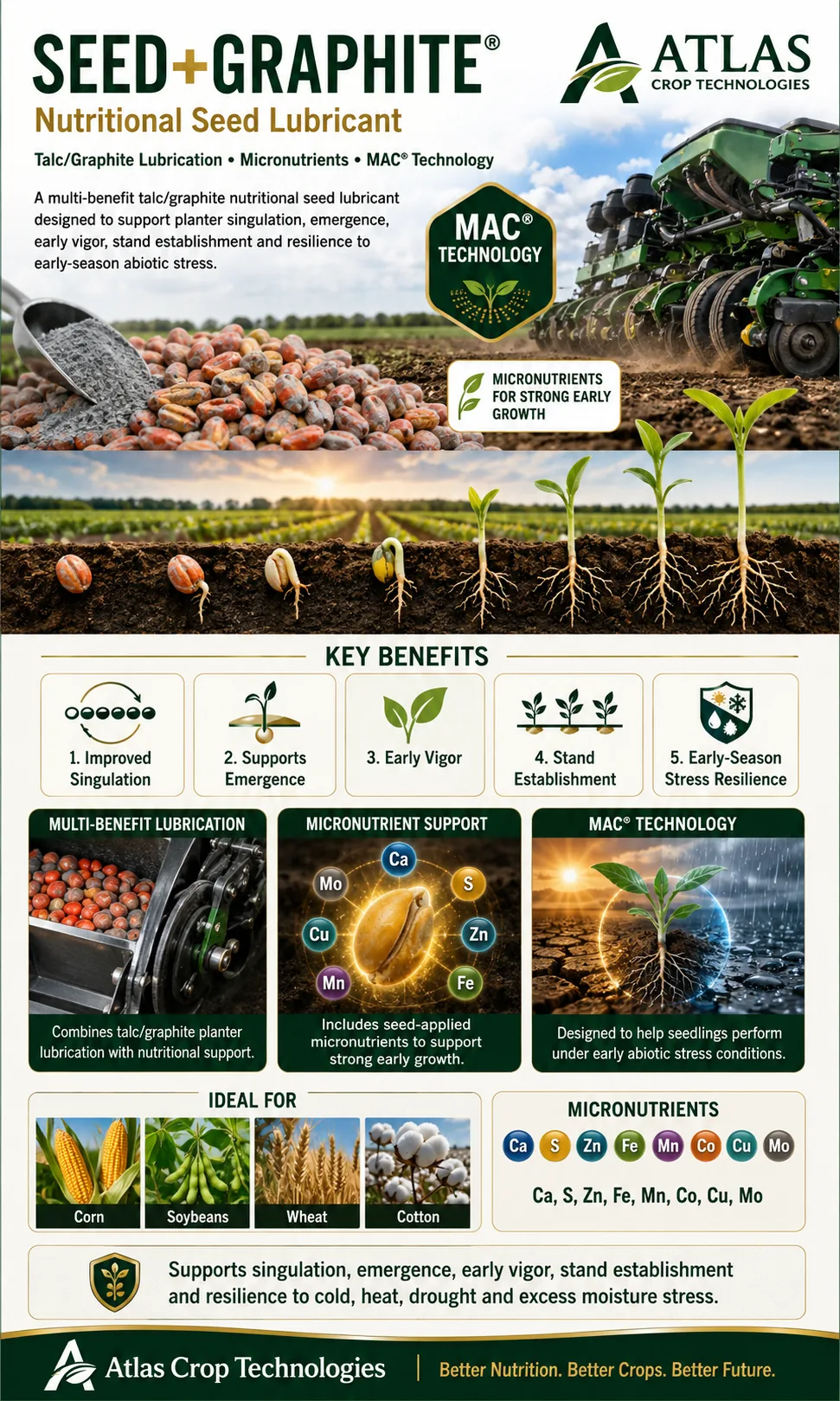
Talc and graphite have traditionally been used to help seed flow smoothly through planting equipment. SEED+GRAPHITE® expands that familiar function by combining physical seed lubrication with early crop nutrition and biostimulant technology.
The product is supplied as an easy-to-use dry powder. Published Verdesian guidance states that it can be applied directly to seed in the planter box or at the seed tender without specialized seed-treatment equipment.
Its talc and graphite components help provide the lubrication required for efficient seed handling and singulation, while the incorporated micronutrients provide localized nutrition around the seed during early development.
MAC® Technology adds a third functional layer, positioning the product around helping young crops manage early abiotic stresses such as cold, heat spikes, drought and excess moisture.
SEED+GRAPHITE® is differentiated by combining several functions that growers would otherwise associate with separate planting or seed-input categories.
Talc helps manage seed-to-seed friction and supports smooth movement of treated seed through planting systems.
Graphite contributes lubricating properties that help support seed movement through metering and planter components.
Calcium, sulfur, iron, zinc, manganese, cobalt, copper and molybdenum are incorporated into the dry product.
Proprietary biostimulant technology is positioned around helping seedlings prepare for early environmental stress.
Published guaranteed composition lists 25.6% talc. Within the combined talc/graphite lubricant fraction, this corresponds to an 80% talc share.
Talc is widely used as a dry seed lubricant to support flowability, especially where seed coatings or environmental humidity can affect seed movement.
Published composition lists 6.4% graphite, representing 20% of the talc/graphite lubricant system.
Graphite contributes additional dry lubrication within seed meters and other planter components.
Precision planting depends on seed moving consistently from the hopper or seed tank through metering components and into the seed furrow. Seed shape, surface treatment, humidity, static, planter design and operating conditions can all influence flow.
A dry lubricant does not replace correct planter adjustment or maintenance, but it can support smoother seed movement and more consistent meter operation when used according to planter and product directions.
Singulation describes the planter's ability to release individual seeds at the intended spacing rather than creating skips, doubles or irregular seed placement.
Published Verdesian positioning specifically identifies talc/graphite lubrication as supporting singulation.
Uniform seed delivery can contribute to more consistent within-row spacing, although final stand uniformity also depends on planter setup, seed size, operating speed, depth control, soil conditions and germination.
Verdesian positions MAC® Technology as a biostimulant component that helps prepare seeds and seedlings for abiotic stresses frequently encountered during establishment.
Low soil temperatures can slow germination, root activity and metabolic processes during early crop establishment.
Rapid temperature increases can create physiological stress in emerging seedlings, particularly where moisture availability is limited.
Young seedlings have small root systems and can be vulnerable to short-term soil moisture deficits during establishment.
Saturated or excessively wet seedbeds can reduce oxygen availability, delay emergence and impose additional stress on developing roots.
These are the principal early-crop outcomes emphasized in current SEED+GRAPHITE® product positioning. They should be understood as support objectives rather than guaranteed field outcomes.
Talc/graphite lubrication is positioned around supporting efficient planter operation and seed singulation.
Micronutrients and MAC® Technology are positioned around early crop development after planting.
Strong emergence and early vigor contribute to the objective of establishing a consistent plant population.
Published guaranteed analysis for SEED+GRAPHITE® includes calcium, sulfur and six trace elements important to plant metabolism and early crop development.
Manufacturer information identifies the nutrient sources as calcium sulfate, cobalt sulfate, copper sulfate, ferrous sulfate, manganese sulfate, sodium molybdate and zinc sulfate.
Published guaranteed analysis further identifies the iron, manganese, copper and zinc fractions as water soluble and the sulfur fraction as combined sulfur.
Zinc participates in enzyme systems, growth regulation and early root and shoot development.
Iron contributes to chlorophyll-related processes, electron transport and several enzyme systems important to plant metabolism.
Manganese functions in enzyme activation and photosynthetic processes as the young crop develops functional leaf area.
Molybdenum is required in very small quantities and is associated with enzymes involved in nitrogen metabolism.
Copper participates in enzyme systems, electron-transfer reactions and structural development.
Cobalt is particularly relevant in biological nitrogen-fixation systems and certain microbial processes associated with legumes.
Calcium contributes to cell-wall and membrane structure and is important during new tissue development.
Sulfur is incorporated into sulfur-containing amino acids and proteins and contributes to plant nitrogen metabolism.
Published Verdesian information describes SEED+GRAPHITE® as a dry powder that can be applied directly to seed in the planter box or at the seed tender, without specialized seed-treatment equipment.
Verify that the intended crop and use are covered by the current product label in the market where planting will occur.
Calculate the amount of seed being planted so the correct lubricant quantity can be measured.
Add SEED+GRAPHITE® directly to seed according to label directions in the planter box or during loading at the seed tender.
Ensure the product is distributed through the seed mass so lubrication is consistent during planting.
The following rates are published by Verdesian for SEED+GRAPHITE®. They should be treated as manufacturer reference information and not as proof of registration in every Atlas Crop Technologies market.
| Crop | oz per 100 lb seed | kg per 100 kg seed |
|---|---|---|
| Alfalfa | 4 oz | 0.25 kg |
| Barley, oats, rye | 4 oz | 0.25 kg |
| Corn | 8 oz | 0.50 kg |
| Cotton | 12 oz | 0.75 kg |
| Milo, millets, sorghum | 10 oz | 0.625 kg |
| Peanuts | 4 oz | 0.25 kg |
| Rice | 4 oz | 0.25 kg |
| Soybeans | 4 oz | 0.25 kg |
| Sugar beets | 8 oz | 0.50 kg |
| Sunflowers | 4 oz | 0.25 kg |
| Wheat | 4 oz | 0.25 kg |
Published Verdesian information describes SEED+GRAPHITE® as labeled for nearly every crop in its reference market and specifically highlights corn, soybean, cotton, wheat and cereal grains and alfalfa.
Precision singulation and stand uniformity make planter lubrication particularly relevant to row-crop corn establishment.
Published application guidance includes soybean, with positioning around planter flow, emergence and early vigor.
Wheat, barley, oats and rye are among the crops included in published reference-rate guidance.
Cotton is specifically listed with a crop-specific published lubricant rate.
Alfalfa is explicitly included among published product crop uses.
Sunflower appears in the manufacturer application-rate table.
Milo, millets and sorghum have a specific published rate in current manufacturer guidance.
Published rates also include peanuts, rice and sugar beets. Registration should always be confirmed locally.
Confirm meter setup for seed size, shape, planting population and operating system before planting begins.
Distribute dry lubricant evenly so seed receives consistent lubrication as it moves from storage to the meter.
Seed lubrication cannot correct poor planting depth, poor closing-wheel performance or inadequate seed-to-soil contact.
Inspect planted seed spacing and placement during operation rather than relying entirely on cab-monitor data.
Published product guidance allows SEED+GRAPHITE® to be added directly to seed in the planter box.
This can provide a straightforward method where seed quantities are manageable and the operator can achieve good distribution through the seed mass.
The product may also be applied at the seed tender, allowing lubricant to be incorporated as seed is transferred toward planting equipment.
Practical mixing uniformity will depend on tender design, loading method, seed flow and adherence to product directions.
MAC® Technology is positioned around helping seeds and young seedlings manage common abiotic stresses during establishment.
This is an important distinction: biostimulant support does not eliminate the underlying environmental stress. Severe cold, heat, drought, flooding or soil saturation can still delay emergence, damage roots or reduce stands.
Seedling resilience therefore works best as part of a broader establishment program that includes suitable planting dates, soil preparation, drainage, irrigation management, quality seed and appropriate crop protection.
Current Verdesian product information references Seed + Graphite Organic and describes an option certified for organic production.
Organic certification is product-, certifier- and market-specific. Buyers should verify the exact product identity, certificate and permitted use under their production standard.
Conventional and organic-certified variants can have different documentation, packaging or market availability.
Confirm the exact SKU and certification status before making organic-compliance claims.
| Component | Published analysis | Additional detail |
|---|---|---|
| Calcium (Ca) | 4.0% | Derived in part from calcium sulfate. |
| Sulfur (S) | 5.0% | 5.0% combined sulfur. |
| Iron (Fe) | 1.0% | 1.0% water-soluble iron; derived from ferrous sulfate. |
| Zinc (Zn) | 2.0% | 2.0% water-soluble zinc; derived from zinc sulfate. |
| Manganese (Mn) | 0.70% | 0.70% water-soluble manganese; derived from manganese sulfate. |
| Cobalt (Co) | 0.070% | Derived from cobalt sulfate. |
| Copper (Cu) | 0.090% | 0.090% water-soluble copper; derived from copper sulfate. |
| Molybdenum (Mo) | 0.080% | Derived from sodium molybdate. |
| Talc | 25.6% | Seed-lubricant component. |
| Graphite | 6.4% | Seed-lubricant component. |
| Talc : Graphite | 80 : 20 | Published lubricant blend ratio. |
| Attribute | Published / practical reference information |
|---|---|
| Product category | Multi-benefit nutritional talc/graphite seed lubricant. |
| Physical form | Dry powder. |
| Application | Applied directly to seed in planter box or at seed tender. |
| Special treatment equipment | Published manufacturer information states no special seed-treatment equipment is required for the described application. |
| Talc | 25.6%. |
| Graphite | 6.4%. |
| Lubricant ratio | 80/20 talc to graphite. |
| Biostimulant technology | MAC® Technology. |
| Stress positioning | Cold, heat spikes, drought and excess moisture. |
| Early-crop objectives | Stronger emergence, early vigor and stand establishment. |
| Nutrients | Calcium, sulfur, iron, zinc, manganese, cobalt, copper and molybdenum. |
| Planter function | Talc/graphite lubrication positioned to support singulation and planter seed flow. |
| Published crop examples | Alfalfa, barley, oats, rye, corn, cotton, milo, millet, sorghum, peanuts, rice, soybeans, sugar beets, sunflowers and wheat. |
| Organic option | Manufacturer references a separate Seed + Graphite Organic product. Confirm exact certification and market availability. |
Dry seed lubrication and biostimulant support cannot correct fundamentally poor germination, damaged seed or unsuitable seed quality.
Meter components, tubes, discs, brushes, vacuum systems and other planter parts must be maintained and calibrated properly.
Seed depth, moisture, temperature, residue and seed-to-soil contact remain central to emergence.
The micronutrients contained in SEED+GRAPHITE® complement rather than replace the crop's complete nutrient requirement.
A nutritional lubricant should not be assumed to replace fungicide, insecticide or other crop-protection seed treatments where those are needed.
Inspect seed placement, emergence timing, population and uniformity to evaluate the performance of the complete establishment system.
Commercial seed may already carry fungicides, insecticides, biological products, inoculants, polymers, nutritional treatments or other coatings.
Because SEED+GRAPHITE® is applied as a dry lubricant, practical handling should consider how the powder interacts with the final seed surface and with any equipment or product restrictions associated with other treatments.
For crops using live inoculants or other biological seed technologies, verify compatibility with all relevant manufacturers or distributors before use.
SEED+GRAPHITE® can combine the routine lubricant function with added nutrition and biostimulant positioning.
Precision planting programs may value lubricant support that helps seed move consistently through the planter meter.
MAC® Technology is positioned specifically around cold, heat, drought and excess-moisture stress.
The product is positioned around stronger emergence and early vigor, supporting the objective of an even stand.
The dry formulation delivers a package of eight listed nutrient elements in direct association with the seed.
Published application guidance allows direct planter-box or seed-tender use without a separate liquid seed-treatment process.
A more uniform stand can help preserve crop yield potential, but final yield remains dependent on genetics, population, weather, fertility, irrigation, weeds, pests, disease and season-long management.
Manufacturer testimonials and field observations can illustrate practical experience but should not be interpreted as guaranteed economic or yield outcomes for every farm or environment.
Discuss crop fit, planting conditions, planter systems and early-season establishment objectives.
Review integration with commercially treated seed, seed tenders and planter-box handling.
Explore country registration, commercial availability, packaging and portfolio positioning.
Evaluate SEED+GRAPHITE® as part of integrated establishment, nutrient-efficiency and seed-technology programs.
Providing the following information can help Atlas Crop Technologies evaluate product fit and route your enquiry efficiently.
A zinc-enriched seed treatment designed to support germination, emergence, root development, nutrient uptake and early crop establishment.
View Product → FertigationA water-soluble potassium-efficiency technology containing BioSF325™, designed to support potassium use efficiency, crop quality, shelf life and marketable yield through fertigation.
View Product → FertigationA water-soluble phosphorus-efficiency technology containing BioSF325™, designed to support phosphorus use efficiency, root development and crop performance through fertigation.
View Product →Tell us about your crop, seed volume, planter system, planting population, existing seed treatments or market requirement. Our team will route your enquiry to the appropriate regional contact.
The answers below provide general product and agronomic context. Always use the current approved local label as the authoritative source for legal product use.
SEED+GRAPHITE® is a multi-benefit nutritional seed lubricant from Verdesian Life Sciences.
It combines talc/graphite planter lubrication, a micronutrient package and MAC® Technology in one dry seed-applied product.
It is seed applied and is described by Verdesian as a nutritional seed treatment and multi-benefit seed lubricant.
Unlike many liquid commercial seed treatments, it is supplied as a dry powder intended for direct application to seed in the planter box or at the seed tender.
No. The product combines talc and graphite with calcium, sulfur, iron, zinc, manganese, cobalt, copper and molybdenum plus proprietary MAC® Technology.
Published Verdesian product information lists 25.6% talc and 6.4% graphite.
Within the lubricant fraction this corresponds to an 80/20 talc-to-graphite ratio.
Talc is a dry seed lubricant used to support seed flow and reduce friction-related handling issues within planting systems.
Actual planter requirements can vary by equipment manufacturer, crop and seed treatment.
Graphite provides dry lubrication that can support seed movement through meter components and other parts of the planter.
Singulation is the process of separating and delivering individual seeds through a precision planter meter.
Good singulation reduces skips and doubles and contributes to the objective of uniform within-row plant spacing.
Yes. Talc/graphite lubrication to support singulation is one of the main product features identified by Verdesian.
Planter calibration, seed size, meter condition and planting speed remain important determinants of actual singulation performance.
MAC® Technology is the proprietary biostimulant technology incorporated into SEED+GRAPHITE®.
Verdesian positions it around helping prepare seeds and seedlings for early-season abiotic stress.
Published manufacturer information specifically references:
No. The product is positioned to help prepare seedlings for stress, not to eliminate or prevent severe environmental stress.
Extreme cold, heat, drought, flooding or other adverse conditions can still reduce crop establishment.
Current Verdesian positioning emphasizes:
Published guaranteed analysis includes:
Published guaranteed analysis identifies the 2.0% zinc fraction as water-soluble zinc.
Manufacturer analysis identifies the listed iron, manganese and copper fractions as water soluble.
Published Verdesian information lists calcium sulfate, cobalt sulfate, copper sulfate, ferrous sulfate, manganese sulfate, sodium molybdate and zinc sulfate among the nutrient sources.
No. Its nutrient package is positioned around early seedling nutrition. It does not replace the crop's complete nitrogen, phosphorus, potassium, sulfur or micronutrient fertility program.
Published Verdesian guidance states that the dry powder can be applied directly to seed in the planter box or at the seed tender.
No specialized liquid seed-treatment equipment is required for the described use.
Yes. Seed-tender application is one of the methods specifically referenced in current manufacturer product information.
Yes. Direct planter-box application is also included in published Verdesian guidance.
Current manufacturer information lists 8 oz per 100 lb seed, equivalent to 0.50 kg per 100 kg seed.
Always verify that this rate is approved for your market.
Current manufacturer information lists 4 oz per 100 lb seed, equivalent to 0.25 kg per 100 kg seed.
Published guidance lists 4 oz per 100 lb seed, equivalent to 0.25 kg per 100 kg seed.
Current manufacturer information lists 4 oz per 100 lb seed, equivalent to 0.25 kg per 100 kg seed.
Published guidance lists 12 oz per 100 lb seed, equivalent to 0.75 kg per 100 kg seed.
Published guidance for milo, millets and sorghum lists 10 oz per 100 lb seed, equivalent to 0.625 kg per 100 kg seed.
Current manufacturer information also lists rates for alfalfa, peanuts, rice, sugar beets and sunflowers.
Do not extrapolate a rate automatically. Published Verdesian guidance advises users to consult their dealer or distributor for crops not listed in the rate table.
It may be used within seed systems that already include commercial seed treatments, but the compatibility of the exact seed-treatment package should be confirmed before use.
Follow all labels and planter-manufacturer requirements.
Where live inoculants or biological products are present, verify compatibility with the relevant manufacturers because biological organisms can be sensitive to other seed-treatment materials.
No. The product is a nutritional seed lubricant with biostimulant positioning and should not be assumed to replace fungicides required for seedling-disease management.
No. It should not be assumed to provide insect-control functions unless an approved local label explicitly states such a use.
Current Verdesian information references a separate Seed + Graphite Organic version and describes an option certified for organic production.
Always verify the exact product certificate, certifying body and local organic-production requirements before use.
No. It is positioned to support emergence and stand establishment, but emergence also depends on seed viability, depth, temperature, moisture, disease, soil structure and planting quality.
No agricultural input can guarantee a particular yield.
Better planting performance, emergence and early vigor can help preserve yield potential, but final yield depends on many season-long factors.
The crop's established plant population determines the number and distribution of plants available to intercept light, use water and nutrients and contribute to final production.
Poor emergence or uneven establishment can be difficult for some crops to compensate for later.
No. Seed lubricant can support seed flow, but meter calibration, equipment condition, speed, vacuum or pressure settings, seed depth and field setup remain essential.
No. Registration, approved crops, claims, rates, organic certification, package sizes and directions can differ between markets.
Contact Atlas Crop Technologies for current country-specific information.
Include your country, crop, seed quantity, seed size if known, planting population, planter or seed-tender type, existing seed treatments and any early-season establishment concern.
Use the contact form on this page or email contact@fertilizercoatingproducts.com .
Include your company, country, crop or market, estimated product requirement and the nature of your commercial or distribution enquiry.
Trademark Notice: All products featured on this website are registered trademarks of Verdesian Life Sciences.