Enzyme Function
Zinc participates in numerous enzyme systems and biochemical reactions involved in plant metabolism, making adequate zinc status important during active growth.
Trademark Notice: All products featured on this website are registered trademarks of Verdesian Life Sciences.
A zinc-enriched seed treatment designed to give emerging crops a stronger start by supporting rapid germination, emergence, early nutrient uptake, root development and crop establishment.
Take Off zn ST® is particularly relevant where zinc nutrition may constrain early crop development. By positioning the treatment directly on the seed, the technology is present at the point where the crop begins its transition from stored seed reserves toward active root and shoot growth.
Product claims, approved crops, rate, composition, pack size and application directions can vary by registration. Always follow the current approved local label.
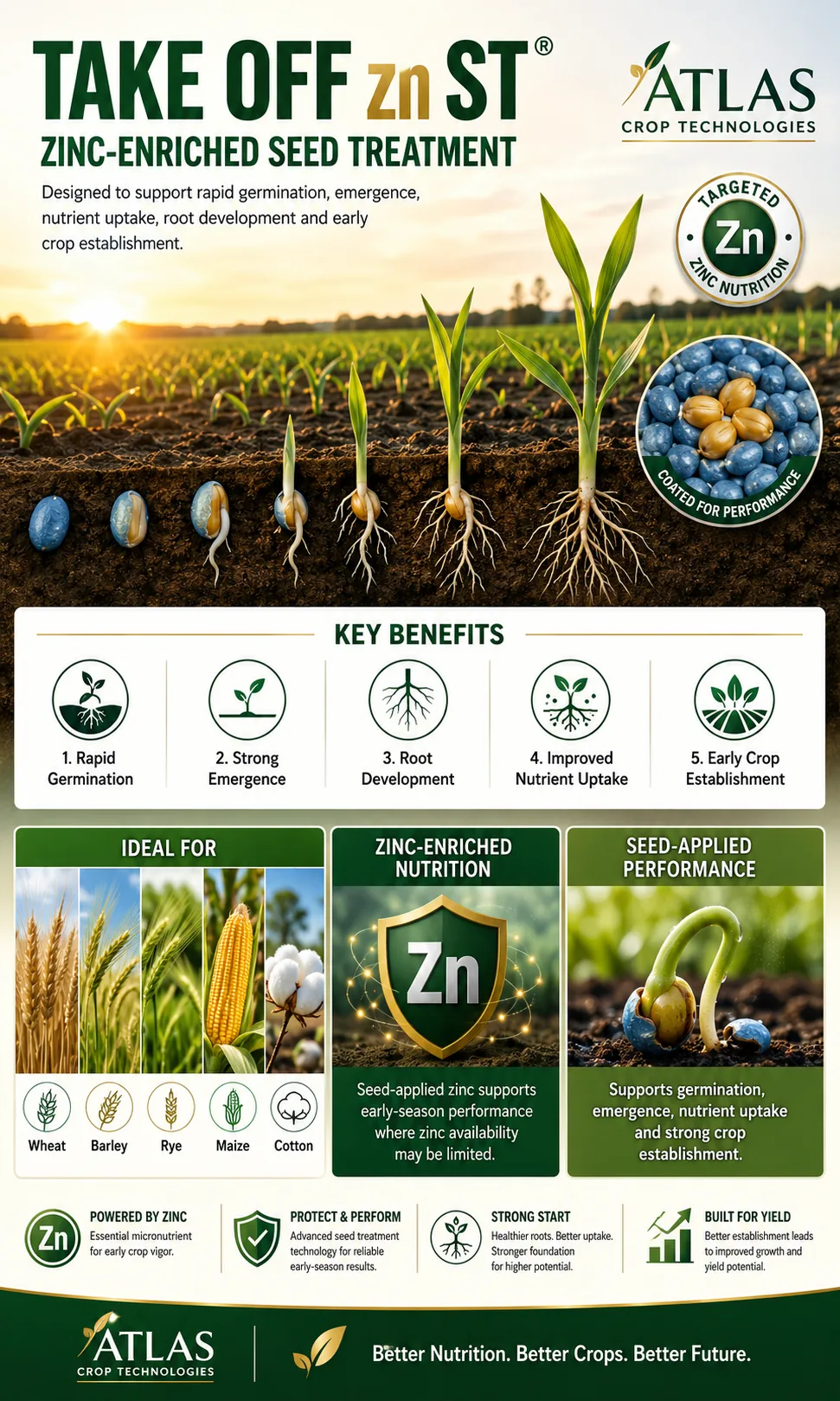
Early crop establishment depends on a sequence of tightly connected processes: seed hydration, germination, root initiation, emergence, photosynthetic development, nutrient acquisition and expansion of the young crop canopy.
Take Off zn ST® is designed to support this early development phase by combining seed-treatment positioning with added zinc. Published Verdesian information describes the product as being formulated specifically to improve crop performance in zinc-deficient soils and to accelerate germination, emergence, establishment and canopy closure.
The technology is also positioned around improved nutrient uptake, nitrogen utilization and root mass. This makes it relevant to crop programs in which growers want to support early-season momentum while integrating zinc nutrition into an existing commercial or on-farm seed-treatment process.
As with any micronutrient technology, Take Off zn ST® should be considered one component of an integrated crop nutrition program. Seed-applied zinc does not replace the need to understand whole-season zinc demand, soil nutrient status or other macro- and micronutrient requirements.
Zinc is required in much smaller quantities than macronutrients such as nitrogen, phosphorus and potassium, but its biological role is still fundamental. When zinc supply is inadequate, critical physiological processes can be constrained even when the crop has sufficient access to major nutrients.
Zinc participates in numerous enzyme systems and biochemical reactions involved in plant metabolism, making adequate zinc status important during active growth.
Zinc is associated with physiological processes involved in normal plant growth and development, particularly during periods of rapid cell activity.
A vigorous early root system expands the soil volume explored by the crop and supports access to water and nutrients during establishment.
Published Take Off zn ST® information specifically positions the technology around faster establishment and canopy closure as part of a strong early start.
The total quantity of zinc present in a soil does not necessarily indicate how much zinc is readily accessible to a young root system. Soil pH, carbonate content, phosphorus status, organic matter, temperature, moisture, root development and other soil characteristics can influence practical zinc availability.
This is one reason seed-applied zinc nutrition can be considered as part of an integrated strategy: the treatment is positioned immediately around the seed rather than relying solely on the young root system encountering available zinc elsewhere in the soil profile.
Take Off zn ST® is positioned around several connected stages of early crop development rather than a single isolated event.
The seed activates metabolic processes needed to begin root and shoot growth. Published product information positions Take Off zn ST® around accelerated germination.
Rapid and uniform emergence helps move the crop toward productive photosynthetic growth while reducing the time young plants remain in their most vulnerable establishment stage.
Published Verdesian information lists increased root mass among the agronomic characteristics associated with Take Off zn ST®.
As the seedling becomes increasingly dependent on external resources, the developing root system must acquire nutrients and water from the soil.
Published Take Off zn ST® information describes increased nitrogen utilization and faster nitrogen uptake by the developing seedling.
Earlier canopy development can form part of a strong crop establishment strategy by moving plants toward a larger photosynthetically active leaf area.
Published Verdesian information positions Take Off zn ST® around early development and nutrient efficiency. Actual crop response varies with seed quality, crop, soil, weather and the complete nutrient-management program.
Take Off zn ST® is positioned as a functional seed-treatment technology designed around early crop metabolism and establishment rather than merely as a bulk nutrient application.
Published Verdesian material describes the product as helping accelerate carbon dioxide fixation in the plant and increasing the rate of nitrogen uptake by the seedling, supporting stronger root and shoot establishment.
Zinc availability is influenced by several interacting soil and crop factors. Soil or tissue testing and local agronomic interpretation should be used when determining whether zinc nutrition may be limiting.
Zinc availability can become more restricted under alkaline or calcareous soil conditions, even where the soil contains measurable total zinc.
Restricted root growth and slower biological activity in cool soils can limit early nutrient acquisition during establishment.
Compaction, poor structure, waterlogging or other root constraints can reduce the volume of soil explored by young plants.
The chemical environment surrounding plant roots can influence zinc solubility and crop access to the nutrient.
Crops developing quickly after emergence need functioning root and metabolic systems capable of supporting increasing nutrient demand.
Soil tests, tissue analysis, field history and previous crop response can provide valuable evidence when designing a zinc management program.
Current European Verdesian product information lists barley, rye, wheat, cotton and maize for the referenced Take Off zn ST® application program. National registrations may differ.
Early and uniform establishment can support the development of a productive cereal stand where zinc nutrition is agronomically relevant.
Listed in European product guidance for seed-treatment use subject to the current local registration.
Included within the published European reference application instructions for Take Off zn ST®.
Maize is included in the published European application guidance for Take Off zn ST®.
Cotton is also included in the published European product application guidance, subject to local label approval.
This crop list represents published European product guidance and is not a universal registration list. Always verify the crop on the approved label applicable where the seed will be treated and planted.
Seed-treatment application should be carried out using suitable, calibrated equipment and according to the current approved product label, treatment recipe and equipment instructions.
Verify that Take Off zn ST® is approved for the intended crop and market before seed treatment begins.
Identify all fungicides, insecticides, micronutrients, polymers, biological products and other seed-treatment components planned for use.
Check compatibility, pH, mixing sequence and total liquid volume before preparing a commercial batch.
Use calibrated equipment to achieve consistent product distribution over the treated seed according to the approved instructions.
Published European Verdesian guidance lists this suggested rate for barley, rye, wheat, cotton and maize.
This reference does not override the approved label applicable in the country of use.
Published European product guidance states that the referenced 1 L/t Take Off zn ST® rate should be applied with a minimum total liquid volume of 4 litres.
Follow the current local label, seed-treatment equipment guidance and approved slurry requirements.
Commercial seed treatment often involves multiple components. Published European product information describes Take Off zn ST® as compatible with most common agricultural chemicals and fertilizers.
However, compatibility should never be assumed solely because two individual products are approved on the same crop. Formulation type, concentrate chemistry, water quality, pH, slurry volume, polymers, biological products and mixing order can influence the final treatment.
Small-scale compatibility testing: published Verdesian guidance recommends conducting a small-scale compatibility test before mixing a full commercial batch.
Published European Take Off zn ST® information provides specific considerations for low-pH environments and concentrate mixing.
Published Verdesian guidance states that tank-mix environments with a pH below 2.5 can reduce the efficacy of Take Off zn ST® and should be avoided.
The practical pH of a seed-treatment slurry can be affected by water, acidifying products and other treatment components, so the full recipe should be considered.
Published European instructions advise that concentrated seed-treatment products should not come into direct contact with each other before the mixing process onto the seed.
The same guidance states that Take Off zn ST® should be applied last to the mix.
| Attribute | Published reference information |
|---|---|
| Technology category | Zinc-enriched seed treatment. |
| Main agronomic positioning | Germination, emergence, establishment, canopy closure, nutrient uptake, nitrogen utilization and root development. |
| Target field context | Particularly positioned for improved performance where zinc availability is limiting. |
| Listed crops | Barley, rye, wheat, cotton and maize in the published European application instructions. |
| Reference application rate | 1 litre per tonne of seed. |
| Reference liquid volume | Minimum 4 litres of liquid. |
| Compatibility | Described as compatible with most common agricultural chemicals and fertilizers, with a small-scale compatibility test recommended. |
| pH consideration | Published guidance advises avoiding tank-mix environments below pH 2.5. |
| Mixing position | Published European guidance states that Take Off zn ST® should be applied last to the mix. |
| Reference pack size | 10 litres in current European product information. |
These details summarize current published European Verdesian information. Registration, formulation and approved directions may vary by market.
Published product information describes Take Off zn ST® as helping plants avoid early-season stresses that can restrict establishment and ultimately limit yield potential.
Low soil temperatures can slow germination, root activity and nutrient acquisition, increasing the importance of good seed quality and well-designed establishment management.
Both insufficient and excessive moisture can restrict emergence and early root development, particularly during the period when seedlings have limited rooting depth.
Young root systems explore only a small volume of soil, so limited local micronutrient availability may have greater importance during early establishment than later in crop development.
Compaction, surface crusting and poor soil structure can restrict emergence or early root exploration independently of nutrient supply.
A more uniform crop stand can help plants progress through development stages more consistently, although final establishment is influenced by many interacting agronomic factors.
Seed treatment performs best as part of a complete establishment strategy incorporating seed quality, seedbed preparation, planting depth, soil fertility and appropriate crop protection.
Positions zinc-containing technology directly on the seed before planting to support early establishment objectives.
Soil-applied fertilisers remain essential for supplying the wider macro- and micronutrient needs of the developing crop.
Soil testing, tissue analysis, scouting and local agronomic recommendations can help identify additional nutrient requirements later in the season.
The need for supplemental zinc depends on crop species, soil nutrient status, pH, field history, yield potential and environmental conditions. Seed treatment should therefore complement rather than replace an evidence-based nutrient management plan.
Where soil tests, plant analysis, field history or local agronomic experience indicate zinc may restrict crop development.
Where rapid emergence, stand development and early crop momentum are important objectives within the production system.
Where the crop already receives a structured fungicide, insecticide or nutritional seed-treatment package and zinc technology can be evaluated within that workflow.
Where cool soils, slow establishment, variable moisture or other field factors make a strong early start agronomically important.
Where early root mass and nutrient acquisition are key parts of the crop-management strategy.
Where growers are seeking to improve how the crop captures and uses available nutrition rather than relying solely on additional fertiliser.
Discuss crop fit, soil zinc context, existing seed-treatment strategy and how Take Off zn ST® may integrate with the wider nutrient program.
Evaluate operational integration, mixing sequence, compatibility, treatment volume and local technical documentation.
Explore country availability, market positioning, portfolio fit, commercial supply and regional development opportunities.
Assess Take Off zn ST® as one element of integrated nutrient-efficiency programs for cereals, maize and other approved crops.
Providing context with your enquiry helps Atlas Crop Technologies route your request to the appropriate technical or regional contact.
Different technologies address different early-season crop, nutrient and establishment objectives. Product selection should be based on the crop, local registration and complete agronomic program.
A seed-applied nutrient complex developed to support early root development, nutrient uptake and strong crop establishment.
View Product → Seed TreatmentA biostimulant seed treatment developed to support rapid seedling development, root growth and early nitrogen utilization.
View Product → Seed TreatmentA seed treatment designed to accelerate germination, emergence and early nitrogen uptake to support strong crop establishment.
View Product →Tell us about your crop, seed-treatment program, zinc nutrition requirement, country or distribution opportunity. Our team will route your enquiry to the appropriate regional contact.
The information below summarizes product positioning and general agronomic context. Always use the current approved local label as the authoritative source for product use.
Take Off zn ST® is a zinc-enriched seed treatment from Verdesian Life Sciences designed around rapid germination, emergence, nutrient uptake, root development and strong crop establishment.
It is positioned within crop nutrition and seed-treatment programs to support zinc nutrition and early crop development.
Published European product information describes benefits including accelerated germination, emergence, establishment and canopy closure, improved nutrient uptake, increased nitrogen utilization and increased root mass.
Zinc is an essential plant micronutrient involved in important metabolic and growth processes. Take Off zn ST® is specifically positioned for improved performance where soil zinc availability may constrain crop establishment.
Published product information particularly highlights its use where zinc nutrition is limiting. The agronomic value of supplemental zinc should be assessed using field history, soil or tissue analysis and local crop recommendations.
Published European Verdesian application guidance lists:
Crop registrations can vary by country, so confirm the current local product label before treatment.
Take Off zn ST® is applied as a seed treatment before planting. Suitable seed-treatment equipment should be used according to the approved label and equipment instructions.
Published European Verdesian guidance lists a suggested rate of 1 litre per tonne of seed for barley, rye, wheat, cotton and maize.
This is reference information only. Use the rate only when it is confirmed on the current approved label in the relevant market.
Published European product information states that the referenced application should be made with a minimum 4 litres of liquid.
Always verify treatment volume against the current local label and seed-treatment equipment requirements.
Published European information describes Take Off zn ST® as compatible with most common agricultural chemicals and fertilizers.
However, compatibility should still be confirmed for the exact products and treatment recipe. Verdesian recommends conducting a small-scale compatibility test before preparing a full batch.
Yes. Published European guidance states that tank-mix environments with a pH below 2.5 reduce Take Off zn ST® efficacy and should be avoided.
Follow the latest local product instructions because formulation and guidance may vary by registration.
Published European product information advises avoiding direct contact between concentrated seed-treatment products before they are mixed onto the seed.
The same guidance states that Take Off zn ST® should be applied last to the mix.
Increased root mass is among the benefits listed in published Verdesian Take Off zn ST® information. Root development is important because larger and more active root systems can explore more soil for available nutrients and water.
Published product information describes Take Off zn ST® as optimizing and accelerating carbon dioxide fixation and increasing the rate of nitrogen uptake by the seedling.
It should still be considered complementary to an appropriate nitrogen fertiliser program rather than a replacement for crop nitrogen supply.
Not necessarily. Seed-applied zinc and soil or foliar zinc programs serve different positioning and crop nutrition objectives.
Whole-season zinc requirements should be based on crop demand, soil nutrient status, local recommendations and field history.
No agricultural input can guarantee a particular field outcome. Published product information positions Take Off zn ST® around faster germination and emergence, but actual crop performance is affected by seed quality, soil temperature, moisture, planting conditions, disease, soil structure and many other agronomic factors.
Accelerated establishment and canopy closure are included in published European Verdesian positioning for Take Off zn ST®.
Actual canopy development depends on crop, planting density, environment, nutrient availability and other management factors.
Current European Verdesian product information lists a 10-litre pack size.
Pack sizes and commercial availability may differ by country.
No. Registration, claims, formulation, approved crops, rates, pack sizes and application directions can differ by market.
Contact Atlas Crop Technologies for current availability and local technical documentation.
Include your country, crop, seed quantity, existing seed-treatment products, soil or tissue zinc information where available, expected planting timing and the agronomic objective you are trying to address.
Use the enquiry form on this page or email contact@fertilizercoatingproducts.com .
Include your country, company, target crop or market and approximate commercial requirement so Atlas Crop Technologies can route your enquiry to the appropriate regional contact.
Trademark Notice: All products featured on this website are registered trademarks of Verdesian Life Sciences.