Trademark Notice: All products featured on this website are registered trademarks of Verdesian Life Sciences.

Atlas Crop Technologies · Technology & Innovation

Technology that improves the value of every application.

Modern crop nutrition is no longer defined only by how many kilograms of nutrient are applied. Increasingly, performance depends on how effectively nutrients remain available, reach the root system, enter the plant and support crop development at the stages when demand is greatest.

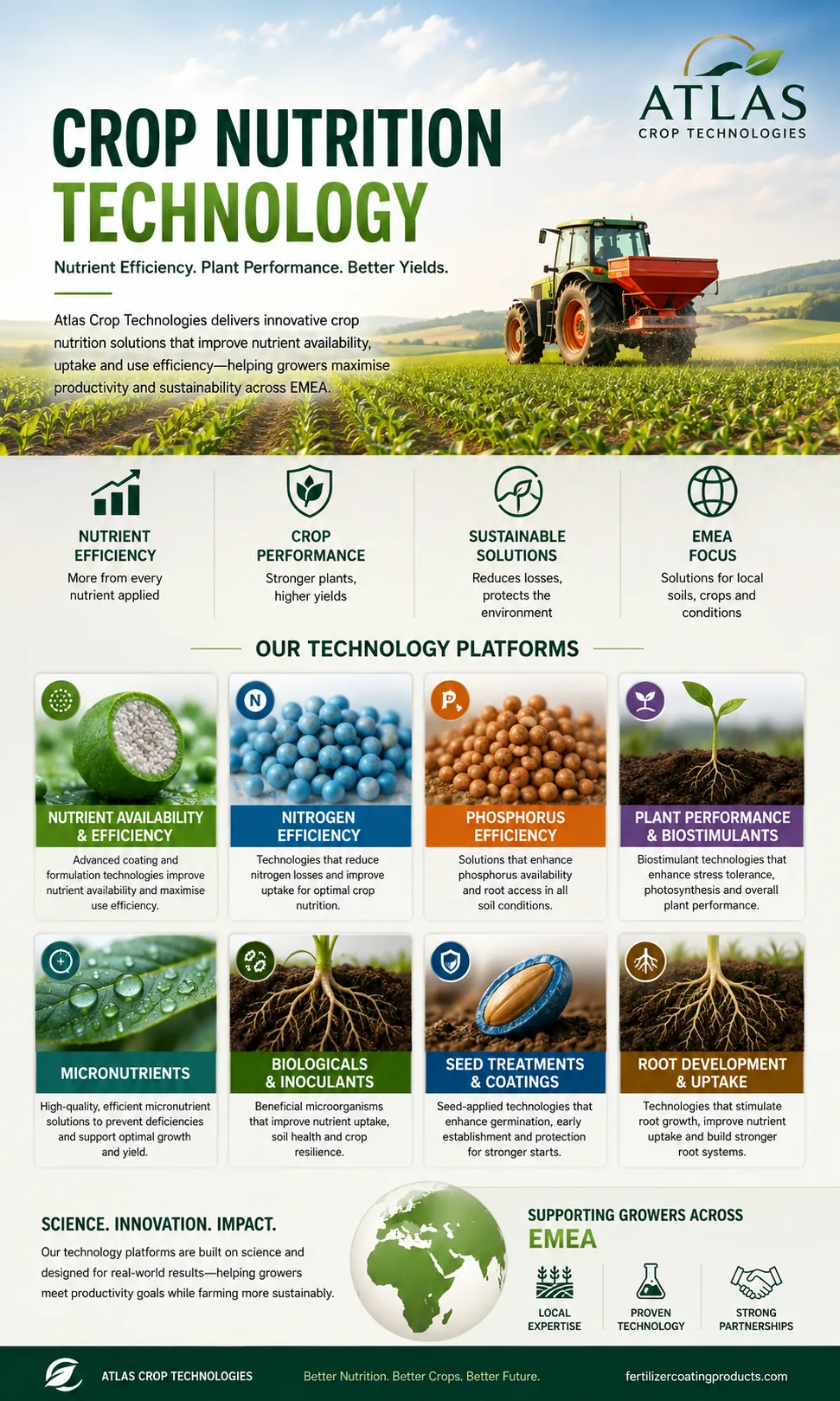
Atlas Crop Technologies works across complementary technology categories including nitrogen and phosphorus efficiency, fertiliser enhancement, biostimulants, micronutrients, biological inoculants and seed-applied technologies. The objective is to help customers build more precise crop nutrition programs around local soils, crops, fertiliser practices, environmental conditions and commercial requirements.

Explore Products
Crop nutrition technology supporting nutrient availability, plant uptake, roots and biological performance
Global crop technology. Local commercial support. Rotterdam · Istanbul · Dubai · Casablanca · Nairobi · Johannesburg
Technology Philosophy

From nutrient applied to nutrient effectively used.

A nutrient program can be influenced by reactions in the fertiliser, soil, rhizosphere, root zone and plant. Technology selection therefore starts with identifying where efficiency may be constrained and which intervention is appropriate for that point in the system.

01

Protect nutrient availability

Applied nutrients can be affected by volatilisation, transformations, movement through the soil profile, fixation, precipitation or other chemical and biological processes. Appropriate technologies can be positioned to help manage selected pathways and maintain nutrient availability for longer.

02

Improve access to the root zone

Nutrients must be positioned where developing roots can access them. Placement, soil moisture, rooting volume, soil chemistry, nutrient mobility and application timing all influence whether an applied nutrient is accessible to the crop.

03

Support plant utilisation

Nutrient uptake is only one part of crop performance. Plant metabolic activity, root development, photosynthesis, enzyme function, reproductive growth and tolerance to environmental stress can all influence how effectively nutrition is converted into productive biomass and crop quality.

Nutrient Use Efficiency

Managing the journey from fertiliser to crop.

Nutrient use efficiency is shaped by the interaction between product choice, agronomy and environment. No technology replaces sound fertiliser management; technology is most valuable when it addresses a clearly identified constraint.

A

Right nutrient source

Nutrient form affects solubility, transformations, compatibility and suitability for a particular crop, soil, climate and application system. Selecting the source is the first step before an enhancement technology is considered.

B

Right rate

Rates should reflect realistic crop requirements, soil nutrient supply, yield objective, expected nutrient recovery, local recommendations and applicable regulation. Efficiency technologies should not be interpreted as a justification for indiscriminate nutrient application.

C

Right timing

Crop demand changes throughout the season. Matching nutrient availability with critical growth stages can reduce unnecessary exposure to loss pathways and improve the probability that nutrition is available when plants require it.

D

Right placement

Broadcast, banded, incorporated, fertigation, foliar, starter and seed-applied programs create different agronomic environments. Technology selection should reflect where the nutrient or active component will be placed.

E

Right supporting technology

Stabilisation, protection, chelation or complexation, biological activity, biostimulation and seed-applied technologies address different objectives. The mechanism should match the agronomic problem rather than being added without a defined purpose.

F

Right local validation

Soil type, weather, irrigation, crop genetics, management intensity and local regulations vary between markets. Product selection, rate and application instructions should always be checked against the current approved label and local agronomic guidance.

Nitrogen Technology

Managing one of crop nutrition's most dynamic nutrients.

Nitrogen is essential to amino acids, proteins, enzymes, chlorophyll and many processes associated with crop growth. At the same time, nitrogen can move through several chemical and biological forms after application, making management highly dependent on source, soil, moisture, temperature and application method.

01

Urea-based fertiliser management

Surface-applied urea undergoes hydrolysis after application. Under conditions that favour ammonia loss, the period immediately following application can be important. Technologies intended for use with urea-based fertilisers may be selected to help manage this phase when permitted by the product label.

02

Ammonium transformation management

Ammonium nitrogen can be converted through soil microbial processes into nitrate. Because nitrate behaves differently in soil, technologies designed to influence the rate of specific nitrogen transformations may have a role in selected fertiliser systems and environmental conditions.

03

Synchronising nitrogen with crop demand

The agronomic objective is not simply to keep nitrogen in one form indefinitely. It is to improve alignment between available nitrogen and the period during which roots can acquire it. Split application, placement, irrigation and supporting technologies can all contribute to that strategy.

04

Factors affecting nitrogen strategy

Relevant factors can include fertiliser source, soil texture, soil pH, temperature, rainfall or irrigation forecast, residue cover, incorporation, application timing, crop rooting pattern and anticipated crop uptake.

05

Fertiliser coating and treatment

Certain technologies can be applied to granular fertiliser as coatings or treatments, creating a practical route to incorporate functionality at the fertiliser level. Successful use requires attention to dose uniformity, application equipment, handling, storage, compatibility and the physical quality of the treated fertiliser.

06

Program-level evaluation

Nitrogen technologies should be evaluated as part of the complete nutrient program rather than in isolation. Rate, timing, placement, source, application logistics and expected environmental exposure remain fundamental management decisions.

Phosphorus Technology

Keeping phosphorus accessible in chemically complex soils.

Phosphorus supports energy transfer, root development, establishment and numerous metabolic processes. Its behaviour differs from nitrogen because phosphorus is relatively immobile in many soils and can interact strongly with surrounding soil minerals and chemistry.

01

Soil chemistry matters

The availability of fertiliser phosphorus is influenced by soil pH, mineralogy, calcium, iron and aluminium chemistry, moisture and the properties of the fertiliser band or granule environment. These interactions help explain why phosphorus management must be locally adapted.

02

Placement can be critical

Because phosphorus moves relatively short distances through many soils, proximity between available phosphorus and actively growing roots can be important. Starter placement, banding, incorporation and root architecture can therefore influence crop access.

03

Managing the fertiliser microenvironment

Phosphorus efficiency technologies may be designed to influence interactions around fertiliser particles, granules or application zones. The objective is to help maintain a useful pool of phosphorus in forms that can remain accessible to developing roots.

04

Early-season importance

Young crops have relatively small root systems and limited soil exploration capacity. Adequate phosphorus availability close to the developing root zone can therefore be especially important during establishment, particularly where cool or otherwise limiting conditions restrict root activity.

05

Root development and exploration

Phosphorus availability and root system development are closely related. Technologies that support root growth may complement phosphorus management by increasing the volume of soil explored by the crop, where supported by local evidence and approved use directions.

06

Soil testing remains essential

Enhancement technologies do not replace knowledge of soil phosphorus status. Soil analysis, historical management, crop removal, placement strategy and local recommendations remain central to responsible phosphorus fertilisation.

Biostimulant Technologies

Supporting the plant processes behind nutrient performance.

Crop nutrition performance is influenced not only by nutrient supply but also by root activity, physiological status and the plant's ability to respond to its environment. Depending on composition, registration and approved claims, biostimulant technologies may be used to support selected plant or rhizosphere processes.

01

Root architecture

Root length, branching, density and distribution influence the volume of soil explored by a crop. Programs intended to support root development can be particularly relevant during establishment and periods of rapid nutrient demand.

02

Nutrient acquisition

A productive root system and active rhizosphere can influence the plant's ability to encounter and absorb water and nutrients. Biostimulant positioning should be complementary to an adequate base fertility program rather than a substitute for essential nutrients.

03

Physiological performance

Depending on the technology, approved uses may relate to processes associated with metabolism, nutrient utilisation, establishment, crop quality or tolerance to particular abiotic stresses. Expectations should always be aligned with product-specific evidence and label claims.

04

Application timing

Timing should reflect the intended physiological objective. Seed, soil, in-furrow, transplant, fertigation and foliar applications reach different plant tissues and growth stages, so the application route is an important part of product selection.

05

Crop and environment

Crop species, variety, growth stage, temperature, water availability, nutrient status and stress severity can influence response. Local trials and agronomic context are therefore important when building a repeatable program.

06

Integrated programs

Biostimulants are most effectively positioned as one component of integrated crop management alongside balanced nutrition, irrigation, soil management, crop protection and appropriate agronomic practices.

Micronutrient Technology

Small quantities. Essential biological functions.

Micronutrients are required in smaller quantities than primary macronutrients but remain essential to enzyme systems, photosynthesis, reproductive development, nitrogen metabolism and other crop processes. Availability depends on more than total soil concentration.

Zn

Zinc

Zinc is associated with enzyme activity, growth regulation and plant development. Availability can be constrained by soil pH, high phosphorus conditions, low soil zinc status and other soil factors.

B

Boron

Boron is involved in cell wall development, growing points and reproductive processes. The margin between deficiency and excess can be relatively narrow in some crops, reinforcing the importance of accurate diagnosis and rate selection.

Fe

Iron

Iron participates in chlorophyll-related processes, electron transport and enzyme activity. Plants may experience limited iron availability even where total soil iron is high, particularly under soil conditions that restrict soluble forms.

Mn

Manganese

Manganese has roles in photosynthetic processes and enzyme systems. Soil pH, aeration, organic matter and oxidation-reduction conditions can affect its availability.

Cu

Copper

Copper is required for several enzyme systems and processes associated with plant metabolism and reproductive growth. Soil texture, organic matter and pH can influence crop availability.

Mo

Molybdenum

Molybdenum is associated with nitrogen metabolism and is particularly important to biological nitrogen fixation in legumes. Its soil availability often responds differently to pH than several metallic micronutrients.

Biological & Inoculant Technologies

Working with beneficial microorganisms in the crop environment.

Biological products use selected microorganisms or biologically derived systems for defined agricultural purposes. Unlike conventional mineral fertilisers, living biological technologies can be particularly sensitive to storage, handling, environmental conditions and compatibility.

01

Seed inoculation

Seed application places the biological component close to the emerging root system. In legume production, properly selected inoculants can be used to support establishment of the crop-microbe association required for biological nitrogen fixation.

02

Rhizosphere positioning

Some microbial technologies are intended to function around roots, where plants, microorganisms, nutrients and soil chemistry interact. Successful colonisation or activity can depend on strain characteristics and local environmental conditions.

03

Nutrient-related functions

Depending on organism, formulation and approved claims, biological technologies may be associated with nitrogen fixation, nutrient mobilisation, nutrient acquisition, root interaction or other defined plant-growth functions.

04

Storage and viability

Biological activity can be affected by temperature, storage duration, exposure to sunlight and other handling conditions. Product-specific shelf-life and storage instructions should therefore be treated as important technical requirements.

05

Compatibility management

Compatibility with seed-treatment chemicals, fertilisers, water quality, micronutrients and other tank-mix partners should be verified rather than assumed. The order of mixing and time between treatment and planting may also be relevant.

06

Environment-sensitive performance

Soil moisture, temperature, pH, salinity, crop host, competing microbial populations and application conditions can affect biological performance. Appropriate local positioning is therefore essential.

Seed-Applied Technology

Starting crop nutrition at the first point of establishment.

Seed-applied products concentrate technology around the seed and emerging seedling. This can be an efficient placement strategy because the product is positioned where early root growth begins, but it also requires careful attention to formulation, compatibility and seed safety.

01

Early establishment

Germination and emergence establish the foundation for the season. Seed-applied technologies may be positioned to support selected establishment objectives, depending on the product, crop and approved use.

02

Proximity to emerging roots

Placement on or near the seed can put a technology close to the developing radicle and young root system, potentially making low-dose inputs operationally efficient when the formulation is designed for that use.

03

Biological inoculation

Seed treatment is a common route for crop-specific inoculants because it can establish direct proximity between the selected microorganism, host crop and developing root.

04

Application quality

Uniform coverage, accurate dose, drying characteristics, seed flowability, dust-off, equipment calibration and treatment sequence can all affect commercial seed-treatment quality.

05

Seed safety

Formulations and combinations used on seed should be specifically suitable for the crop and application method. Excess liquid, inappropriate chemistry or unverified mixtures can affect seed handling or germination.

06

Planting window

The acceptable interval between treatment and planting can vary by product, microorganism and seed-treatment combination. Current product directions should be followed for storage and planting timing.

Fertiliser Coating & Treatment

Putting technology directly onto the fertiliser granule.

Applying an enhancement technology at the fertiliser level can simplify field delivery and create consistent association between the technology and the nutrient carrier. Commercial success, however, depends on more than the active ingredient: formulation, coating quality and fertiliser handling are equally important.

01

Dose accuracy

Coating equipment should deliver the intended quantity of treatment across the fertiliser stream. Calibration should reflect fertiliser throughput, density, treatment rate and equipment configuration.

02

Coverage uniformity

Consistent distribution helps reduce untreated zones and excessive local application. Mixing energy, spray pattern, droplet characteristics and residence time can all contribute to coating quality.

03

Granule quality

Fertiliser particle size distribution, dust level, temperature, moisture and surface properties can influence treatment behaviour. The underlying fertiliser should therefore be considered part of the coating system.

04

Handling characteristics

A commercial treatment should be assessed for its effect on flowability, caking, dust, transfer through conveyors, blending equipment, storage and downstream application systems.

05

Blend compatibility

Treated fertiliser may subsequently be blended with other nutrient granules. Physical and chemical compatibility, segregation potential and storage duration should be considered when designing the process.

06

Operational integration

Technology must fit real manufacturing and distribution conditions. Pumping, metering, storage, cleaning, operator procedures and quality-control checks are therefore part of successful commercial implementation.

Technology Selection

Start with the constraint, not the product category.

The strongest programs begin with a defined agronomic or operational problem. Atlas uses that objective to determine which technology category deserves further evaluation.

01

Define the crop objective

Is the priority establishment, nitrogen management, phosphorus availability, micronutrient correction, root development, biological nitrogen fixation, nutritional support during reproductive growth, crop quality or another clearly defined outcome?

02

Characterise the soil

Soil pH, texture, organic matter, salinity, carbonate status, nutrient analysis, drainage and historical management can materially alter both nutrient behaviour and product suitability.

03

Understand the fertiliser program

Source, formulation, nutrient concentration, application rate, blending process, placement, incorporation, fertigation system and application schedule determine how a technology can realistically be integrated.

04

Assess environmental exposure

Rainfall, irrigation, temperature, soil moisture and application-to-incorporation interval can alter nutrient behaviour. Technologies should be selected around realistic field conditions rather than an idealised scenario.

05

Check application practicality

A technically suitable product must also fit the customer's equipment, manufacturing process, storage, labour, planting system and field logistics. Operational simplicity can be a major component of commercial value.

06

Confirm regulatory fit

Registration, classification, permitted claims, crop uses, application rates, labelling and documentation vary by jurisdiction. Local regulatory status should be confirmed before commercial recommendation or use.

Technology by Application Point

Different technologies act at different points in the crop nutrition system.

Understanding where a technology is positioned helps clarify what it can reasonably be expected to influence.

01

On the fertiliser

Fertiliser-applied coatings and treatments place technology directly on a nutrient carrier. This approach can be relevant where the objective is associated with the applied fertiliser or the immediate environment surrounding the fertiliser.

02

In the soil or root zone

In-furrow, banded, drenched, fertigated and soil-applied products operate in the root-zone environment. Their behaviour can depend strongly on soil properties, water distribution and root development.

03

On the seed

Seed treatments create an early and highly localised application point. Technologies used in this position must be specifically formulated and approved for safe, practical application to seed.

04

On the foliage

Foliar applications can provide direct contact with above-ground plant surfaces. Uptake and crop response depend on formulation, nutrient form, leaf condition, spray coverage, environmental conditions, concentration and growth stage.

05

In irrigation water

Fertigation can distribute nutrients or compatible technologies through the irrigation system. Water chemistry, concentration, injector accuracy, irrigation uniformity and system compatibility should be evaluated.

06

Across the complete program

Some crop programs combine fertiliser-applied, soil-applied, seed-applied and foliar technologies. Each component should have a defined role, and unnecessary duplication should be avoided.

Formulation & Compatibility

The active technology is only part of the solution.

Real-world crop nutrition products must remain stable, measurable, compatible, practical to apply and appropriate for the intended delivery system. Formulation quality therefore has direct commercial and agronomic importance.

01

Physical compatibility

Potential issues can include sedimentation, crystallisation, separation, excessive viscosity, foaming, blocked filters, poor coating distribution, granule caking or changes in seed flowability.

02

Chemical compatibility

Tank-mix partners can alter pH, ionic strength, solubility and stability. Concentrated fertiliser solutions can be particularly challenging environments, so compatibility should be demonstrated under representative conditions.

03

Biological compatibility

Living microorganisms may be affected by pesticides, fertiliser salts, preservatives, micronutrients, temperature and contact time. Biological compatibility should be assessed using product-specific guidance.

04

Water quality

Water pH, hardness, bicarbonates, salinity, suspended solids and temperature can influence spray, fertigation and biological formulations. Local water should be considered when evaluating application systems.

05

Mixing sequence

Even products that are individually compatible may require a particular addition order. Adequate dilution, agitation and mixing time can reduce the risk of undesirable concentrated interactions.

06

Jar and process testing

Where permitted and appropriate, small-scale compatibility testing can help identify physical problems before a mixture is prepared at commercial scale. Product labels and supplier instructions remain the primary source of direction.

Technology Development

Moving from technical concept to practical crop program.

Agricultural technology has to function outside the laboratory. Atlas therefore approaches technology through a combination of technical understanding, application practicality, local agronomy and commercial implementation.

01

Define the mechanism

The first question is what the technology is intended to influence: nutrient transformation, availability, root development, microbial interaction, micronutrient delivery, plant physiology or another specific process.

02

Match the application system

Formulation and use pattern must fit fertiliser manufacturing, blending, seed treatment, soil application, fertigation, foliar application or another defined route.

03

Evaluate compatibility

Fertiliser types, water, seed-treatment mixtures, packaging, storage temperatures and application equipment can create different compatibility requirements.

04

Assess agronomic relevance

A mechanism is commercially useful only when it addresses a meaningful constraint in the target crop and geography. Soil, climate, crop management and farmer practice therefore inform product positioning.

05

Build local evidence

Demonstration and trial programs can help determine where a technology is most appropriately positioned. Results should be interpreted within the conditions, crop, management system and statistical context of the work performed.

06

Support commercial deployment

Successful launch can require technical training, application guidance, quality procedures, market-specific documentation and communication that accurately reflects approved claims and local regulations.

Measuring Performance

Evaluate the outcome that the technology is designed to influence.

Technology evaluation should use measurements that are relevant to the mechanism and agronomic objective. Yield can be important, but it is not the only informative measurement in a crop nutrition program.

01

Establishment

Emergence percentage, stand uniformity, early biomass, root development and seedling vigour may be relevant for seed-applied, starter and early-season technologies.

02

Plant nutrition

Soil testing, tissue analysis, petiole analysis or other crop-specific diagnostic tools can help evaluate nutritional status when interpreted using an appropriate sampling method and local reference standards.

03

Root development

Root mass, length, architecture, density and soil exploration may provide useful information where the technology is specifically intended to influence root-zone performance.

04

Crop development

Biomass, canopy development, chlorophyll-related measurements, flowering, maturity and other growth indicators may help describe how crop development differs between management programs.

05

Yield and quality

Harvested yield, marketable yield and quality parameters should be measured using suitable experimental design. Relevant quality criteria differ significantly between grain, oilseed, vegetable, fruit and industrial crops.

06

Economic value

Commercial evaluation should consider product and application cost together with operational benefits, crop response, risk management and the value of any measurable yield or quality outcome.

Technology & Responsible Nutrition

Efficiency begins with better agronomic decisions.

Crop nutrition technologies can form part of a more resource-conscious fertiliser strategy, but responsible nutrient management still depends on appropriate rates, timing, placement, soil stewardship and compliance with local regulation.

01

Use nutrients purposefully

Fertiliser should be applied in response to crop demand and soil nutrient supply. Technologies are most valuable when they help address a specific efficiency constraint within that responsible nutrient plan.

02

Reduce avoidable inefficiency

Better synchronisation, placement and nutrient protection can help address pathways that otherwise reduce the agronomic value of applied fertiliser. Appropriate strategy depends on the nutrient, field and environment.

03

Build soil and crop resilience

Balanced nutrition, active roots, appropriate soil management and integrated crop practices support a production system that is better equipped to use available water and nutrients.

Commercial Application

Technology support across the crop nutrition value chain.

Atlas Crop Technologies works with organisations operating at different points between fertiliser manufacture and crop production. The technical question changes depending on how and where the technology will be commercialised.

01

Fertiliser manufacturers

Technology evaluation can include coating integration, formulation compatibility, treatment dose, manufacturing practicality, storage, quality control and commercial positioning.

02

Fertiliser blenders

Blenders may require technologies that fit existing batch or continuous operations while maintaining granule quality, blend uniformity, flowability and practical throughput.

03

Distributors

Distribution partners need products matched to local crops, agronomy, regulation, seasonal demand and customer practice, supported by clear technical positioning and appropriate commercial documentation.

04

Seed businesses

Seed-applied technologies require attention to treatment process, seed flow, compatibility, biological viability where applicable, packaging, storage and the interval between treatment and planting.

05

Agronomists and advisers

Advisers need a clear understanding of mechanism, crop fit, timing, diagnostic indicators, compatibility and realistic expectations in order to integrate technology into complete management programs.

06

Growers

Grower value depends on whether a technology solves a real production constraint within the realities of field operations, input cost, crop value, environmental conditions and existing management practice.

EMEA Perspective

One technology portfolio. Very different production environments.

Europe, the Middle East and Africa encompass highly diverse soils, climates, crops, irrigation systems, regulatory frameworks and fertiliser markets. Effective product positioning therefore requires regional adaptation.

EU

Europe

European programs can span high-input cereal and oilseed systems, maize, horticulture, vineyards, orchards, protected cropping and specialised nutrition. Nutrient efficiency, regulation, application precision and sustainability objectives are increasingly interconnected.

ME

Middle East

Crop nutrition programs may operate under irrigation, high temperatures, calcareous soils, salinity constraints and intensive fertigation systems. Water quality and nutrient availability are therefore important elements of technology selection.

AF

Africa

Production systems range from large commercial farms to smallholder agriculture and encompass very different soil fertility conditions, rainfall patterns, fertiliser supply chains and crop requirements. Practicality, affordability and local validation are essential.

01

Rotterdam

Regional support presence for European customers and international crop nutrition and fertiliser-market engagement.

02

Istanbul

Regional connection point between European, Mediterranean, Black Sea and neighbouring crop nutrition markets.

03

Dubai

Commercial support for Middle Eastern markets and regional partners operating across international fertiliser and agricultural supply chains.

04

Casablanca

Regional presence supporting customers and opportunities across North and West African agricultural markets.

05

Nairobi

Regional support for East African crop production and crop nutrition markets.

06

Johannesburg

Regional presence supporting crop nutrition and commercial partnerships across Southern African agricultural markets.

Technology Decision Guide

Which type of technology should you investigate?

These examples are a starting point for technical discussion rather than product recommendations. Final selection depends on product registration, crop, soil, fertiliser system and local label directions.

N

Concern: nitrogen efficiency

Review nitrogen source, application method, incorporation, weather exposure, soil conditions and the relevant nitrogen transformation or loss pathway before evaluating a nitrogen efficiency technology.

P

Concern: phosphorus availability

Review soil pH, soil-test phosphorus, fertiliser source, placement, crop rooting pattern and local soil chemistry before evaluating phosphorus efficiency or root-zone technologies.

R

Concern: root development

Consider soil structure, compaction, moisture, temperature, salinity, nutrient balance and crop establishment together with biostimulant, biological or starter-nutrition options.

µ

Concern: micronutrient availability

Diagnose the nutrient and reason for deficiency before selecting soil, seed, fertigation or foliar delivery. Tissue and soil analysis can provide important context.

B

Concern: biological establishment

Review organism or strain, crop host, storage history, treatment compatibility, soil conditions, moisture, temperature and planting interval before using an inoculant.

S

Concern: early crop establishment

Review seed quality, planting conditions, temperature, moisture, nutrient placement and early root-zone constraints before selecting seed-applied, biological, starter or biostimulant technologies.

Before Selecting a Product

Ten questions that make a technology discussion more productive.

Providing this information helps Atlas route an enquiry to the most relevant technology category and regional contact.

01

Which country and market?

Registration, available products, labels and commercial formats can vary between countries.

02

Which crop?

Include crop species and, where relevant, production type, rotation or variety.

03

What is the agronomic objective?

Define the problem to solve rather than beginning with a technology name.

04

Which fertiliser source?

Specify the nutrient source, grade, formulation and application rate where known.

05

How is it applied?

Broadcast, incorporated, banded, in-furrow, fertigation, foliar and seed treatment require different technical approaches.

06

When is it applied?

Pre-plant, at planting, side-dress, vegetative, reproductive and post-harvest timings serve different objectives.

07

What are the soil conditions?

Soil pH, texture, organic matter, nutrient status, salinity and carbonate conditions can all be relevant.

08

What is the water regime?

Rainfed, supplemental irrigation, drip, pivot and other systems create different nutrient and application environments.

09

What equipment is available?

Manufacturing, coating, blending, seed-treatment and field-application equipment can determine practical product options.

10

Who is the commercial user?

Fertiliser manufacturer, blender, distributor, seed company, adviser and grower applications may require different formulations, packaging and technical support.
Technical & Commercial Enquiries

Start with your crop, fertiliser and objective.

Tell us your country, crop, fertiliser program, application method and the agronomic or commercial challenge you want to address. Our team can route the enquiry to the appropriate regional contact and technology discussion.

Technology FAQ

Frequently Asked Questions

General information about crop nutrition technology, product selection and working with Atlas Crop Technologies.

We support customers through offices in Rotterdam, Istanbul, Dubai, Casablanca, Nairobi and Johannesburg, serving markets across Europe, the Middle East and Africa.

Our portfolio includes technologies for nitrogen and phosphorus efficiency together with biostimulants, micronutrients, inoculants, biological solutions, seed treatments and related crop nutrition technologies.

Exact product availability and approved claims differ by country, so contact us with the market and technology category you are interested in.

Nutrient use efficiency describes how effectively a production system converts nutrients supplied by fertiliser, soil and other sources into useful crop growth, harvested yield or quality. It is influenced by nutrient source, rate, timing and placement as well as soil properties, weather, root development, irrigation and crop demand.

No single technology controls all of these variables. Our approach is therefore to identify a specific efficiency constraint and position the appropriate technology around that constraint.

Nitrogen can undergo several transformations after fertiliser application. Depending on the nitrogen source and field conditions, particular pathways may reduce the proportion of applied nitrogen that remains available to the crop at the desired time.

Nitrogen efficiency technologies may be incorporated into a program to help manage selected pathways and improve synchronisation between nutrient availability and crop demand. The appropriate approach depends on fertiliser source, placement, soil, weather and approved product directions.

Phosphorus is relatively immobile in many soils and can interact strongly with soil minerals. The extent and type of those reactions vary with pH, mineralogy, calcium, iron, aluminium, moisture, fertiliser chemistry and placement.

Effective phosphorus management therefore combines soil testing, appropriate rates, fertiliser source and placement with supporting efficiency or root-zone technologies where justified.

Depending on composition, registration and approved claims, biostimulant technologies may support nutrient uptake, root development, physiological processes, crop establishment, crop quality or tolerance to selected abiotic stresses.

They are best viewed as complementary tools within an integrated crop program, not as substitutes for adequate fertilisation, irrigation, soil management or crop protection.

Fertilisers principally supply plant nutrients. Biostimulant products are generally positioned around defined plant or rhizosphere processes rather than simply supplying conventional quantities of essential nutrients.

Regulatory definitions vary between jurisdictions, so the legal classification and claims of any individual product must be checked in the market where it is sold.

Biological inoculants may be applied to seed, soil or another approved application site to introduce selected beneficial microorganisms. The exact method depends on the crop, organism, formulation and label.

Storage temperature, shelf life, compatibility, treatment sequence, planting interval, soil temperature and moisture can be especially important for living biological products.

No. Seed can also be used as a delivery point for inoculants, micronutrients, biostimulant technologies and other approved crop-input technologies. Seed application can position a relatively small quantity of product close to the developing seedling and root system.

Any treatment must be appropriate for the crop and seed system and should be evaluated for compatibility, coverage, flowability, storage and seed safety.

Potentially, but compatibility should never be assumed. A nitrogen technology, micronutrient, biological inoculant and biostimulant may each serve a different purpose, yet their formulations may not necessarily be physically, chemically or biologically compatible in the same mixture.

Check labels, manufacturer guidance, water quality, application sequence and equipment requirements before combining products.

Certain crop nutrition technologies may be suitable for application to fertiliser granules or for integration into fertiliser-treatment systems, depending on the product and approved use.

Commercial coating requires accurate metering, uniform distribution, compatibility with the fertiliser substrate and attention to flowability, caking, dust, storage and blending performance.

Begin with the problem you want to solve. Useful information includes crop, country, soil conditions, soil or tissue analysis where available, fertiliser source, application rate, placement, timing, irrigation system and relevant environmental conditions.

Atlas can use this information to discuss an appropriate technology category and confirm which products are available in your market.

A rate change should not be assumed from the use of a technology alone. Fertiliser rates should be determined using crop demand, expected yield, soil nutrient supply, local recommendations, regulations and product-specific evidence.

Any claim relating to nutrient-rate optimisation should be evaluated according to the approved product label and locally relevant agronomic data.

No agricultural technology should be expected to perform identically in every environment. Soil properties, weather, water availability, crop genetics, nutrient status, management and the severity of the targeted constraint can influence response.

Local evaluation and appropriate product positioning are important components of repeatable performance.

Measurements should match the intended mechanism and crop objective. Depending on the technology, useful measurements can include establishment, root growth, plant nutrient status, crop development, yield, quality and economic return.

Replicated trials and appropriate untreated or standard-practice comparisons provide more reliable information than isolated visual observations.

Contact us with your country and the product or technology category of interest. Availability, registration status, approved crops, claims, application rates and label directions can differ by market.

Yes. We welcome enquiries from fertiliser manufacturers and blenders interested in nutrient-efficiency and related crop nutrition technologies. The discussion can include product fit, coating or treatment requirements, operational integration, compatibility and regional market requirements.

Yes. We welcome enquiries from distributors, agronomic partners, advisers, seed businesses and other organisations working in crop nutrition. Contact us with your market, customer type and technology area of interest so the enquiry can be directed appropriately.

Product compatibility depends on the exact products, concentrations, water quality, application method and approved labels. Contact us with the complete proposed mixture and market so available product-specific information can be reviewed.

Do not assume compatibility based only on individual product descriptions.

Start by defining the fertiliser grade, target crop or market, desired technology function, manufacturing process, treatment point, application rate, packaging and commercial geography.

From there, formulation compatibility, coating or blending practicality, storage, quality control, regulatory requirements and agronomic positioning can be evaluated more systematically.

Atlas Crop Technologies

Build the right technology around the right agronomic objective.

Whether you are developing a fertiliser treatment, evaluating a nutrient efficiency technology, building a biological portfolio, designing a seed treatment or looking for crop-specific nutrition support, start the discussion with our regional team.

View Product Portfolio

Trademark Notice: All products featured on this website are registered trademarks of Verdesian Life Sciences.

Thank you — your message has been sent.