Water Regulation
Potassium contributes to plant water regulation and stomatal function, linking potassium nutrition with crop water relations and environmental stress response.
Trademark Notice: All products featured on this website are registered trademarks of Verdesian Life Sciences.
A fully water-soluble potassium nutrition technology containing BioSF325™ to support more efficient potassium use, strong crop growth, improved produce quality, better shelf-life characteristics and increased marketable yield.
Steric® K combines a concentrated NK 16:49 nutrient formulation, 8% sulphur and BioSF325™ technology. The product is designed for fertigation programs where potassium nutrition is closely linked with fruit filling, colour development, ripening, crop quality, stress resilience and harvest performance.
Current European Verdesian guidance specifies fertigation only and explicitly states that Steric® K should not be applied as a foliar fertiliser. Registration, analysis, rates and crop uses can vary by market.
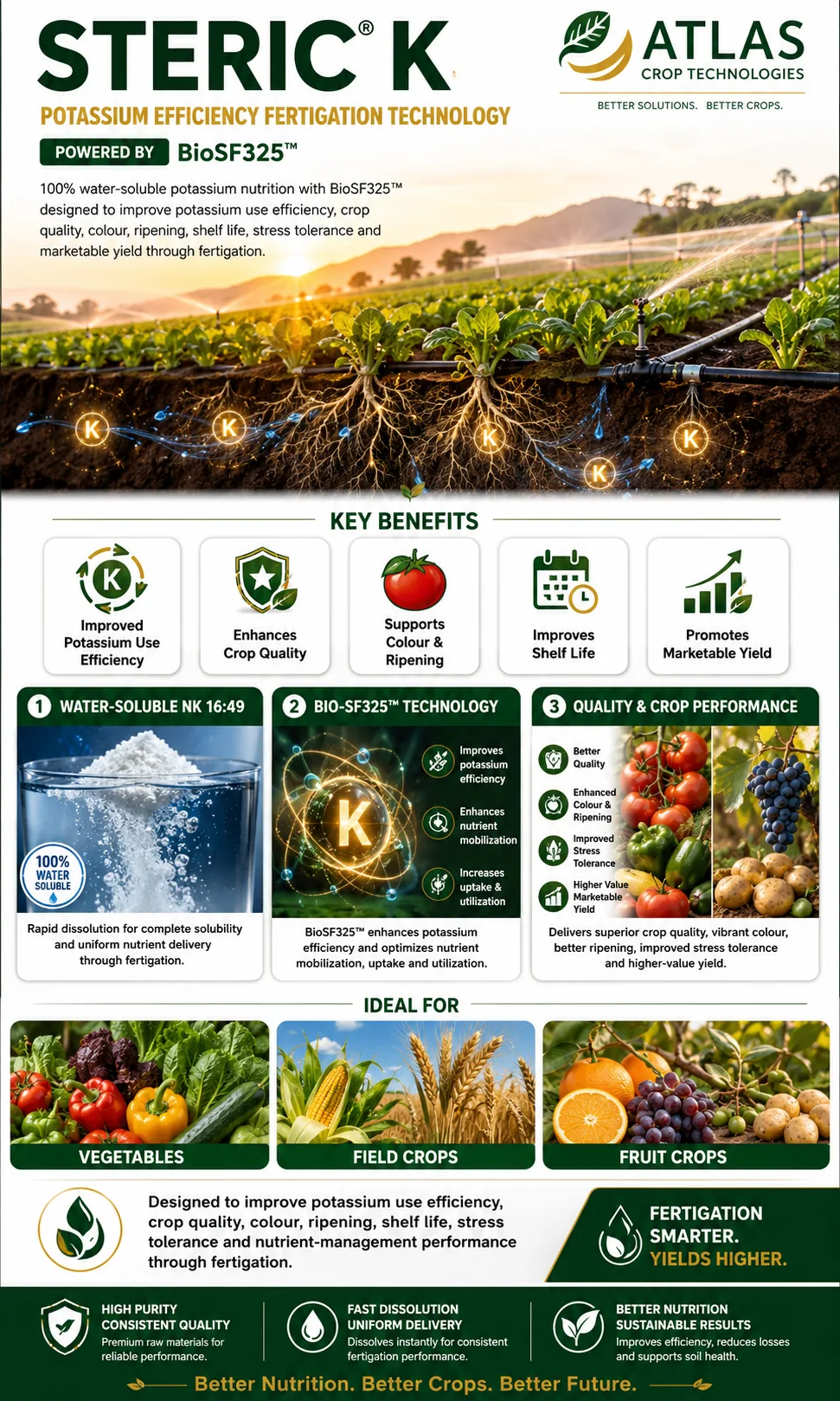
Potassium is one of the major nutrients required by high-performing crops, yet crop response depends not only on how much potassium is supplied but also on how effectively the plant can acquire and use it.
Steric® K is designed around this nutrient-efficiency challenge. Current European Verdesian information describes the product as containing BioSF325™ technology with four key components that work synergistically within the plant to drive nutrient use efficiency.
In Steric® K, this technology is specifically positioned around more efficient use of potassium. Improved potassium efficiency is associated with strong, healthy growth, improved crop quality, better shelf life and increased marketable yield.
Steric® K is supplied as a 100% water-soluble dry formulation for application through fertigation systems. Current European product information identifies the formulation as NK 16:49 with 8% sulphur and a reference pH of 4.7.
Potassium is involved in many processes that influence water relations, carbohydrate movement, enzyme activity, photosynthesis, crop quality and plant response to environmental stress.
Potassium contributes to plant water regulation and stomatal function, linking potassium nutrition with crop water relations and environmental stress response.
Adequate potassium supports physiological processes involved in photosynthetic activity and productive crop growth.
Published BioSF325™ positioning includes support for carbohydrate production, an important process in fruit filling, storage-organ development and crop quality.
Steric® K is specifically positioned around quality traits such as fruit consistency, colouration, ripening, shelf life and resistance to mechanical damage.
Potassium fertilisation is often evaluated in terms of kilograms of nutrient supplied, but the agronomic objective is ultimately to convert available potassium into productive crop function and marketable output.
Steric® K is positioned around improving the plant's ability to use potassium efficiently. BioSF325™ technology is described as acting within the plant rather than relying solely on higher potassium input.
Improved potassium nutrient-use efficiency is linked in Verdesian's European product positioning with strong crop growth, improved fruit or harvested-product quality, better shelf life and increased marketable yield.
This makes Steric® K particularly relevant to programs where potassium is being supplied to support bulking, filling, ripening, quality, colour development or resistance to harvest and environmental stress.
Verdesian describes BioSF325™ as a technology with four key components. They are positioned as working synergistically in the plant rather than acting only as isolated ingredients.
BioSF325™ is fundamentally positioned around increasing nutrient-use efficiency within the crop.
In Steric® K, the technology is specifically designed to improve the plant's ability to use available potassium more efficiently.
Regional product information associates BioSF325™ with physiological processes including photosynthesis, nitrogen-use efficiency, chlorophyll formation and carbohydrate production.
The four components are described as interacting synergistically, supporting the wider crop response rather than operating as four unrelated product functions.
Public product information identifies BioSF325™ and describes its four-component synergistic design, but this page does not attempt to invent or infer any proprietary component concentrations or confidential formulation details not disclosed in current public product information.
Current European Verdesian product information identifies Steric® K as an NK 16:49 formulation.
This combines nitrogen and a high potassium analysis within a water-soluble nutrient formulation designed for fertigation.
Current European product information also lists 8% sulphur within the Steric® K formulation.
Sulphur contributes to the complete nutrient profile but should still be accounted for within the farm's wider sulphur and nitrogen program.
Steric® K is described as a fully water-soluble dry formulation, allowing it to be dissolved before addition to a fertigation stock tank.
Current European product information lists a reference pH of 4.7.
Actual fertigation stock-solution chemistry will also depend on water quality, concentration and other products in the nutrient program.
Steric® K timing recommendations repeatedly focus on fruit enlargement, filling or bulking stages when crop potassium demand can be substantial.
Published crop positioning includes improved colour intensity and more uniform colour development in several fruit crops.
Tomato and pepper positioning includes more even and consistent ripening as part of the intended crop-quality response.
Improved shelf life is a central Steric® K quality objective, particularly in crops where post-harvest marketability matters.
Current European product information highlights a number of crop-specific quality and development objectives. These examples do not replace local crop registration or rate instructions.
Positioned around improved fruit consistency and colouration during quality development.
Published positioning includes more intense colouration and advanced maturity.
Steric® K is positioned around more even fruit filling and more uniform colouration.
Published benefits include improved resistance to cold and drought together with improved oil-content objectives.
Positioning includes advancing maturity and improving shelf life by balancing harvested-product nitrogen and increasing potassium content.
Published Steric® K positioning includes even and consistent ripening and improved shelf life.
Positioning includes greater tuber resistance to mechanical damage and greater tolerance to frost, drought, heat and high light intensity.
European timing guidance includes applications during later fruit enlargement and during the harvest period.
Potassium plays important roles in plant-water regulation, while Steric® K product positioning includes improved tolerance to drought in crops such as olives and potatoes.
Published crop positioning references increased resistance or tolerance to cold, frost and heat in selected crops.
Potato positioning includes tubers becoming more resistant to mechanical damage, an important consideration during harvest, handling and storage.
Current European Verdesian guidance states that Steric® K can be applied to most crops via fertigation.
The product must be dissolved in water before being introduced into the fertigation-system stock tank.
Current European product guidance explicitly states not to apply Steric® K as a foliar fertiliser.
Application route should never be inferred simply because a product is water soluble. Use the route stated on the locally approved product label.
Confirm crop approval, deficiency level, application timing, rate and the other fertilisers planned in the same fertigation program.
Measure the required quantity according to the current label, crop demand and qualified agronomic recommendation.
Current European guidance states that every 1 kg of Steric® K should be premixed in at least 4 litres of water.
Once completely dissolved, add the premix to the fertigation-system stock tank and deliver through the irrigation program as directed.
This premixing ratio is intended to support complete dissolution before the product enters the fertigation stock tank. Water temperature, quality and total stock concentration can still influence practical mixing.
Current European Verdesian guidance provides general per-application rates based on the assessed severity of potassium deficiency.
General European reference rate per application for a minor potassium deficiency.
General European reference rate per application for a moderate deficiency.
General European reference rate per application for severe deficiency.
Current European Verdesian guidance states that Steric® K can replace normally used potassium fertilisers in fertigation systems at approximately 25% of their normal rate of application.
The manufacturer describes this as a 4:1 conventional-potassium replacement ratio.
Potassium programs vary substantially with crop, soil or substrate, water potassium, yield load, harvest objective and the conventional fertiliser source being replaced.
Any replacement calculation should therefore be reviewed in the context of the locally approved Steric® K recommendations and the crop's total potassium requirement.
European guidance recommends application during fruit enlargement and whenever potassium is required.
In high-yielding years, an additional application during or after harvest may also be considered according to local directions.
Published timing includes the main fruit-enlargement phase and the period through colour break beginning approximately six to four weeks before harvest.
Additional autumn use may be considered in high-yielding seasons.
European guidance describes several applications between colour change and maturity.
Suggested timing includes a spring application from the beginning of fruit enlargement and an autumn application during or after harvest.
Published guidance includes application when first flowers are visible and another approximately two weeks before the beginning of harvest.
European guidance includes application at the beginning of head formation, then approximately two weeks and one week before harvest.
Suggested timing includes mid-to-late fruit enlargement and the harvest period.
European guidance includes one application at bulking and a second approximately one month before harvest.
For crops not specifically described here, determine timing from the current local label, potassium demand pattern and qualified crop advice.
Crop value is often determined by the proportion of harvested produce that meets market specifications—not simply by total biological yield.
Colour, uniformity, size, firmness, maturity, mechanical integrity and shelf life can all influence how much harvested produce reaches a marketable grade.
Steric® K is positioned around potassium-use efficiency and quality characteristics that can contribute to marketability. Verdesian's European product information specifically connects improved crop quality and shelf life with increased marketable yield.
Actual saleable yield remains influenced by crop genetics, pest and disease pressure, irrigation, harvest timing, grading criteria, post-harvest handling and market specifications.
Current European Verdesian positioning for lettuce describes Steric® K as advancing maturity and improving shelf life.
The manufacturer associates this effect with reduced nitrogen content and increased potassium content within the harvested produce.
This crop-specific positioning does not mean nitrogen should be reduced arbitrarily. Nitrogen and potassium management must remain balanced according to crop requirements and local recommendations.
Crop quality reflects interactions between potassium, nitrogen, calcium, magnesium, phosphorus, micronutrients, irrigation and crop load.
Excessive or insufficient amounts of one nutrient can influence the plant's response to others, making whole-program nutrient balance an important part of Steric® K integration.
Potatoes have substantial potassium demand during tuber bulking and quality development.
Current European Steric® K positioning describes treated tubers as becoming more resistant to mechanical damage and more tolerant to external stresses including frost, drought, heat and high light intensity.
Suggested timing includes application at tuber bulking and another application approximately one month before harvest.
Current European Steric® K information positions the product in olives around improved resistance to cold and drought together with improved oil-content objectives.
Suggested application periods include spring from the beginning of fruit enlargement and an autumn treatment during or after harvest.
Fruit and oil harvests physically remove potassium from the production system. High-yielding perennial crops therefore require nutrient programs that account for crop removal as well as immediate seasonal demand.
Steric® K should be integrated into that larger nutrient budget rather than considered independently from soil, leaf and harvest-removal information.
Current European Verdesian guidance describes Steric® K as compatible with most other fertilisers.
As with any concentrated fertigation program, practical compatibility depends on water chemistry, pH, concentration, temperature, nutrient sources and mixing sequence.
A combination that remains clear in dilute irrigation water may behave differently when prepared as a concentrated stock solution. Care should therefore be taken when introducing unfamiliar fertiliser combinations.
Practical approach: review all product labels, understand water chemistry and perform a small-scale compatibility check where the intended combination has not previously been validated.
Current European product guidance explicitly states that Steric® K should not be tank mixed with ammonium thiosulphate.
The same guidance explicitly states that Steric® K should not be tank mixed with potassium thiosulphate.
Water pH, hardness, bicarbonates, salinity and dissolved minerals can influence fertiliser behaviour and should be understood when preparing concentrated stock solutions.
Steric® K should be completely dissolved before being added to the fertigation system.
Injector calibration is essential to ensure the prepared nutrient solution reaches the irrigation zone at the intended concentration.
Blocked, damaged or poorly balanced emitters can create uneven nutrient delivery even when the stock solution has been prepared correctly.
Soil or substrate tests can help quantify existing potassium supply and provide context for fertigation decisions.
Some irrigation waters contribute measurable potassium and other nutrients that should be considered within the total nutrient budget.
Potassium demand can increase significantly with crop biomass, fruit load, tuber bulking and high yield potential.
Nitrogen influences vegetative growth and crop demand. Potassium and nitrogen programs should be balanced rather than optimized independently.
Potassium and calcium are both important in fruit and vegetable quality, making balanced nutrient supply particularly important in high-value crops.
Excessively unbalanced potassium programs can influence relationships with magnesium, so complete nutrient analysis remains important.
Steric® K itself contains 8% sulphur, which should be included when calculating the complete crop sulphur program.
Review crop stage, fruit load, target yield, substrate or soil data, tissue analysis and existing potassium sources.
Determine whether the program is addressing deficiency, replacing part of conventional potassium nutrition or targeting a quality stage.
Monitor crop growth, leaf or tissue analysis, fruit filling, colour, harvest quality and post-harvest performance where appropriate.
Select potassium sources that fit crop demand, water chemistry, fertigation equipment and the complete nutrient recipe.
Match Steric® K application to deficiency level, crop requirement and the nutrient contribution from all other sources.
Coordinate potassium delivery with periods of strong crop demand such as filling, bulking, colour change, ripening and harvest development.
Use the fertigation system to deliver dissolved nutrient solution uniformly into the active root zone.
Steric® K is designed around improving potassium use efficiency rather than relying only on higher potassium input.
Published European guidance provides a 25% conventional-potassium replacement reference for appropriately designed fertigation programs.
Higher efficiency has additional value when crop-quality improvements help a larger proportion of harvested produce meet market specifications.
Resource efficiency depends on total fertiliser inputs, irrigation uniformity, crop uptake, harvest removal, nutrient losses and actual marketable output. Product efficiency should therefore be evaluated as part of the complete crop and fertigation program.
| Attribute | Published reference information |
|---|---|
| Product | Steric® K. |
| Technology | BioSF325™. |
| BioSF325™ positioning | Four key components designed to work synergistically within the plant to drive nutrient use efficiency. |
| Nutrient analysis | NK 16:49. |
| Sulphur | 8%. |
| Reference pH | 4.7. |
| Physical form | 100% water-soluble dry formulation. |
| Current European application route | Fertigation. |
| Foliar use | Current European guidance explicitly states not to apply Steric® K as a foliar fertiliser. |
| Core agronomic positioning | Improved potassium use efficiency, strong crop growth, crop quality, shelf life and marketable yield. |
| Conventional K replacement reference | 25% of the normally used potassium fertiliser rate, described as a 4:1 replacement ratio. |
| Premixing reference | Premix each 1 kg of Steric® K in at least 4 litres of water before adding to the fertigation stock tank. |
| Minor deficiency reference | 2–5 kg/ha per application. |
| Moderate deficiency reference | 5–11 kg/ha per application. |
| Severe deficiency reference | 11–20 kg/ha per application. |
| Top fruit positioning | Improved fruit consistency and colouration. |
| Citrus positioning | More intense colouration and advanced maturity. |
| Vine & cherry positioning | More even filling and colouration. |
| Olive positioning | Improved resistance to cold and drought and improved oil-content objectives. |
| Lettuce positioning | Advanced maturity and improved shelf life, with product positioning around lower nitrogen and higher potassium in harvested produce. |
| Tomato & pepper positioning | Even, consistent ripening and improved shelf life. |
| Potato positioning | Greater tuber resistance to mechanical damage and increased tolerance to frost, drought, heat and high light intensity. |
| Compatibility | Compatible with most other fertilisers. |
| Do not tank mix with | Ammonium thiosulphate or potassium thiosulphate. |
| European reference pack size | 10 kg. |
This table summarizes current published European Verdesian product information. The current local product label and registration remain authoritative.
Where the crop program aims to achieve effective potassium nutrition while improving nutrient-use efficiency.
Where colour, filling, maturity, uniformity or shelf life strongly influence harvested-value and marketability.
Steric® K is specifically designed for dissolved delivery through irrigation-based nutrient systems.
High-yield crops and strong fruit, tuber or biomass loads can create substantial potassium demand during filling and maturation.
Steric® K is positioned around quality attributes that can influence saleability, harvest durability and post-harvest performance.
Published crop positioning includes improved resilience objectives in selected crops exposed to drought, cold, frost, heat or high light intensity.
Providing crop, irrigation and nutrition details helps Atlas Crop Technologies route your enquiry to the appropriate regional or technical contact.
Discuss potassium demand, crop-quality objectives, deficiency diagnosis, timing and practical fertigation integration.
Review dissolution, stock-tank preparation, injection, compatibility, water chemistry and irrigation-system performance.
Explore product availability, local registration, commercial volumes, technical positioning and portfolio integration.
Evaluate Steric® K as one component of complete potassium-efficiency, crop-quality and fertigation programs.
Build crop programs around nutrient demand, application method, local registration and the specific physiological or quality objective being targeted.
A water-soluble phosphorus-efficiency technology containing BioSF325™, designed to support more efficient phosphorus use, root development and crop performance through fertigation.
View Product → Seed TreatmentA zinc-containing seed treatment formulated to support rapid germination, emergence and early crop establishment, particularly where zinc nutrition may be limiting.
View Product → FoliarA patented foliar nutrient-management complex positioned around nutrient uptake, nutrient utilization and enhanced root development.
View Product →Tell us about your crop, potassium program, fertigation system, deficiency status, crop-quality objective, market or distribution requirement. Our team will route your enquiry to the appropriate regional contact.
The answers below provide general product and agronomic context. Always use the current approved product label as the authoritative source for legal use directions.
Steric® K is a 100% water-soluble potassium nutrition product containing BioSF325™ technology.
Current European Verdesian product information describes an NK 16:49 formulation containing 8% sulphur and positions Steric® K around improved potassium use efficiency, crop quality, shelf life and marketable yield.
Steric® K combines a nutrient formulation with BioSF325™ technology. Its published European analysis is NK 16:49 with 8% sulphur, while BioSF325™ is positioned around improving nutrient-use efficiency.
BioSF325™ is a Verdesian technology described as containing four key components that drive nutrient-use efficiency.
The manufacturer describes the four components as working synergistically within the plant rather than acting only in isolation.
In Steric® K, BioSF325™ is positioned around helping the plant use potassium more efficiently.
Regional product information also associates the technology with photosynthesis, nitrogen-use efficiency, potassium uptake, chlorophyll production, carbohydrate production and vegetative growth.
Current European Verdesian information describes Steric® K as an NK 16:49 formulation containing 8% sulphur.
The current locally supplied label should always be checked because formulations and registrations may vary.
Current European product information lists a reference pH of 4.7.
Final fertigation-stock pH will also depend on irrigation water, product concentration and other fertilisers in the solution.
Yes. Current European product information describes Steric® K as a 100% water-soluble dry formulation.
Current European Verdesian guidance specifies application through fertigation.
The product should first be dissolved in water and then introduced into the fertigation-system stock tank according to current directions.
Current European guidance explicitly states: do not apply Steric® K as a foliar fertiliser.
Follow the application route specified by the approved product label in your market.
Current European product information states that Steric® K can be applied to most crops via fertigation.
Published benefit or timing examples include top fruit, citrus, vines, cherries, olives, lettuce, tomato, pepper, potatoes, watermelon and cucumber.
Exact legal crop approval must still be verified on the current local label.
Potassium use efficiency broadly describes how effectively potassium supplied to a crop contributes to plant function, growth and harvested output.
Steric® K is designed around improving this efficiency rather than relying solely on a higher potassium application rate.
Current European Verdesian guidance states that Steric® K can replace normally used potassium fertilisers in fertigation systems at approximately 25% of their normal rate.
This is described as a 4:1 replacement ratio.
It should not be treated as a universal potassium-reduction rule. The complete crop potassium program must still be calculated agronomically.
Regional Steric® K information describes replacement of traditional potassium-fertiliser forms such as MOP, nitrate-based potassium sources, SOP and MKP within an appropriately designed program.
The exact replacement program should be validated locally because different sources also contribute other nutrients such as chloride, nitrogen, sulphur or phosphorus.
Current European guidance states that every 1 kg of Steric® K should be premixed in at least 4 litres of water.
The fully dissolved premix can then be added to the fertigation stock tank.
Current European guidance lists a general rate of 2–5 kg/ha per application for minor deficiency.
Confirm the crop-specific program with the current local label.
Current European guidance lists 5–11 kg/ha per application for moderate deficiency.
Current European guidance lists 11–20 kg/ha per application for severe deficiency.
Verdesian recommends consulting a local agronomist when the deficiency level is uncertain.
Visual crop symptoms can provide an indication but should ideally be interpreted alongside soil, substrate or plant-tissue analysis, crop stage and the existing fertiliser program.
Similar symptoms can also arise from other nutrient, root or water stresses.
Current European product information positions Steric® K in top fruit around improved fruit consistency and colouration.
Suggested timing includes the fruit-enlargement phase and additional use when potassium is required.
Published European Steric® K information describes more intense colouration and advanced maturity in citrus.
Timing guidance includes the main fruit-enlargement phase and the period through colour break before harvest.
Current product positioning describes more even filling and more uniform colouration in vines and cherries.
European product information positions Steric® K in olives around improved resistance to cold and drought and improved oil-content objectives.
Suggested timing includes spring from fruit enlargement and autumn during or after harvest.
Steric® K is positioned in lettuce around earlier maturity and improved shelf life.
European product information associates this with reduced nitrogen and increased potassium in the harvested produce.
Published Steric® K positioning includes more even and consistent ripening together with improved shelf life in tomato and pepper.
Current European product information describes treated potato tubers as becoming more resistant to mechanical damage and more tolerant to external stresses such as frost, drought, heat and high light intensity.
Suggested timing includes tuber bulking and approximately one month before harvest.
Improved shelf life is one of the central crop-quality benefits described in current European Steric® K positioning.
Actual post-harvest life also depends on maturity at harvest, cultivar, disease, handling, storage temperature, humidity and supply-chain conditions.
Colour development is specifically included in published Steric® K benefits for top fruit, citrus, vines and cherries.
Colour response is also affected by cultivar, light, temperature, maturity and crop load.
Verdesian positions improved potassium efficiency, crop quality and shelf life as contributing to an increase in marketable yield.
Marketable yield is not the same as total biological yield and depends on grading standards, crop quality, pest and disease pressure, harvest handling and buyer specifications.
Published crop-specific positioning includes improved drought-resistance or tolerance objectives in olives and potatoes.
No nutrient treatment can prevent damage from severe drought, so irrigation and soil-water management remain essential.
Cold-resistance positioning is included for olives, while potato positioning includes improved tolerance to frost.
This should not be interpreted as frost protection or a guarantee against damage under freezing conditions.
Current European guidance describes Steric® K as compatible with most other fertilisers.
The exact combination should still be checked for the concentrations, water chemistry and products used in the intended program.
Current European guidance states that Steric® K should not be tank mixed with:
Irrigation-water pH, bicarbonates, hardness, salinity and dissolved minerals can influence nutrient solubility, stock-tank compatibility and emitter performance.
Yes. Current European product information lists 8% sulphur.
This sulphur contribution should be included when calculating the complete crop nutrient program.
No. Soil, substrate and plant-tissue analysis can provide valuable information about potassium status and help determine whether deficiency or crop demand justifies additional potassium.
No agricultural input can guarantee a particular yield or quality outcome.
Steric® K is positioned around potassium-use efficiency, crop quality, shelf life and marketable yield, but actual performance depends on genetics, climate, irrigation, nutrition, crop load, pests, disease and management.
Current European Verdesian product information lists a 10 kg pack size for Steric® K.
Packaging and commercial availability can vary by market.
No. Registration, nutrient analysis, approved crops, rates, timings, claims, compatibility and packaging can differ between countries.
Contact Atlas Crop Technologies for current country-specific information.
Include your country, crop, growth stage, soil or substrate, irrigation system, water analysis if available, current potassium source and rate, soil or tissue analysis, other fertigation products and your target quality or yield objective.
Use the contact form on this page or email contact@fertilizercoatingproducts.com .
Include your company, country, crop or market, approximate volume requirement and the nature of your commercial or distribution enquiry.
Trademark Notice: All products featured on this website are registered trademarks of Verdesian Life Sciences.