Water Relations
Potassium plays an important role in plant turgor, stomatal function and the regulation of water movement through crop tissues.
Trademark Notice: All products featured on this website are registered trademarks of Verdesian Life Sciences.
A rapidly available, non-chlorinated foliar potassium technology combined with Take Off® technology to support potassium uptake, nitrogen efficiency, water utilization, carbohydrate movement, productive filling and crop quality.
ReKovery Fruit is designed for periods when the crop has a high physiological requirement for potassium or where rapid foliar support is needed to help maintain nutrient balance, water relations and productive crop development.
Product registration, formulation, claims, approved crops, rates, timings, spray concentrations and pack size can vary by country. Always read and follow the current approved local label.
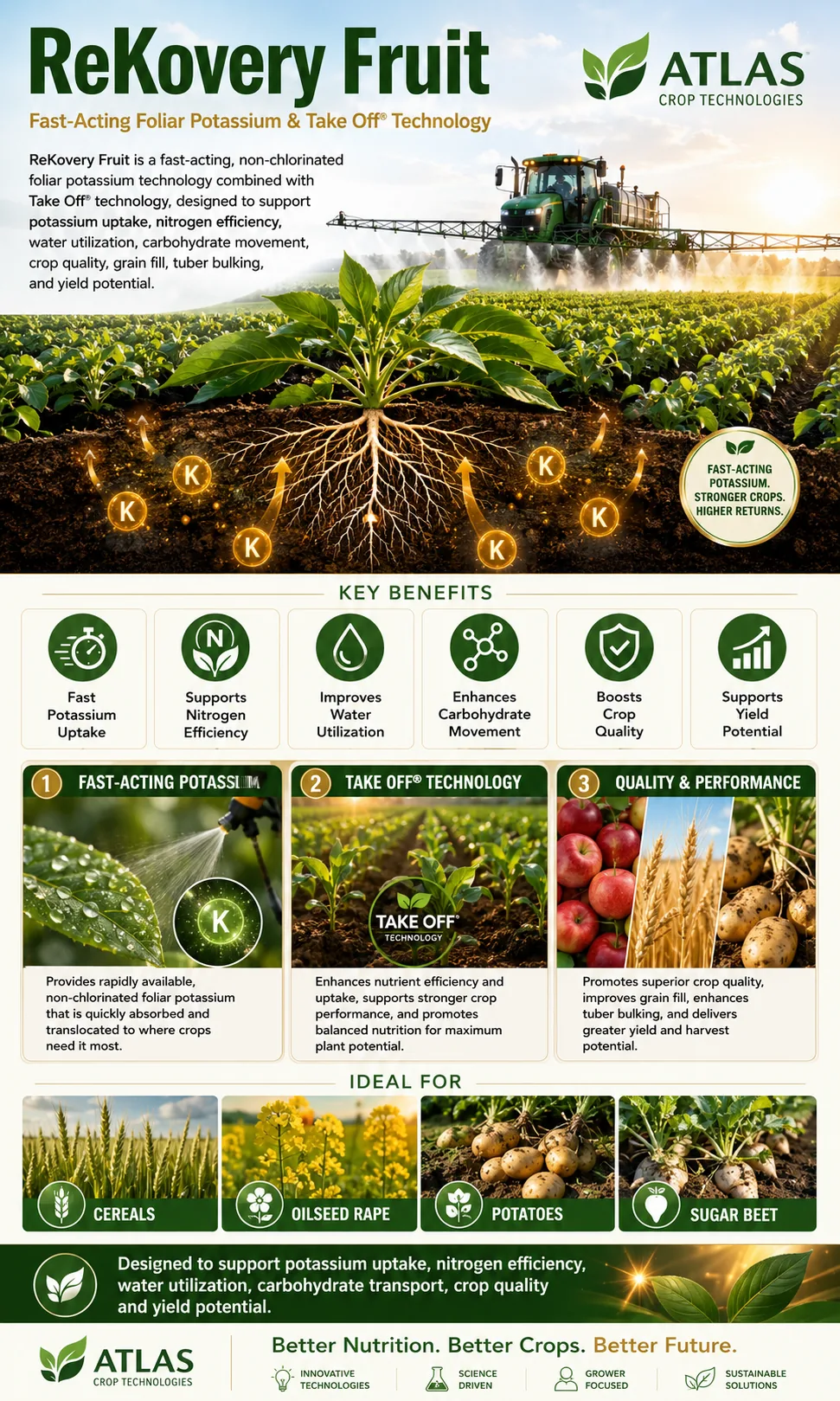
Potassium is required in large quantities by many crops and is central to water regulation, carbohydrate transport, enzyme activity, photosynthesis, productive filling and crop-quality development.
ReKovery Fruit is designed to deliver potassium rapidly through the foliage. Current European manufacturer information describes the product as a non-chlorinated pure form of potassium for rapid uptake.
The potassium component is combined with Verdesian's Take Off® technology, which is positioned within ReKovery Fruit around maximizing nitrogen efficiency and water utilization to support yield potential and quality.
Foliar delivery can be particularly useful where a grower wants to complement the main soil or fertigation potassium program at a defined crop stage. It should not, however, be viewed as an automatic replacement for the crop's full-season potassium requirement.
Unlike nutrients incorporated directly into many structural organic molecules, potassium performs much of its value through regulation, activation and movement within the plant.
Potassium plays an important role in plant turgor, stomatal function and the regulation of water movement through crop tissues.
Potassium participates in the regulation of physiological processes that contribute to efficient photosynthesis.
Sugars produced in leaves must be transported to growing and storage tissues. Potassium is central to these translocation processes.
Potassium activates many enzyme systems involved in metabolism and productive crop growth.
Current European Verdesian information describes ReKovery Fruit as providing a non-chlorinated form of potassium for rapid uptake.
The objective is to provide a fast nutritional route at crop stages where foliar potassium can complement the main fertility program.
ReKovery Fruit combines its potassium component with Take Off® technology.
Current European product positioning associates this technology with maximizing nitrogen efficiency and water utilization while supporting optimum yield and quality.
Potassium and nitrogen do not act independently within the crop. Productive biomass requires nitrogen assimilation, photosynthetic activity, water regulation and the movement of carbohydrates toward developing sinks. ReKovery Fruit is positioned around supporting these connected physiological processes.
Leaves produce carbohydrates through photosynthesis, but those carbohydrates must be transported to developing stems, roots, grains, tubers, fruits and other sink tissues.
Current ReKovery Fruit information specifically emphasizes potassium's role in carbohydrate transportation.
Potassium contributes to the physiological systems that allow sugars and other assimilates to move from source tissues toward areas of active cell division, growth and storage.
This connection helps explain why potassium demand can become especially important during grain filling, tuber bulking, fruit development and other stages of rapid sink growth.
During grain fill, assimilates produced by green leaf area are transported toward developing grain.
Potatoes, sugar beets and other storage crops rely on efficient transport of photosynthates into rapidly expanding storage organs.
Fruit expansion and quality depend on a continued supply of water, minerals and photosynthetic assimilates to the developing fruit.
Potassium participates in the opening and closing of stomata, which regulate gas exchange and water-vapour loss from leaves.
Potassium contributes to osmotic regulation and cell turgor, helping tissues maintain the pressure needed for normal growth.
Appropriate potassium status contributes to balanced control of transpiration as the crop exchanges water and gases with the atmosphere.
ReKovery Fruit is specifically positioned around supporting water utilization through the combined potassium and Take Off® technology package.
Nitrogen supports proteins, chlorophyll and vegetative growth, while potassium contributes to enzyme function, water balance, photosynthesis and carbohydrate movement.
Current European ReKovery Fruit positioning specifically states that nitrogen efficiency is highly dependent on potassium.
The Take Off® component in ReKovery Fruit is positioned around maximizing nitrogen efficiency together with water utilization.
This does not mean ReKovery Fruit supplies or replaces the crop's complete nitrogen requirement.
Productive carbohydrate movement is important to grain, fruit and storage-organ filling.
Manufacturer positioning for the broader ReKovery potassium platform includes crop colour as a quality characteristic associated with effective potassium nutrition.
Sugar production and translocation contribute to quality development in many fruit and vegetable crops.
Potassium nutrition is one component of crop-quality programs where post-harvest durability and shelf life are important.
Current European ReKovery Fruit information includes potassium's role in oil production among the physiological reasons for maintaining appropriate crop potassium status.
This makes potassium management particularly relevant in crops where harvested oil content contributes strongly to crop value.
European manufacturer guidance provides a specific ReKovery Fruit program for oilseed rape:
The current local label must always be checked before use.
Current European guidance states that ReKovery Fruit can be applied through all standard crop sprayers using current best practices.
Verify crop registration, crop stage, application rate and the physiological objective before spraying.
Confirm that the selected rate and water volume remain within the published concentration limits and current local label.
Begin with a partially filled tank and the agitation system operating.
Use properly calibrated equipment and sufficient water to achieve appropriate crop coverage.
Current European Verdesian information lists a general ReKovery Fruit application range of 1 to 3 litres per hectare.
The actual rate depends on crop, crop stage, objective and current label directions.
Published European guidance states that ReKovery Fruit should be applied in a solution at or below 2% concentration.
This is described as a maximum of 2 litres of product in 100 litres of water.
If ReKovery Fruit is being applied with another product at low water volumes, European guidance specifies a solution at or below 1%.
This is described as 1 litre in 100 litres of water.
Current European Verdesian information lists a 10-litre pack size. Packaging and availability may differ by market.
Current European manufacturer guidance provides a defined spray-tank preparation process.
Current European product information describes ReKovery Fruit as compatible with most agrochemical and plant nutrition products.
Compatibility can still be affected by formulation chemistry, water quality, concentration, pH, number of tank-mix partners and mixing order.
European guidance specifically instructs users to avoid direct contact between concentrates during tank preparation and to add ReKovery Fruit as the final product.
This mixing order should be incorporated into the complete tank-mix procedure together with the labels of all other products.
Best practice: where an unfamiliar combination is being considered, perform an appropriate small-scale compatibility check before preparing a full commercial spray tank.
The spray system should provide appropriate distribution over the intended crop canopy.
Select a water volume that balances practical field capacity with crop coverage and concentration requirements.
Nozzle output, pressure, travel speed and boom setup should be calibrated before application.
Avoid spraying when environmental conditions create unacceptable drift, evaporation, crop-stress or rainfastness risks.
The following crop programs reflect current published European manufacturer guidance. Use only where consistent with the current approved product label in the country of application.
Apply at growth stage 30/32 and repeat at growth stage 37.
Apply at the onset of stem extension and repeat at green bud stage.
Begin approximately four weeks after emergence and follow with two additional applications at approximately fortnightly intervals.
Cereal crops require sufficient potassium to support canopy function, water relations, nutrient efficiency and subsequent grain-filling potential.
The published ReKovery Fruit cereal program targets stem-extension stages when the crop is actively developing biomass and building the canopy that will later support grain filling.
Apply 1.0 litre per hectare at growth stage 30/32 and repeat at growth stage 37 according to published European guidance.
Local crop labels, variety, nutrient status and crop-management objectives should guide final use.
Potato crops can develop high potassium demand as canopy growth transitions toward active tuber development and bulking.
Potassium contributes to water relations, photosynthetic function and the movement of carbohydrates toward developing tubers.
Current European ReKovery Fruit guidance provides a repeated foliar program beginning approximately four weeks after crop emergence.
Sugar beet relies on productive canopy photosynthesis followed by transport of assimilates toward the developing storage root.
Potassium is closely connected with both water relations and carbohydrate translocation, making crop potassium status relevant to this source-to-sink process.
European guidance groups sugar beet with potatoes:
Potassium is important throughout fruit development, helping support fruit weight, quality and productive crop physiology.
ReKovery appears within Verdesian's current grape product portfolio as a foliar nutritional technology.
ReKovery also appears within the manufacturer's current berry crop portfolio for foliar use.
The broader ReKovery platform targets vegetable crops as part of its foliar and nutrient-management positioning.
Portfolio inclusion does not establish identical crop rates or legal registration in every country. Confirm the current local ReKovery Fruit label before application.
Current European manufacturer information specifically describes ReKovery Fruit as a non-chlorinated pure form of potassium.
This distinguishes the product from potassium sources where chloride forms part of the nutrient salt.
Foliar nutrient formulations must balance nutrient concentration, plant safety, leaf penetration, coverage and practical compatibility.
ReKovery Fruit is specifically positioned as a fast-acting foliar potassium technology under current European guidance.
Soil testing can provide information about exchangeable potassium and broader soil nutrient status.
Plant-tissue testing can provide useful information about crop potassium status during the growing season.
Visual crop symptoms, canopy condition, growth pattern and crop load can provide additional context but should not be used in isolation.
Drought, root restriction, salinity, disease, magnesium imbalance and other stresses can produce symptoms that resemble nutrient deficiency. Where possible, combine crop observation with soil or tissue analysis and qualified agronomic interpretation.
Most high-yielding crops require substantial quantities of potassium, and the majority of whole-season potassium nutrition commonly comes through soil, substrate or fertigation pathways.
Foliar application provides a different route. It can be used at defined crop stages to supplement potassium nutrition rapidly through the leaf surface.
ReKovery Fruit therefore fits best when its foliar role is considered within the entire crop potassium budget.
Because potassium participates in stomatal control and turgor, adequate potassium status is relevant when crops encounter water stress.
Balanced potassium contributes to the physiological processes that allow crops to maintain growth and productive tissue.
The broader manufacturer ReKovery positioning associates potassium nutrition with strengthened crop stress response and resilience.
Build the main fertility program around crop demand, nutrient analysis, expected yield and the productive capacity of the soil or substrate.
Use foliar potassium at an appropriate crop stage according to current local product directions and the defined agronomic objective.
Use tissue testing, crop observation, yield data and quality measurements where appropriate to evaluate the whole nutrition program.
Use a potassium source and formulation suited to the crop stage, foliar application method and overall nutrient strategy.
Match product rate to crop, crop stage, crop status and current approved directions.
Target crop stages where potassium demand, productive filling or physiological support justifies application.
Use calibrated foliar application to place the spray evenly on the intended crop canopy.
| Attribute | Published reference information |
|---|---|
| Product | ReKovery Fruit. |
| Product category | Fast-acting foliar potassium nutrient. |
| Application route | Foliar. |
| Potassium positioning | Non-chlorinated pure form of potassium for rapid uptake. |
| Technology | Take Off® technology. |
| Primary physiological positioning | Potassium uptake, nitrogen efficiency, water utilization and carbohydrate transportation. |
| Potassium functions highlighted by manufacturer | Enzyme activation, photosynthesis, sugar production, carbohydrate storage and transport, nitrogen efficiency, oil production and water-use processes. |
| Productive filling examples | Grain fill and tuber bulking. |
| European general rate | 1–3 L/ha, subject to current local label. |
| Standard spray concentration | At or below 2%, described as up to 2 L product in 100 L water. |
| Low-water tank-mix concentration | At or below 1%, described as up to 1 L product in 100 L water, where another product is being applied at low water volumes. |
| Application equipment | Standard crop sprayers using current best practices. |
| Mixing | Add to a half-filled tank with agitation running, mix well, fill to the required volume and continue agitation. |
| Tank-mix order | Add ReKovery Fruit as the final product. |
| Compatibility | Compatible with most agrochemical and plant nutrition products according to current European product guidance. |
| Cereal timing | 1.0 L/ha at GS30/32, repeated at GS37. |
| Oilseed rape timing | 1.0 L/ha at onset of stem extension, repeated at green bud stage. |
| Potato & sugar beet timing | 1–2 L/ha approximately four weeks after emergence plus two additional applications at approximately fortnightly intervals. |
| European reference pack size | 10 L. |
This table summarizes current published European manufacturer information. The approved local product label remains authoritative.
Consider the product where a foliar route fits the crop program and potassium demand is a defined agronomic priority.
Grain fill, tuber bulking and fruit development create strong demand for carbohydrate movement and effective potassium function.
Potassium's role in stomatal function and turgor makes potassium status relevant to crop water regulation.
ReKovery Fruit combines potassium with Take Off® technology and is positioned specifically around nitrogen efficiency.
Potassium is closely connected with filling, carbohydrate transport and several harvested-crop quality characteristics.
Where compatibility permits, ReKovery Fruit may be considered for integration into an existing crop spray program.
Discuss crop fit, potassium status, crop stage, spray timing and practical foliar integration.
Evaluate foliar potassium around filling, crop quality, water utilization and marketable-output objectives.
Explore local product status, technical positioning, commercial availability and regional portfolio opportunities.
Evaluate ReKovery Fruit within integrated nutrient-efficiency and foliar crop-nutrition programs.
Provide relevant crop and spray-program information so Atlas Crop Technologies can route your request effectively.
Select products according to nutrient need, application method, crop stage, local registration and the specific agronomic objective.
A water-soluble potassium-efficiency technology containing BioSF325™, designed to support potassium use efficiency, crop quality, shelf life and marketable yield through fertigation.
View Product → FertigationA phosphorus-efficiency fertigation technology containing BioSF325™ to support efficient phosphorus nutrition, root development and crop performance.
View Product → Seed AppliedA multi-benefit nutritional seed lubricant combining talc/graphite, micronutrients and MAC® Technology to support planter performance, emergence and early vigor.
View Product →Tell us about your crop, growth stage, potassium program, spray volume, tank-mix requirement, market or distribution opportunity. Our team will route your enquiry to the appropriate regional contact.
The information below provides general product and agronomic context. The current approved product label in the country of use remains the authoritative source for legal directions.
ReKovery Fruit is a fast-acting foliar potassium nutrition product from Verdesian Life Sciences.
Current European manufacturer information describes it as a non-chlorinated pure form of potassium for rapid uptake combined with Take Off® technology.
It is positioned around rapid foliar potassium nutrition, potassium uptake, nitrogen efficiency, water utilization, carbohydrate movement and crop-quality development.
Yes. Current European ReKovery Fruit guidance positions the product specifically for foliar application through standard crop sprayers.
Current manufacturer positioning describes ReKovery Fruit as a fast-acting product providing a potassium form intended for rapid foliar uptake.
Actual uptake depends on crop condition, leaf surface, environmental conditions, concentration and application quality.
Current European Verdesian information describes ReKovery Fruit as a non-chlorinated potassium source.
Take Off® is Verdesian technology incorporated into ReKovery Fruit. Within current ReKovery Fruit positioning it is associated with maximizing nitrogen efficiency and water utilization.
Potassium participates in many important crop processes including enzyme activation, water regulation, photosynthesis, sugar production, carbohydrate transport and productive filling.
Potassium plays an important role in the movement and translocation of carbohydrates from photosynthetic source tissues toward developing sink tissues such as grain, fruit and tubers.
Grain filling depends on continued photosynthesis and the movement of assimilates toward developing grain. Potassium contributes to water relations, enzyme activity and carbohydrate transport involved in these processes.
Developing tubers act as strong carbohydrate sinks. Potassium's role in carbohydrate transport and water regulation makes crop potassium status important during tuber bulking.
Current product positioning includes improved water utilization as an agronomic objective.
This is linked to potassium's physiological roles and the Take Off® component of the product.
No. Nutritional support cannot replace the crop's need for adequate root-zone water.
Severe drought should be managed primarily through irrigation, soil-water conservation and other appropriate agronomic practices.
Potassium is involved in the regulation of stomatal opening and closing, which affects gas exchange and water loss from leaves.
Nitrogen-driven growth depends on adequate water relations, photosynthesis, enzyme activity and carbohydrate supply. Potassium contributes to each of these processes.
Current ReKovery Fruit positioning explicitly states that nitrogen efficiency is highly dependent on potassium.
No. Although the product is positioned around nitrogen efficiency, it should not be treated as a replacement for the crop's required nitrogen supply.
Not automatically. High-yielding crops can require large total quantities of potassium.
ReKovery Fruit is a foliar technology and should normally be integrated into the crop's complete potassium budget according to local agronomic recommendations.
Current European Verdesian guidance lists 1 to 3 litres per hectare as the general application range.
Crop-specific guidance and the approved local label take precedence.
Current European guidance states that ReKovery Fruit should be applied at a concentration of 2% or less.
The manufacturer's example is a maximum of 2 litres of product in 100 litres of water.
Where another product is being applied at low water volumes, European guidance states that ReKovery Fruit should be at 1% concentration or less.
The published example is 1 litre in 100 litres of water.
Published guidance advises starting with the spray tank approximately half filled and the agitation system operating.
Add the required product, mix thoroughly, fill to the required level, maintain agitation during spraying and standing periods and apply promptly after mixing.
When tank mixing with other products, current European guidance states that ReKovery Fruit should be added as the final product.
Highly concentrated formulations can behave differently before dilution than they do in the finished spray solution.
Following the approved mixing sequence reduces the risk of localized incompatibility during tank preparation.
Current European guidance describes ReKovery Fruit as compatible with most agrochemical products.
Always confirm the exact mixture against all product labels and perform compatibility testing where required.
Current European guidance describes it as compatible with most plant nutrition products.
Compatibility is formulation-specific, so the exact combination still needs to be checked.
Where a particular tank mixture has not previously been used or formally validated, a small-scale compatibility test can be a useful precaution before preparing a commercial spray tank.
Current European guidance lists 1.0 litre per hectare at growth stage 30/32, repeated at growth stage 37.
European guidance lists 1.0 litre per hectare at the onset of stem extension, followed by another 1.0 litre per hectare at green bud stage.
European guidance lists 1 to 2 litres per hectare beginning approximately four weeks after crop emergence.
Two additional applications are then described at approximately fortnightly intervals.
Sugar beet is grouped with potatoes in current European guidance: 1 to 2 litres per hectare beginning approximately four weeks after emergence, followed by two further applications roughly two weeks apart.
ReKovery is present within current Verdesian crop portfolios for several fruit and specialty-crop categories.
Exact ReKovery Fruit crop approval, rate and timing must be confirmed from the current local label.
ReKovery appears within the current Verdesian grape portfolio as a foliar nutritional technology.
Country-specific ReKovery Fruit approval should still be verified.
ReKovery appears within the current Verdesian berry crop portfolio as a foliar product.
Use only if the current local label covers the intended crop.
Crop quality is a principal part of current ReKovery Fruit positioning.
Potassium nutrition is related to filling, carbohydrate transport, water relations and other processes that influence harvested-crop quality.
The broader manufacturer positioning for ReKovery potassium nutrition includes crop colour among the quality characteristics associated with effective potassium nutrition.
Colour development is also strongly influenced by crop genetics, maturity, temperature, light and other management factors.
The broader ReKovery platform includes taste among the crop-quality characteristics associated with potassium nutrition.
Actual taste and soluble-solids development depend on crop, cultivar, maturity, water management, crop load and overall nutrition.
Shelf life is included within broader ReKovery potassium-quality positioning.
Post-harvest performance is also affected by harvest maturity, disease, handling, storage temperature, humidity and supply-chain conditions.
Current European ReKovery Fruit information lists oil production among the crop processes in which potassium has an important role.
Foliar potassium can be used within programs designed to prevent or correct nutrient limitations, subject to crop need and current product directions.
Severe whole-crop potassium deficiency may require additional soil or fertigation correction because foliar application alone may not supply the crop's total potassium requirement.
Use crop symptoms together with soil, substrate or tissue analysis where practical.
Similar visual symptoms can result from drought, root damage, salinity, disease or other nutrient imbalances.
No agricultural input can guarantee a particular crop yield.
ReKovery Fruit is designed to support potassium nutrition, physiological efficiency and crop quality, but final yield depends on genetics, environment, water, nutrition, pests, disease and overall management.
ReKovery Fruit is positioned as a crop nutrition product, not as a replacement for registered fungicides, insecticides, herbicides or other crop-protection products.
Current European Verdesian product information lists a 10-litre pack size.
Packaging and availability can differ by market.
No. Registration, formulation, crop approvals, rates, timings, product claims, compatibility directions and packaging can differ between countries.
Contact Atlas Crop Technologies for current local information.
Include your country, crop, variety, crop stage, current potassium program, soil or tissue analysis if available, planned water volume, tank-mix partners and the agronomic objective you want to address.
Use the contact form on this page or email contact@fertilizercoatingproducts.com .
Include your company, country, crop or market, approximate commercial requirement and the nature of your enquiry.
Trademark Notice: All products featured on this website are registered trademarks of Verdesian Life Sciences.