Preside Ultra®
A concentrated soybean inoculant technology developed to support early nodulation, biological nitrogen fixation, root development, vigorous crop establishment and efficient nitrogen acquisition.
Preside Ultra® is designed for soybean production programs in which growers and agronomists want to establish an effective association between the crop and compatible nitrogen-fixing rhizobia from the beginning of the season. Manufacturer information describes the technology as using multiple strains of Bradyrhizobium japonicum together with Take Off® technology.
Product registration, formulation, approved claims, pack sizes and directions for use vary by market. Always follow the current approved local label.
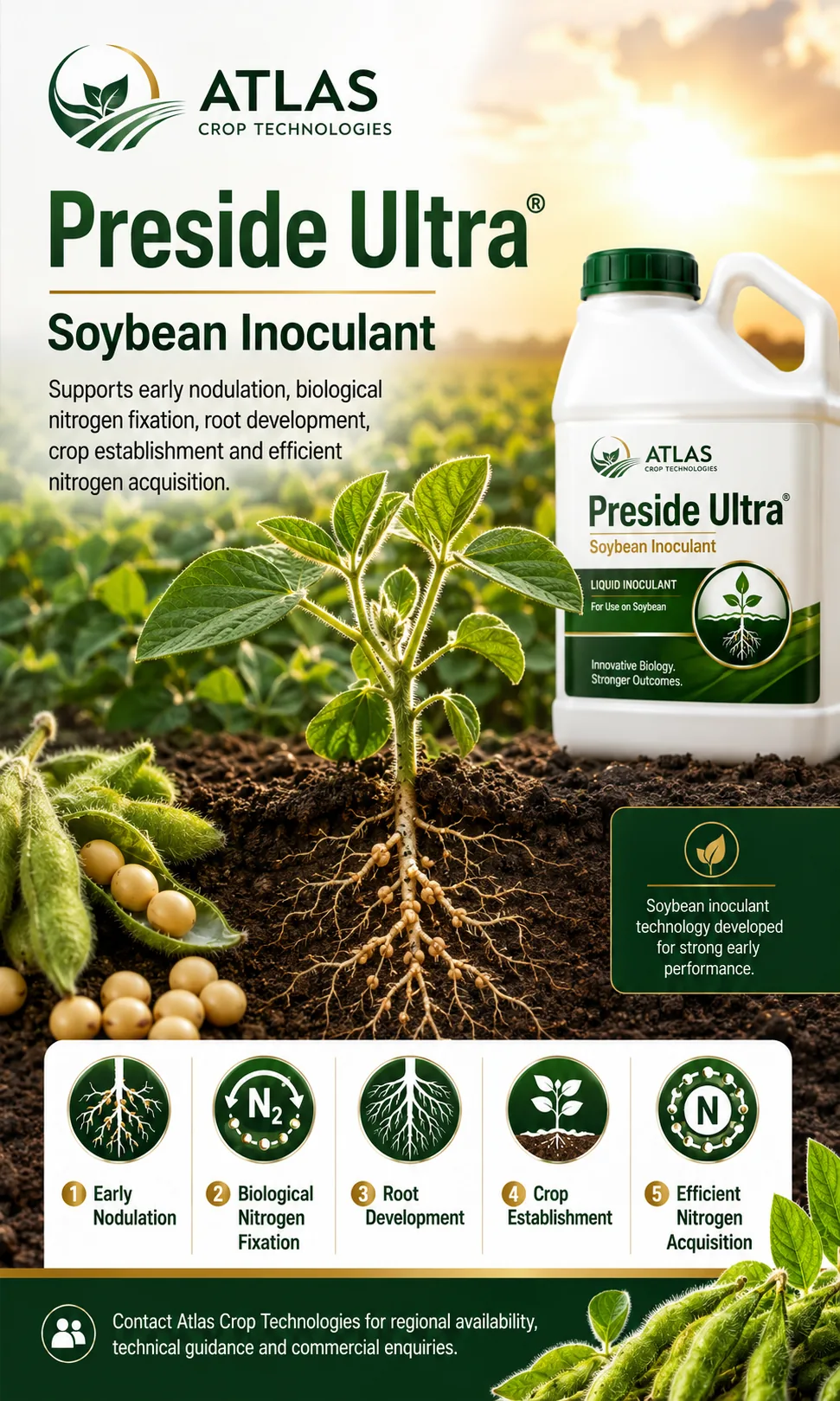
A biological foundation for the soybean crop
Soybean has a particularly high nitrogen requirement. One of the crop's defining agronomic advantages is its ability to form a symbiotic relationship with compatible rhizobia. These bacteria colonise soybean roots and stimulate the formation of nodules in which biological nitrogen fixation can take place.
Preside Ultra® is designed to introduce a concentrated population of soybean-compatible rhizobia at planting so that the crop has an opportunity to initiate effective nodulation early in development. The objective is not simply the presence of nodules, but the establishment of an active root–microbe relationship capable of contributing to crop nitrogen nutrition.
Manufacturer information positions Preside Ultra® around faster establishment, increased nodulation and improved utilisation of available nitrogen. Actual field response is influenced by environment, soil conditions, soybean history, inoculant handling, planting conditions, cultivar and the wider agronomic program.
Crop: Soybean
Technology type: Biological inoculant
Application: Seed inoculation / seed treatment, subject to local label
Biological focus: Soybean-compatible rhizobia
Primary agronomic objectives: Nodulation, biological nitrogen fixation, root development and crop establishment
Program position: Planting and early-season crop establishment
Designed to support the crop from the root system upward
Preside Ultra® is positioned as more than a simple seed coating. Its role is to help establish the biological processes that support soybean nitrogen nutrition and early crop development.
Biological Nitrogen Fixation
Compatible rhizobia living in soybean nodules can convert atmospheric nitrogen into biologically available forms that contribute to crop nitrogen nutrition. Successful inoculation is intended to help establish this symbiosis early in the season.
Early Nodulation
Early and effective root colonisation can support the development of active nodules while the crop is establishing. Nodule number, position, size and activity can all be influenced by field conditions and management.
Root Development
A vigorous root system provides the physical platform for water and nutrient acquisition. Manufacturer information links early nodulation with increased secondary and feeder-root development and additional potential nodulation sites.
Crop Establishment
Rapid, uniform establishment can help the soybean crop develop a productive canopy and make more effective use of the available growing season. Emergence performance remains dependent on seed, soil, temperature, moisture and planting conditions.
Nitrogen Acquisition
Preside Ultra® is positioned to strengthen the crop's biological route for nitrogen acquisition rather than relying exclusively on nitrogen already present in the root zone.
Early-Season Vigour
Strong early biological activity and establishment can contribute to a more competitive soybean stand. Final performance depends on the complete production system rather than inoculation alone.
From treated seed to active nodules
Rhizobia are positioned with the seed
The inoculant places viable, soybean-compatible bacteria close to the germinating seed and developing root system. Correct storage, treatment and handling are important because the inoculant contains living biological organisms.
Roots and bacteria interact
Following germination, compatible rhizobia can recognise and colonise young soybean roots. Successful infection initiates the biological processes that lead to nodule formation.
Nodules develop
Nodules form on the root system and provide specialised sites for the soybean–rhizobia relationship. Effective nodulation is an important component of the crop's nitrogen economy.
Nitrogen fixation contributes to crop nutrition
Within functioning nodules, atmospheric nitrogen can be converted into forms usable by the plant. This energy-intensive process is supported by carbohydrates supplied by the soybean plant.
Inoculation does not guarantee nodulation or yield response. Rhizobial survival and symbiotic performance can be affected by soil temperature, moisture, pH, salinity, seed-treatment chemistry, inoculant age, treatment-to-planting interval, crop history and other environmental factors. Use current local agronomic guidance alongside the product label.
Multiple-strain rhizobia technology
Manufacturer information describes Preside Ultra® as a super-concentrated soybean inoculant containing multiple strains of Bradyrhizobium japonicum. The use of soybean-compatible rhizobia is intended to establish a strong bacterial population near developing roots at the time when the crop begins the nodulation process.
A concentrated inoculant approach can allow a high population of rhizobia to be delivered with a relatively small treatment volume. The exact organism concentration, formulation and application rate relevant to your market must be confirmed from the current local label.
Take Off® technology
Verdesian product literature describes Preside Ultra® as incorporating Take Off® technology, positioned to accelerate nutrient acquisition and utilisation within the plant.
In practical program design, this places Preside Ultra® at the intersection of two agronomic objectives: establishing soybean rhizobia around the developing root system and supporting the plant's ability to make effective use of its nutrient supply.
Technology descriptions and permitted performance claims can differ between jurisdictions. Only claims appearing on the approved local product documentation should be used for commercial recommendations.
Performance information from Verdesian literature
The figures below are provided for technical context and originate from manufacturer product materials. They are not a guarantee of performance and should not be interpreted as locally approved claims unless they appear in the relevant market documentation.
Up to 2× more rhizobia
Verdesian's U.S. product literature states that Preside Ultra® can provide up to twice as many rhizobia per seed as comparison soybean inoculants used in the referenced manufacturer materials.
Up to 65% more nodule mass
Manufacturer materials report up to 65% greater nodule mass in referenced comparisons, with the objective of increasing potential nitrogen-fixing capacity.
20% faster establishment
Verdesian's current U.S. product information reports a 20% faster establishment observation associated with the product in referenced manufacturer data.
1.9 bu/ac manufacturer-reported advantage
U.S. manufacturer literature reports a 1.9 bushel-per-acre advantage over untreated acres in the cited dataset. Yield response can vary substantially by location, season, soil and management.
Manufacturer-reported results are contextual information, not a prediction of individual farm performance. Trial design, geography, environmental conditions, statistical significance, local registration and commercial claim requirements should be reviewed before using any numerical result in a recommendation or sales communication.
Why nodulation matters in soybean
Soybean removes and accumulates substantial quantities of nitrogen during the growing season. Effective biological nitrogen fixation can therefore make an important contribution to the crop's total nitrogen requirement.
The nodulation process begins relatively early in crop development. Ensuring that viable, compatible rhizobia are present close to young roots can be an important management consideration, particularly in fields where natural populations may be limited or inconsistent.
Nodulation should be evaluated by more than simply counting visible nodules. Agronomists may consider nodule distribution, size, internal colour and the overall health of the root system when assessing whether symbiotic nitrogen fixation appears to be developing effectively.
What to examine after establishment
Plant appearance alone cannot confirm nitrogen fixation. Where nodulation is poor, investigate biological, chemical, physical and environmental causes before drawing conclusions about product performance.
Situations where inoculation deserves particular attention
The value of any soybean inoculation program depends on the field, crop history and production environment. The following situations commonly justify closer agronomic evaluation.
First-time soybean fields
Fields without a history of soybean production may not contain sufficiently large populations of soybean-compatible rhizobia. Inoculation can therefore be an important establishment consideration.
Long intervals between soybean crops
Where soybean has not been grown for an extended period, the size and effectiveness of the resident rhizobial population may warrant review as part of the planting program.
Challenging soil conditions
Soil pH, temperature, moisture, salinity and other stresses can influence rhizobial survival, infection, nodulation and overall root function.
High-value establishment programs
Where uniform establishment and early-season crop development are strategically important, inoculation may form one component of a broader seed-treatment and crop-nutrition strategy.
Uncertain native rhizobia populations
Previous soybean production does not automatically guarantee that sufficient numbers of highly effective rhizobia are present under current field conditions.
Intensive crop-management systems
Growers seeking to optimise multiple yield-limiting factors may evaluate inoculation alongside seed quality, fertility, planting precision, disease management, weed control and water management.
Where Preside Ultra® fits
Preside Ultra® is positioned as a seed-applied soybean inoculant. The objective is to place viable rhizobia close to the developing root system so that root infection and nodulation can begin as the crop establishes.
Depending on the approved local label and commercial system, treatment may be incorporated into professional seed-treatment workflows or other permitted inoculation processes.
Protect biological viability
Unlike conventional non-living seed-treatment ingredients, rhizobial inoculants rely on viable microorganisms. Handling practices can therefore directly influence the biological quality of the treatment.
Application method, rate, timing, sequence, compatibility, storage, treatment-to-planting interval and crop suitability can vary by country, crop-production system and local registration. Always follow the current approved product label, seed-treatment instructions and local agronomic guidance.
Biologicals require compatibility planning
Soybean seed is frequently treated with combinations of fungicides, insecticides, micronutrients, polymers, biological products and other technologies. Not every combination is equally compatible with living rhizobia.
The effect of another treatment can depend on active ingredient, formulation, concentration, mixture pH, sequence of application, drying conditions and the amount of time between treatment and planting.
Compatibility should therefore be assessed using current manufacturer information and the approved labels for every component of the seed-treatment program.
Questions to confirm
Conditions that can influence inoculation performance
Soil temperature
Temperature influences germination, root growth, microbial activity and the speed at which the soybean–rhizobia relationship develops.
Soil moisture
Excessively dry or saturated conditions can restrict root activity and may create an unfavourable environment for biological establishment.
Soil pH
Strongly acidic or otherwise unsuitable soil conditions can affect both soybean root development and microbial survival or activity.
Salinity and stress
Elevated salinity and other abiotic stresses may reduce seedling vigour, root development and the effectiveness of biological interactions.
Seed-treatment chemistry
Some chemical combinations or extended exposure periods can reduce rhizobial survival. Compatibility and planting-window instructions are therefore important.
Crop history
The frequency with which soybean has been grown can influence the resident population of compatible rhizobia, but should not be used as the sole measure of biological effectiveness.
One component of a complete soybean program
Preside Ultra® should be viewed within the context of the full soybean production system. Biological nitrogen fixation performs best when the crop has the underlying agronomic conditions required for healthy roots and productive growth.
Seed quality, soil fertility, phosphorus and potassium availability, micronutrient status, planting depth, population, soil structure, moisture management, disease control and weed competition can all influence the crop's ability to convert successful establishment into yield.
Review alongside inoculation
Information that helps us evaluate fit
For a useful technical discussion, provide as much field and program information as possible when contacting Atlas Crop Technologies.
Location & market
Country, production region and intended market help determine registration status, product availability and relevant local guidance.
Field history
Include previous crops, the last soybean crop and any known history of nodulation or establishment limitations.
Soil information
Soil type, pH, salinity, organic matter and recent soil-test information provide valuable agronomic context.
Seed-treatment program
List fungicides, insecticides, biologicals, micronutrients, polymers and other products planned for use on the seed.
Application equipment
Tell us whether seed is treated by the seed supplier, distributor, professional seed-treatment facility or another approved system.
Commercial requirement
For distribution enquiries, include estimated volume, geography, customer type, season timing and any registration or logistics requirements.
Preside Ultra® product profile
Explore related technologies
Combine seed, biological and crop-nutrition technologies according to crop needs, local registration and the wider agronomic program.
primacyALPHA®
A foliar nutrient and biostimulant technology intended to support nutrient assimilation, crop quality and reproductive performance.
View Product → InoculantPrimo R1
A multi-strain soybean inoculant formulated to support consistent nodulation, root development and crop establishment.
View Product → FoliarReKovery Fruit
A fast-acting foliar potassium nutrition product designed to support potassium uptake, water use and crop quality.
View Product →Discuss Preside Ultra® with our team
Tell us your country, soybean production system, field history, seed-treatment program, application method and commercial or technical requirement. Atlas Crop Technologies will route your enquiry to the appropriate regional contact.
Frequently Asked Questions
General technical information is provided below. The current approved local product label remains the definitive source for registered uses, directions and claims.
Preside Ultra® is a soybean inoculant technology developed to support early nodulation, biological nitrogen fixation, root development, crop establishment and efficient nitrogen acquisition. Manufacturer information describes it as a concentrated, multiple-strain soybean inoculant.
A soybean inoculant contains compatible rhizobia intended to establish around developing soybean roots. These bacteria can initiate nodule formation and, within functioning nodules, contribute to biological nitrogen fixation.
Current manufacturer information describes Preside Ultra® as using multiple strains of Bradyrhizobium japonicum. Because formulations and registrations can vary by market, confirm the organism declaration on the current approved local label.
Soybean has a high nitrogen requirement. Through its symbiotic relationship with compatible rhizobia, the plant can develop nodules in which atmospheric nitrogen is converted into forms that contribute to crop nutrition. Effective nodulation therefore plays an important role in soybean nitrogen management.
Establishing effective nodules early can help develop the biological nitrogen-fixation system as the crop's nitrogen demand increases. The timing and effectiveness of nodulation depend on rhizobial viability, root growth, soil conditions and crop management.
Manufacturer literature describes Preside Ultra® as incorporating Take Off® technology, positioned to support nutrient acquisition and utilisation. Refer to current local product information for the claims authorised in your market.
Inoculation may deserve particular attention in fields with no previous soybean history, long intervals since soybean was last grown, uncertain resident rhizobia populations or conditions that may challenge biological establishment. Local agronomic advice should guide the final decision.
Preside Ultra® is positioned as a soybean inoculant and seed-treatment technology. Exact application rate, equipment, sequence, timing, treatment-to-planting interval and permitted crop uses must follow the approved local label.
Use only the rate stated on the current approved product label for your country and formulation. Do not transfer a rate from another market because formulation, concentration, packaging and registration can differ.
Compatibility depends on the exact products, formulations, concentrations, application sequence and treatment-to-planting interval. Biological inoculants contain living microorganisms, so compatibility should be confirmed using current manufacturer guidance and the approved labels for all products in the mixture.
Rhizobial inoculants depend on living microorganisms. Excessive heat, unsuitable storage, prolonged exposure, drying or other adverse conditions can affect organism viability. Follow the product's stated storage and handling requirements.
Representative plants can be carefully excavated rather than pulled from the soil so the root system and nodules remain intact. Agronomic assessment may consider nodule presence, distribution, size, internal colour and overall root health. Local crop advisers can help interpret field observations.
No single plant characteristic guarantees yield. Nodulation, nitrogen fixation, root health, plant population, weather, fertility, disease pressure, water availability and many other factors interact to determine crop performance.
No. Soybean performance depends on balanced crop nutrition and appropriate soil and crop management. Biological nitrogen fixation should be considered alongside phosphorus, potassium, sulphur, micronutrients, pH management and other locally relevant factors.
No. Manufacturer trial observations describe performance under particular trial conditions and are not guarantees for an individual field. Results can vary with soil, weather, genetics, crop history, application quality and management. Numerical claims should only be used commercially where permitted by local registration.
Not necessarily. Product registration, formulation, permitted claims, pack size, application directions and availability may vary by market. Contact Atlas Crop Technologies for current local information.
Include your country and region, crop area, field history, soybean variety where relevant, soil conditions, seed-treatment products, intended treatment method, planting timing and the specific agronomic question you want to address.
Use the contact form on this page or email contact@fertilizercoatingproducts.com. Include your country, company, customer segment, expected requirement and any registration or distribution information relevant to your market.
This page provides general product and agronomic information only. Product registration, composition, microorganism concentration, approved crops, claims, application rates, treatment methods, compatibility, storage instructions, pack sizes and commercial availability may differ between countries. Local legislation and the current approved product label always take precedence. Product performance can vary according to soil, climate, crop history, seed quality, application quality and other management factors. Consult a qualified local agronomist or Atlas Crop Technologies representative before making a crop-management recommendation.