Magnum
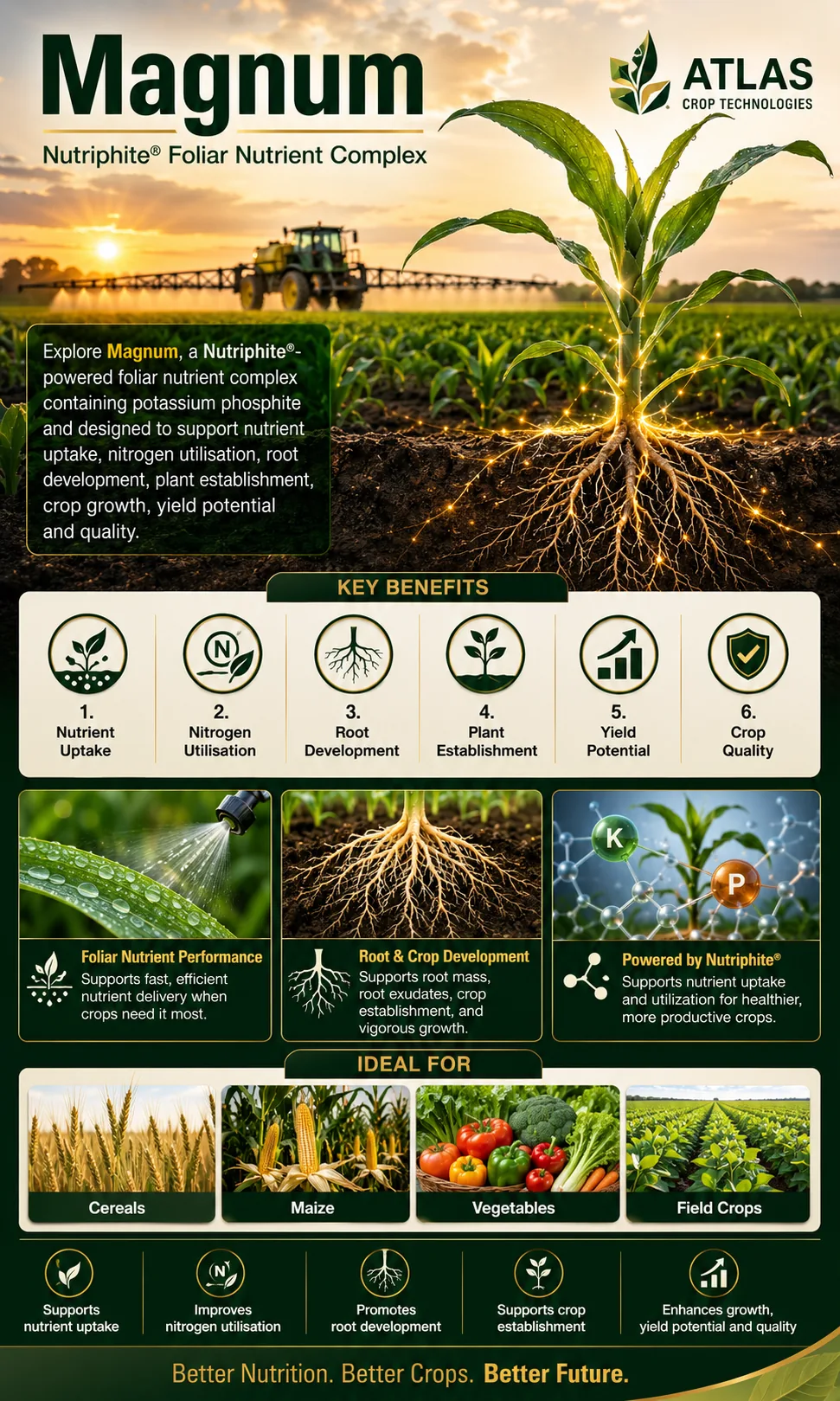
A patented-style foliar nutrient complex powered by Nutriphite® technology and containing potassium phosphite, positioned to improve nutrient uptake, synthesis and utilisation while supporting root development, crop establishment, growth, yield potential and quality.
Verdesian links Magnum with increased nitrate-reductase production, greater root mass, increased root surface area and enhanced root-exudate production—physiological responses intended to help crops acquire and utilise available nutrition more efficiently.
Formulation, guaranteed analysis, rates, crops, timings, tank-mix compatibility and registration can vary by market. Always follow the current approved local Magnum label.
Nutrient management beyond simply adding more fertiliser
Crop productivity depends not only on how much nutrient enters the field, but also on whether that nutrient remains available, can be reached by roots, enters the plant and is efficiently assimilated into productive metabolism.
Magnum is positioned within this nutrient-efficiency framework.
Rather than acting as a replacement for the main fertility program, Magnum is designed as a foliar nutrient complex that supports the crop's ability to acquire and process nutrition already available within the production system.
Current manufacturer positioning places particular emphasis on root development, nutrient uptake, nitrogen utilisation and crop quality.
Technical positioning
Powered by Nutriphite®
Verdesian identifies Magnum as part of its Nutriphite® technology platform.
Nutriphite® technologies are built around phosphite-containing nutrient formulations intended to support nutrient uptake and plant physiological performance.
Magnum combines that phosphite-based approach with a specific manufacturer positioning around root development, nitrogen metabolism and nutrient utilisation.
From leaf application to whole-plant response
Potassium phosphite
Current Verdesian Europe information states that Magnum contains potassium phosphite.
Phosphite is a phosphorus-containing chemical form with a different oxidation state from conventional phosphate.
That difference changes its behaviour in solution, soil and plant metabolism.
Magnum's phosphite chemistry should therefore be understood as part of its specific nutrient-technology positioning rather than assumed to be equivalent to a standard phosphate fertiliser.
Phosphite ≠ phosphate
Crops require phosphorus in metabolically usable phosphate forms. The base phosphorus program should continue to follow soil testing, crop removal, yield goals, fertiliser placement and locally validated fertility recommendations.
Nitrate reductase production
Verdesian states that studies at Nottingham and Kiel Universities showed potassium phosphite increasing production of the key enzyme nitrate reductase by up to 10%.
The manufacturer presents this as part of Magnum's proposed physiological mechanism for improved nitrogen utilisation.
The cited figure should be treated as a manufacturer-reported research result rather than a guaranteed response under every field, crop or environmental condition.
Why nitrate reductase matters
Nitrate reductase catalyses an early step in the plant's assimilation of absorbed nitrate.
Nitrate taken up by roots cannot simply become protein directly. It must first pass through biochemical reduction and assimilation pathways.
Efficient nitrate assimilation therefore requires active enzyme systems, sufficient carbon skeletons, energy and adequate supporting nutrition.
Nitrogen efficiency requires a complete pathway
Nitrogen supply
Nitrogen must first be present in the soil, fertiliser, irrigation water or biological system.
Root availability
Nitrogen must remain in forms and locations accessible to active roots.
Root uptake
Roots absorb nitrogen primarily as nitrate and ammonium.
Transport
Absorbed nitrogen moves to tissues where metabolic demand is present.
Assimilation
Nitrate and ammonium enter biochemical pathways leading toward amino-acid and protein synthesis.
Productive growth
Efficient nitrogen utilisation contributes to chlorophyll, enzymes, structural proteins and new plant tissue.
Greater root mass expands the crop's resource-capture system
Current Verdesian information links increased nitrate-reductase production with increased root mass.
The manufacturer states that a greater root surface-area-to-volume ratio can increase contact between roots, soil water and dissolved nutrients.
Agronomically, a larger and more active root system has more opportunity to explore soil and intercept nutrient-rich zones.
More roots can create more opportunity
Root exudates influence the soil immediately around roots
Growing roots release sugars, organic acids, amino acids and other compounds into the surrounding rhizosphere.
These compounds can influence microbial activity, mineral surfaces, pH at microscopic scales and nutrient chemistry.
Root exudation is therefore one of the mechanisms through which plants actively modify their own nutrient-acquisition environment.
Magnum boosts root-exudate production
Verdesian states that Magnum increases production of root exudates.
The manufacturer positions this as helping release or mobilise nutrition in the root environment for more effective plant uptake.
Nutrients must still be present in the soil or fertiliser program, and availability remains influenced by soil pH, moisture, mineralogy, microbial activity and root health.
Acquisition depends on both soil supply and plant activity
Availability
Nutrients must exist in forms that can enter soil solution or otherwise become accessible to roots.
Root interception
Growing roots encounter nutrients directly as they explore new soil.
Diffusion
Nutrients such as phosphorus and potassium often move toward roots partly through concentration gradients.
Mass flow
Nutrients dissolved in soil water can move toward roots with transpiration-driven water movement.
Root physiology
Active transport proteins and membrane processes ultimately govern nutrient entry into root cells.
Metabolic demand
Uptake often interacts with the crop's internal need for nutrients during active growth.
Early root development influences the rest of the season
Establishment determines the initial architecture from which the crop later captures water, nutrients and light.
Healthy early roots increase soil exploration while an expanding canopy improves photosynthetic carbon capture.
Magnum is positioned by the manufacturer to support establishment through its nutrient-uptake and root-development effects.
Foliar technology works within a wider system
Foliar nutrient delivery
Current Verdesian Europe information lists Magnum as a foliar application.
Foliar application places the spray directly onto leaf and other exposed plant surfaces, allowing the product to interact with active plant tissue at selected developmental stages.
Performance depends on correct product rate, carrier volume, nozzle selection, spray coverage, crop condition and suitable weather.
Good foliar performance starts with good spraying
A spray must first remain on the plant
Foliar nutrient performance begins with deposition and retention on the target canopy.
Droplet size, leaf angle, waxiness, spray volume, humidity and drying conditions all influence the contact period between the spray solution and leaf surfaces.
Once retained, movement into plant tissue depends on formulation, nutrient chemistry and plant physiological conditions.
Foliar response is condition-dependent
Match the application to physiological demand
Exact Magnum timings must follow the crop-specific local label. These stages describe the agronomic logic used when considering foliar nutrient-efficiency products.
Early vegetative growth
Strong root and shoot development establishes the crop's future capacity to capture resources.
Rapid canopy growth
Expanding leaf area increases demand for nitrogen, potassium, phosphorus, sulphur and micronutrients.
Pre-reproductive growth
Maintaining nutrient acquisition before flowering can support development of later yield components.
Yield and quality development
Crop-specific foliar programs may support continued nutrient metabolism during reproductive development where the label allows.
Weather affects foliar application quality
High temperature
Hot conditions can accelerate droplet evaporation and increase crop-safety risk from concentrated mixtures.
Low humidity
Very dry air can shorten the period during which droplets remain hydrated on leaves.
Excessive wind
Wind can reduce deposition uniformity and increase off-target movement.
Rainfall
Rain soon after application can dilute or wash spray deposits from foliage.
Severe crop stress
Severely wilted or heat-damaged plants may respond differently from actively growing crops.
Canopy density
Dense crop canopies may require spray adjustments to achieve appropriate coverage.
Water quality is part of the tank mixture
Water pH, hardness, bicarbonates, salinity and dissolved minerals can affect foliar mixtures.
A tank that contains Magnum together with pesticides, foliar nutrients and adjuvants becomes a complex chemical system.
Water should therefore be included in compatibility evaluation rather than treated as an inert ingredient.
Check where relevant
Compatibility must be checked for the complete mixture
Foliar nutrient products are frequently combined with fungicides, insecticides, plant-growth regulators, micronutrients or adjuvants.
A successful mixture must be physically compatible, chemically appropriate, crop-safe and legally permitted by the labels of all components.
Do not assume that compatibility with one formulation means compatibility with every product in the same category.
Verify the entire spray program
Physical compatibility testing
Where labels permit a mixture but practical compatibility is uncertain, a small-scale jar test can help identify gross physical incompatibility before filling a large spray tank.
Watch for precipitation, excessive heat, layering, gel formation, persistent foam or separation.
A jar test does not prove crop safety
Better utilisation does not remove the crop's nitrogen requirement
Magnum is positioned to support nitrogen utilisation inside the plant.
It does not create nitrogen where the production system is deficient and should not automatically be used to justify reducing a well-founded nitrogen recommendation.
Nitrogen management should continue to consider realistic yield potential, soil mineralisation, previous crop, organic sources, irrigation water and fertiliser recovery.
Manage the complete system
Nutrient utilisation depends on more than nitrogen
Phosphorus
Important for energy transfer, root growth and metabolic processes.
Potassium
Important for water regulation, enzyme activation and transport.
Sulphur
Required for sulphur-containing amino acids and closely linked to nitrogen metabolism.
Magnesium
Central to chlorophyll and important in multiple enzyme systems.
Micronutrients
Zinc, manganese, boron, iron, copper, molybdenum and others support specific metabolic functions.
Water
Nutrient uptake and metabolism cannot proceed normally under severe water limitation.
Soil pH influences the nutrition Magnum is intended to help access
Root growth alone cannot fully overcome nutrient chemistry that strongly restricts availability.
High soil pH can reduce availability of zinc, manganese, iron and phosphorus, while very low pH can create other nutrient imbalances and toxicity risks.
Magnum should therefore complement rather than replace proper soil-pH management.
Review before assuming nutrient deficiency
A root-development product cannot eliminate physical root restrictions
Compaction
Dense soil layers can physically restrict root penetration.
Waterlogging
Saturated conditions reduce oxygen and can damage active roots.
Drought
Severe water deficit restricts root extension and nutrient movement.
Salinity
High soluble-salt concentration can reduce water uptake and root growth.
Root pathogens
Disease can reduce functional root area regardless of nutritional inputs.
Soil temperature
Cold soil can slow root growth and nutrient uptake substantially.
Nutrient-efficiency technologies work within biological limits
Drought, heat, cold, salinity, flooding and disease can alter photosynthesis, respiration, nutrient uptake and metabolism.
Maintaining balanced nutrition can help prevent nutrient limitation from compounding environmental stress.
Magnum should not, however, be presented as eliminating severe abiotic stress unless a specific local registration supports such a claim.
Address the underlying constraint
Diagnose before changing the nutrient program
Soil testing
Evaluate pH, nutrient availability, salinity, organic matter and other relevant root-zone properties.
Tissue analysis
Measure actual plant nutrient status at a crop-specific stage.
Root inspection
Check rooting depth, branching, disease and compaction before attributing poor uptake to fertiliser supply alone.
Spatial pattern
Field patterns can help identify whether symptoms follow soil, drainage, irrigation or management zones.
Measure what entered the plant
Soil testing estimates root-zone supply, while tissue analysis provides information on nutrients actually present in plant tissue.
Tissue testing can therefore be useful when deciding whether a foliar nutrient intervention is justified.
Sampling must follow crop-specific procedures because nutrient concentration changes with plant part and growth stage.
Consistency matters
Measure Magnum within the whole production system
Root mass
Carefully excavated plants can be compared for rooting depth, branching and root-system size.
Tissue nutrients
Tissue analysis may indicate whether nutrient status changes after application.
Canopy development
Crop height, leaf area and biomass can provide intermediate growth indicators.
Nitrogen status
Crop-specific nitrogen measurements can provide context where nitrogen utilisation is a primary objective.
Yield
Properly designed treated and untreated comparisons can determine whether physiological differences persist to harvest.
Quality
Depending on crop, evaluate protein, solids, size, colour, marketable yield or other commercially relevant attributes.
Historical US Magnum analysis
Historical Verdesian specialty-crop materials have listed Nutri-Phite Magnum with an analysis of 2-40-16.
This information provides historical formulation context but should not be assumed to represent every current Magnum product supplied globally.
Always check the current guaranteed analysis
Use the label and technical documentation supplied with the actual Magnum product available in your country.
Quality depends on nutrition throughout crop development
Verdesian positions Magnum as contributing to improved crop quality alongside establishment, growth and yield.
Quality is crop-specific and may include grain protein, fruit size, soluble solids, colour, uniformity, dry matter, storage quality or marketable yield.
A nutrient-efficiency product can only contribute where crop nutrition is actually limiting or where improved physiological efficiency translates into harvestable quality.
Nutrition is one part of the system
Where foliar nutrient-efficiency strategies may fit
Exact Magnum crop registrations must always be confirmed locally. The examples below describe general agronomic use cases rather than legal crop approvals.
Cereals
Nitrogen assimilation, rooting and canopy development are important throughout cereal establishment and stem extension.
Maize
Early root growth and later nitrogen uptake are major components of high-yield maize systems.
Oilseeds
Balanced nitrogen, sulphur and root-zone nutrition support biomass development and reproductive growth.
Cotton
Root development, nitrogen and potassium management contribute to boll development and fibre quality.
Tree crops
Perennial crops depend on both current-season uptake and stored nutrient reserves.
Horticultural crops
High-value systems often use tightly managed foliar nutrition, tissue testing and crop-stage timing.
Magnum fits within—not outside—the fertility plan
Nutrient-use-efficiency products should be integrated with a sound base fertility strategy.
The objective is to improve how nutrients are used, not to abandon core agronomic principles.
Right source · rate · time · place
Protect product integrity before spraying
Keep original label
Maintain product identification and lot traceability.
Follow storage limits
Use the current product label and Safety Data Sheet for temperature and storage requirements.
Prevent contamination
Use clean pumps, measuring vessels and transfer equipment.
Use appropriate PPE
Follow the SDS and local workplace-safety requirements.
Manage spills correctly
Follow label, SDS and local environmental requirements for containment.
Dispose responsibly
Manage packaging and unused material according to local regulations.
Avoid common Magnum program mistakes
Treating phosphite as phosphate
Maintain the crop's agronomically required conventional phosphorus program.
Treating nitrogen utilisation as nitrogen replacement
Magnum does not create nitrogen or remove the crop's fundamental N requirement.
Spraying a severely stressed crop
Severe heat or water stress can alter foliar uptake and increase crop-safety risk.
Ignoring water quality
Spray-water chemistry can affect complex tank mixtures.
Assuming universal tank-mix compatibility
Check every proposed mixture against current labels and technical guidance.
Using another country's rate
Formulation and label rates can differ by market.
Ignoring root-zone limitations
Compaction, waterlogging and root disease can restrict nutrient acquisition even where Magnum is used.
Assuming manufacturer mechanisms guarantee yield
Physiological responses do not guarantee a harvest response under every field condition.
Information that helps us evaluate Magnum
Country
Determines local formulation, registration, rate and label.
Crop
Include species, variety and production system where relevant.
Growth stage
Foliar application should align with crop physiology and local directions.
Nitrogen program
Include N source, total rate and timing when nitrogen utilisation is a primary objective.
Soil analysis
Soil pH, phosphorus, potassium, salinity and other data provide essential context.
Tissue analysis
Current plant nutrient status can help define the foliar objective.
Spray volume
Carrier volume influences final spray concentration and coverage.
Tank-mix partners
List crop-protection products, foliar nutrients and adjuvants.
Water analysis
Include pH and hardness where available for complex tank-mix programs.
Magnum product profile
Explore related technologies
Magnum S
A foliar nutrient complex positioned to support root development, nutrient uptake and efficient crop establishment.
View Product → FoliarMagnumPGA
A biostimulant nutrient complex intended to support plant metabolism, nutrient uptake and productive crop growth.
View Product → BroadcastMicroSync Pro®
A granular micronutrient fertiliser designed for blending with NPK programs to deliver broad-acre micronutrient nutrition.
View Product →Integrate Magnum into a complete nutrient strategy
Tell us your country, crop, crop stage, fertility program, tissue analysis, spray water volume, water quality and proposed tank-mix partners. Atlas Crop Technologies can help evaluate where Magnum may fit within your foliar and nutrient-management program.
Frequently Asked Questions
Product-specific information reflects current manufacturer positioning where identified. General explanations provide agronomic context. Always follow the current local Magnum label.
Magnum is a Nutriphite®-powered foliar nutrient complex containing potassium phosphite and positioned to support nutrient uptake, synthesis, utilisation, root development and crop performance.
Nutriphite® is Verdesian's phosphite-based nutrient technology platform. Current European information identifies Magnum as powered by Nutriphite®.
Yes. Current Verdesian Europe product information states that Magnum contains potassium phosphite.
No. Phosphite and phosphate are chemically different phosphorus forms and have different biochemical behaviour.
No universal replacement should be assumed. Maintain the crop's agronomically required conventional phosphorus program using appropriate phosphate sources.
Current Verdesian Europe information lists Magnum as a foliar application. Crop-specific rate, water volume and timing must follow the current local label.
The manufacturer links Magnum with greater root mass, root-exudate production and increased root contact with soil water, all of which are positioned as supporting nutrient uptake.
Verdesian states that Nottingham and Kiel University studies showed potassium phosphite increasing nitrate-reductase production by up to 10%.
No. It is a manufacturer-cited research result and should not be interpreted as a guaranteed increase in every crop or field condition.
Nitrate reductase is an enzyme involved in nitrate assimilation in plants. It catalyses an early reduction step before absorbed nitrate can ultimately be incorporated into amino acids and proteins.
Current Verdesian information associates Magnum with increased root mass and increased root surface-area-to-volume ratio.
Greater root surface creates more physical contact between the crop and soil water, potentially increasing opportunities for nutrient absorption.
Root exudates are compounds released from roots into the surrounding rhizosphere. They can influence microbes, nutrient chemistry and the immediate root environment.
Yes, current manufacturer information states that Magnum increases root-exudate production.
No. Nutrients must already be present in the soil or fertility program. Exudates may influence the chemistry and biology that affect nutrient availability.
No. Magnum is positioned to support nitrogen utilisation, not to create nitrogen or eliminate the crop's nitrogen requirement.
Use crop demand, yield target, soil nitrogen supply, previous crop, organic sources, irrigation water and locally validated recommendations.
Verdesian positions Magnum as contributing to improved establishment through enhanced nutrient uptake and root development.
No. Yield depends on genetics, soil, fertility, water, weather, pests, disease and the complete crop-management system.
No. The manufacturer positions Magnum toward improved quality, but actual results depend on crop, nutrient status, environment and management.
Potentially, subject to the current Magnum label and the label of the fungicide. Verify physical and biological compatibility before use.
Potentially, but the exact combination must be supported by current product labels and technical guidance.
Compatibility depends on formulation, concentration, water quality and mixing sequence. Check current labels and use a compatibility test where appropriate.
Yes. pH, hardness, bicarbonates, salinity and dissolved minerals can influence complex foliar mixtures.
A jar test can help identify gross physical incompatibility in a new label-permitted mixture, but it does not prove crop safety or biological compatibility.
Use conditions that support good deposition, reasonable drying time and crop safety while complying with the current product label. Avoid excessive wind and severe heat stress.
No. Root-development technologies cannot physically remove a compacted layer. Address severe compaction with appropriate soil management.
No. Correct major soil-pH problems using appropriate liming, acidification or other locally recommended soil-management practices.
Tissue testing can be valuable because it helps establish the crop's actual nutrient status and provides context for foliar decisions.
Where practical, compare treated and untreated areas and assess root development, tissue nutrient status, canopy growth, yield components, final yield and relevant quality measurements.
Historical US Verdesian material has listed Nutri-Phite Magnum as 2-40-16, but formulation can differ by region and over time. Use the guaranteed analysis on the current locally supplied label.
No. Product registration, formulation, analysis, crop uses, rates, packaging and claims can differ by market.
Include country, crop, growth stage, nitrogen and fertility program, soil and tissue data, spray volume, water quality, proposed tank-mix partners and your agronomic objective.
Include your company, country, target crops, expected annual requirement, customer segment, season and distribution structure.
Magnum is currently positioned by Verdesian Life Sciences as a Nutriphite®-powered foliar nutrient complex containing potassium phosphite and designed to support nutrient uptake, synthesis, utilisation, root development, establishment, growth, yield potential and crop quality.
Verdesian states that research at Nottingham and Kiel Universities showed potassium phosphite increasing production of nitrate reductase by up to 10%. This is a manufacturer-cited research finding and should not be interpreted as a guaranteed physiological response under every field condition.
The manufacturer further associates Magnum with increased root mass, greater root surface-area-to-volume ratio, increased contact with soil water and increased root-exudate production. These responses describe manufacturer product positioning and do not guarantee a specific yield response.
Nitrate reductase is involved in plant nitrate assimilation. Improved activity of nitrogen-assimilation pathways does not create nitrogen and does not automatically justify reducing agronomically required nitrogen fertiliser.
Phosphite and phosphate are chemically different phosphorus forms. Magnum should not automatically be treated as a substitute for the crop's conventional phosphate-fertiliser requirement.
Historical Verdesian US specialty-crop materials have listed Nutri-Phite Magnum with a 2-40-16 analysis. This historical analysis should not be assumed to represent every current Magnum formulation. Use the guaranteed analysis supplied with the actual product in your market.
Foliar performance depends on crop stage, application rate, water volume, canopy coverage, water quality, temperature, humidity, plant condition and tank-mix chemistry.
Product formulation, guaranteed analysis, application rate, permitted crops, timings, tank-mix directions, pack size, registration and claims may differ by country.
Magnum complements rather than replaces balanced soil fertility, appropriate nitrogen and phosphorus management, irrigation, drainage, soil-pH management, root-health management and crop protection.
Always read and follow the current approved local Magnum label and Safety Data Sheet. Consult a qualified agronomist, crop adviser or Atlas Crop Technologies representative for crop-specific rates, timings, compatibility and nutrient-program integration.