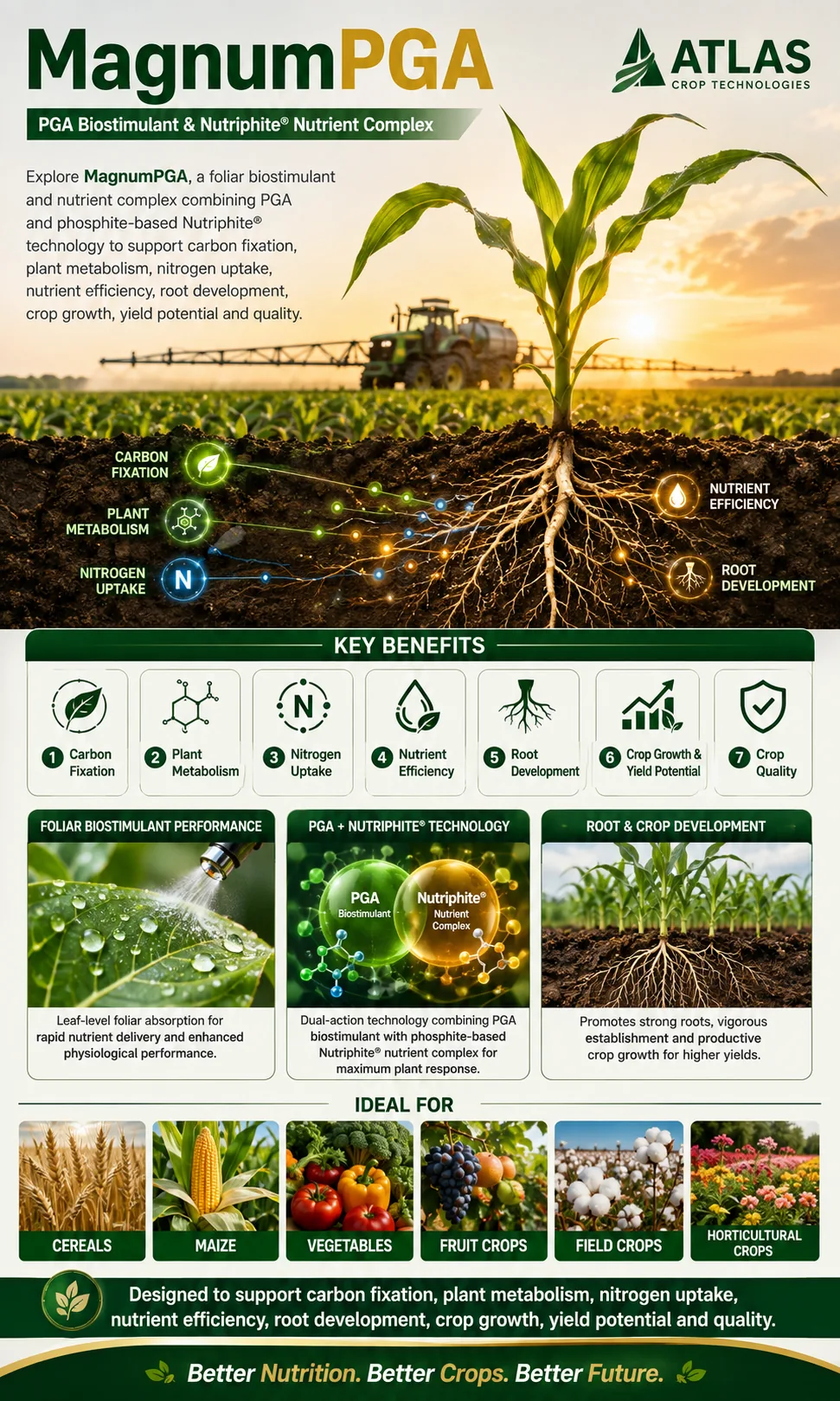
MagnumPGA
A foliar biostimulant and nutrient complex combining two manufacturer-described biostimulant technologies to support carbon fixation, plant metabolism, nitrogen uptake, nutrient efficiency, root development, crop growth, yield potential and quality.
Verdesian positions MagnumPGA around patented PGA biostimulant activity together with stabilized phosphite technology. Current manufacturer information reports up to 48% greater nitrogen efficiency or uptake 21 days after application, up to 30% greater carbon fixation / sequestration, and proven root-mass enhancement.
Manufacturer performance figures describe reported responses and are not guaranteed in every crop or environment. Exact MagnumPGA rates, crops, timings, formulation and registration must follow the current approved local label.
Linking carbon metabolism with nutrient-use efficiency
Crop growth depends on two fundamental resource streams: carbon captured through photosynthesis and mineral nutrition acquired primarily from the root environment.
MagnumPGA is positioned by Verdesian at the intersection of these processes.
The manufacturer describes its PGA technology as increasing carbon fixation and plant metabolism while simultaneously increasing nitrogen uptake and nitrogen metabolism.
A second technology component stabilises phosphite in the spray solution, creating a dual-biostimulant platform intended to support productive above- and below-ground crop development.
Current manufacturer profile
Two technologies · complementary physiological objectives
Current Verdesian information describes MagnumPGA as combining two proven biostimulant technologies.
PGA biostimulant
Verdesian describes patented PGA as increasing carbon fixation and accelerating plant metabolism.
The manufacturer links this response with greater nitrogen uptake and nitrogen metabolism.
Stabilized phosphite
MagnumPGA contains a manufacturer-described patented stabiliser intended to prevent phosphite oxidation in the spray tank.
Verdesian states that stabilisation allows the phosphite component to reach the crop for utilisation.
Stimulating carbon fixation and metabolism
Carbon dioxide fixed during photosynthesis supplies the carbon skeletons from which plants build carbohydrates, amino acids, proteins, lipids and structural biomass.
Verdesian describes PGA as a patented biostimulant that increases carbon fixation and accelerates plant metabolism.
The manufacturer then links this increased metabolic activity with greater nitrogen uptake and nitrogen metabolism.
PGA positioning
Up to 30% greater carbon fixation / sequestration
Current Verdesian product information reports that MagnumPGA's PGA technology can increase carbon sequestration by up to 30%.
The same manufacturer material describes increased CO₂ fixation as part of the product's mode of action.
This supports MagnumPGA's positioning around crop metabolism rather than merely supplying an additional nutrient quantity.
Physiological carbon response ≠ guaranteed field carbon credit
The “up to 30%” value should be understood within Verdesian's product positioning and supporting trials. It should not automatically be interpreted as a permanent field-scale soil-carbon increase, greenhouse-gas inventory value or verified carbon-credit outcome.
Why carbon fixation matters to crop productivity
CO₂ enters leaves
Atmospheric carbon dioxide diffuses into photosynthetically active tissues through stomata.
Photosynthesis captures carbon
Light energy is used to fix inorganic carbon into organic compounds.
Sugars are produced
Fixed carbon contributes to carbohydrates that supply energy and structural building blocks.
Carbon supports roots
Photosynthate is transported below ground to sustain active root growth.
Carbon supports N assimilation
Nitrogen must be incorporated into carbon skeletons during amino-acid and protein synthesis.
Carbon becomes yield
Grain, fruit, tubers, roots, fibre and vegetative biomass are all fundamentally built from assimilated carbon.
Up to 48% greater nitrogen uptake / efficiency
Current Verdesian information reports an increase in nitrogen efficiency of up to 48% at 21 days following MagnumPGA application.
The manufacturer also describes PGA as increasing plant nitrogen uptake by up to 48%.
This product-specific figure should be distinguished from a guaranteed 48% increase under every field condition.
“Up to” describes observed maximum response
Crop response depends on crop species, baseline nitrogen status, soil supply, fertiliser program, water, weather, application timing, rate and overall crop health.
Carbon and nitrogen metabolism are tightly connected
Nitrogen becomes available
Nitrogen enters the crop system from fertiliser, mineralisation, biological sources or irrigation water.
Roots absorb nitrogen
Plants primarily acquire inorganic nitrogen as nitrate and ammonium.
Nitrogen is assimilated
Absorbed nitrogen enters enzymatic pathways that convert it toward amino-acid synthesis.
Carbon skeletons are required
Photosynthetically derived carbon compounds provide frameworks into which nitrogen is incorporated.
Proteins are built
Amino acids form enzymes, structural proteins and other essential compounds.
Growth results
Coordinated carbon and nitrogen metabolism supports productive new crop tissue.
Nitrogen uptake is not the same as biological N₂ fixation
Manufacturer material uses language indicating that MagnumPGA helps plants “take on and fix more nitrogen.”
In general agronomy, the term biological nitrogen fixation has a specific meaning: conversion of atmospheric N₂ by organisms possessing nitrogenase, such as compatible rhizobia in legume nodules.
For non-leguminous crops, MagnumPGA's relevant positioning is better understood as increased nitrogen uptake, assimilation and metabolism.
Avoid overstating the mechanism
Proven root-mass enhancement in manufacturer positioning
Current Verdesian information lists proven root-mass enhancement among MagnumPGA's key benefits.
A larger root system can potentially expose the crop to a greater volume of soil and increase contact with water and nutrient reserves.
Root quantity alone is not the whole story: rooting depth, branching, root hairs, physiological activity and absence of disease all contribute to effective resource capture.
More active roots can support
Patented stabiliser technology
Verdesian states that MagnumPGA contains a patented stabiliser designed to keep phosphite from oxidising in the spray tank.
The manufacturer describes this as maintaining the phosphite in its intended form from tank preparation through plant delivery.
“100% reaches the plant” positioning
This is manufacturer product wording. Real-world deposition and uptake can additionally be influenced by spray coverage, runoff, drift, weather, water quality, canopy architecture and application technique.
Phosphite and phosphate are different
Phosphite is a reduced phosphorus form that differs chemically from phosphate, the conventional phosphorus form used directly in core plant phosphorus nutrition.
These forms should not be treated as agronomically interchangeable.
MagnumPGA's phosphite component is part of its specific biostimulant technology positioning rather than a reason to abandon sound phosphate fertility.
Maintain conventional phosphate nutrition
Base phosphorus management on soil testing, crop requirement, realistic yield target, field history, placement and locally validated recommendations.
Agricultural and horticultural crop programs
Current Verdesian information broadly positions MagnumPGA for agricultural and horticultural crops. Exact crop registration and application directions must be confirmed locally.
Cereals
Carbon assimilation, rooting and nitrogen metabolism are central to establishment, canopy expansion and grain formation.
Maize
High biomass production requires coordinated photosynthesis, nitrogen uptake, rooting and water supply.
Oilseeds
Productive canopy development and reproductive growth depend on balanced carbon and nutrient metabolism.
Pulses
Rooting and mineral nutrition complement biological nitrogen fixation and reproductive development.
Vegetables
Intensive vegetable systems often combine rapid biomass production with exacting nutrient and quality requirements.
Fruit & Perennial Crops
Perennial plants coordinate current photosynthesis with stored carbohydrates and nutrient reserves across seasons.
Follow the current local MagnumPGA label
The current Verdesian Europe product page does not publish one universal litres-per-hectare rate.
Instead, current manufacturer guidance directs users to the product label for application rates.
This is important because suitable rate can vary with crop, formulation, local registration and timing.
Do not transfer rates from related products
Use only the rate shown on the current MagnumPGA label supplied in your country.
Current manufacturer concentration guidance
≤ 2%
Current Verdesian guidance states that MagnumPGA should be applied at a solution concentration no greater than 2% when used alone.
Manufacturer example: 2 L in 100 L water.
≤ 1%
When applying MagnumPGA together with another product at low water volume, Verdesian specifies a solution concentration no greater than 1%.
Manufacturer example: 1 L in 100 L water.
A concentration limit controls the proportion of MagnumPGA in the final spray liquid. It does not independently authorise a particular L/ha dose. The current local label still controls the hectare rate.
Understanding spray concentration
These examples explain percentage calculations only. They are not MagnumPGA rate recommendations.
1 L in 100 L
Approximately a 1% volume concentration.
2 L in 100 L
Approximately a 2% volume concentration and the current manufacturer example for the maximum concentration when MagnumPGA is used alone.
1 L in 200 L
Approximately a 0.5% volume concentration.
Standard crop sprayers
Current Verdesian guidance states that MagnumPGA can be applied through standard crop sprayers.
Accurate calibration remains essential because both product rate and final solution concentration must be controlled.
Check before filling
Preparing the MagnumPGA spray solution
Half-fill with water
Begin with approximately half of the final required spray volume.
Start agitation
Ensure the tank agitation system is operating.
Add MagnumPGA
Measure and add the current label-approved product quantity.
Mix well
Allow adequate circulation for uniform dispersion.
Complete filling
Add remaining water to achieve the intended final tank volume.
Maintain agitation
Verdesian instructs users to continue agitation during spraying and while the tank is standing until empty.
Spray immediately
Current manufacturer guidance directs users to spray immediately after mixing.
Manufacturer describes broad compatibility
Current Verdesian information states that MagnumPGA is compatible with most agrochemical and plant-nutrition products.
This should not be interpreted as universal compatibility with every formulation, rate, crop, water source or adjuvant.
All tank-mix partner labels remain controlling.
Add MagnumPGA last
Avoid direct contact between concentrated tank-mix products during the mixing process.
Add MagnumPGA as the final product in the tank.
Why concentrate-to-concentrate contact is avoided
Agricultural products are formulated for dilution into a carrier, usually water.
Direct contact between concentrated formulations can create temporary zones of extreme pH, ionic strength or ingredient concentration.
These conditions may increase risk of precipitation, gel formation, flocculation or other physical incompatibility.
Dilute sequentially
Physical compatibility testing
Where labels allow a proposed mixture but practical compatibility is uncertain, a proportional jar test using the actual spray water can help identify gross physical incompatibility before filling a large tank.
Reproduce the intended mixing sequence and relative concentrations.
Warning signs
Spray water is part of the formulation in the tank
Water can influence pesticide and foliar-nutrient mixtures through pH, hardness, alkalinity, salinity and dissolved mineral content.
Complex mixtures deserve particular attention because interactions among water and multiple formulations can differ from each product used separately.
Check when appropriate
Getting the spray onto active plant tissue
Deposition
Droplets must first reach the intended crop canopy.
Retention
Spray must remain on plant surfaces rather than drift, bounce or run off.
Hydration
Extremely rapid evaporation can shorten contact between the formulation and leaf surface.
Penetration
Formulation properties, cuticle condition and environmental conditions influence foliar movement.
Translocation
Compounds absorbed into tissues may move according to their chemical and physiological properties.
Metabolic response
Final crop response depends on physiological status and resource availability.
Weather influences foliar performance
High temperature
Heat can accelerate droplet drying and increase crop stress.
Low humidity
Very dry air can shorten the hydrated period of spray deposits.
Wind
Excess wind can reduce deposition and increase off-target movement.
Rain
Rain after treatment can reduce retained spray before adequate uptake.
Severe drought stress
Severely wilted crops may absorb and respond differently from actively growing plants.
Crop stage
Physiological demand and canopy architecture change throughout development.
Growth depends on coordinated biochemical activity
Plant metabolism integrates photosynthesis, respiration, nutrient assimilation, protein synthesis, hormone signalling and transport.
Increasing the rate of one metabolic pathway is useful only when other required resources are also available.
MagnumPGA is therefore best positioned within a balanced crop system rather than as a substitute for missing fertility, water or crop protection.
Productive growth still requires
Higher nitrogen efficiency does not eliminate crop N demand
MagnumPGA's manufacturer positioning includes increased nitrogen uptake and nitrogen efficiency.
That does not mean nitrogen fertiliser can automatically be reduced by the same percentage as a reported physiological response.
Nitrogen recommendations should continue to account for crop demand, realistic yield potential, soil mineralisation, organic inputs, previous crop and expected fertiliser recovery.
Manage the complete nitrogen pathway
Maintain an appropriate phosphate program
Phosphorus is required for energy transfer, membranes, genetic material, root growth and multiple metabolic pathways.
MagnumPGA's stabilized phosphite technology does not remove these conventional phosphate-nutrition requirements.
Consider
Increased metabolism can expose other nutrient limitations
Phosphorus
Required for energy transfer and root development.
Potassium
Supports water regulation, transport and enzyme activation.
Sulphur
Required for sulphur-containing amino acids and interacts closely with nitrogen metabolism.
Magnesium
Central to chlorophyll and numerous enzymatic reactions.
Micronutrients
Zinc, manganese, boron, iron, copper and molybdenum support specialised metabolic functions.
Water
Water is essential for photosynthesis, transport, cell expansion and nutrient movement.
Root-mass enhancement still depends on a viable soil environment
A biostimulant cannot physically remove a compacted layer, drain a saturated field or correct severe salinity.
Root-zone constraints should be diagnosed separately so MagnumPGA is not expected to compensate for an unresolved physical or chemical problem.
Diagnose
Nutrient availability is strongly influenced by soil pH
Strongly alkaline or acidic soil conditions can reduce availability of particular nutrients regardless of root quantity.
Soil pH also influences microbial activity and root function.
MagnumPGA therefore complements rather than replaces appropriate soil pH management.
Include in diagnosis
Metabolism responds to environment
Photosynthesis, nutrient uptake and growth all change under heat, drought, cold, salinity and waterlogging.
Balanced nutrition can prevent nutrient deficiency from adding to environmental stress, but a biostimulant should not be presented as eliminating major abiotic constraints without a specific approved claim.
Where possible
Understand the limiting factor before changing the program
Soil analysis
Establish nutrient supply, soil pH, salinity and root-zone chemistry.
Tissue analysis
Measure nutrients actually present in crop tissue.
Root inspection
Examine rooting depth, branching, disease and physical restriction.
Canopy assessment
Evaluate plant population, leaf area, colour and crop uniformity.
Water status
Determine whether drought or saturation is constraining metabolism.
Fertility history
Review nitrogen, phosphorus, potassium, manure, lime and previous crop.
Measure nutrient status inside the crop
Tissue analysis complements soil testing by measuring the nutrient concentration present in plant material.
It can help identify whether a nutrient is being acquired effectively and provide objective context for foliar nutrition decisions.
Follow crop-specific protocols
Measure physiological claims under your own production conditions
Root mass
Carefully excavate representative plants and compare root-system development.
Tissue nitrogen
Crop-stage-appropriate tissue testing can provide context on nitrogen status.
Canopy growth
Measure plant height, leaf area, biomass or other relevant crop metrics.
Photosynthetic indicators
Where research resources permit, physiological measurements may provide insight into carbon-assimilation responses.
Yield
Use properly designed treated and untreated comparisons whenever practical.
Quality
Measure crop-specific market traits such as protein, size, dry matter, sugars or marketable grade.
Separate product response from normal field variability
Field variability can be larger than the expected response from a foliar treatment.
Replicated strips, consistent agronomy and accurate yield measurement make on-farm evaluations much more informative than a single treated area compared with a distant untreated area.
Record
Genetic potential is realised through the whole production system
Verdesian positions MagnumPGA around maximising yield and quality and helping crops reach their genetic potential.
Genetic yield potential, however, can only be expressed when nutrition, water, light, rooting and crop protection are collectively adequate.
Crop-specific evaluation may include
MagnumPGA belongs inside a complete fertility strategy
Biostimulants are most useful when combined with technically sound nutrient management.
The goal is to improve use of available nutrients—not replace essential nutrient supply with metabolism alone.
Right source · rate · time · place
Current manufacturer-listed pack
Pack configuration may vary by country or future commercial format.
Confirm registration locally
The presence of MagnumPGA on Verdesian's European product portfolio does not establish identical registration in every EMEA country.
Confirm local formulation, label, crop uses, rates and commercial availability before recommendation or sale.
Maintain product quality from warehouse to sprayer
Original container
Maintain product identity, lot information and manufacturer labelling.
Follow storage guidance
Use the current label and SDS for temperature and storage requirements.
Prevent contamination
Use clean pumps, measuring devices and transfer equipment.
Use suitable PPE
Follow the Safety Data Sheet and applicable workplace requirements.
Manage spills
Contain and dispose of spills according to the SDS and local regulations.
Keep application records
Record product lot, field, rate, tank mix, weather and application date.
Avoid common MagnumPGA program mistakes
Inventing a universal L/ha rate
The current European page directs users to the MagnumPGA label for rates.
Confusing concentration with hectare dose
The 1% and 2% manufacturer limits describe final spray concentration.
Exceeding concentration guidance
Current manufacturer guidance states ≤2% alone and ≤1% at low water volumes with another product.
Adding MagnumPGA too early
Current manufacturer guidance says to add MagnumPGA last.
Allowing concentrates to mix directly
Dilute products through carrier water rather than combining undiluted concentrates.
Stopping agitation
Maintain agitation during spraying and while standing until the tank is empty.
Storing mixed spray
Current manufacturer guidance says to spray immediately after mixing.
Treating phosphite as phosphate
Maintain conventional crop phosphorus nutrition.
Using the 48% figure as an N credit
A manufacturer-reported physiological response is not a universal fertiliser-rate reduction.
Calling nitrogen uptake “biological N fixation”
Use precise terminology unless atmospheric N₂ fixation has specifically been demonstrated.
Treating the carbon claim as a carbon credit
Physiological carbon fixation is not automatically equivalent to verified permanent field carbon sequestration.
Ignoring root-zone limitations
Severe compaction, waterlogging, salinity and disease still require direct management.
Information that helps us evaluate a MagnumPGA program
Country
Determines local registration, rate and label.
Crop
Include species, variety and production system.
Growth stage
Foliar timing should correspond with crop physiology and local directions.
Primary objective
Carbon metabolism, N uptake, root mass, crop growth, yield or quality.
Current local rate
Provide the proposed label-approved MagnumPGA rate.
Water volume
Required to verify final spray concentration.
Tank-mix partners
List pesticides, foliar nutrients and adjuvants.
Water quality
Include pH and hardness where available.
Nitrogen program
Important when nitrogen-use efficiency is the main objective.
Phosphorus program
Confirms that conventional phosphate requirements remain addressed.
Soil / tissue data
Provides context on baseline fertility and plant nutrient status.
Crop area
Supports product-volume and commercial planning.
MagnumPGA product profile
Explore related technologies
MicroSync Pro®
A granular micronutrient fertiliser designed for blending with NPK programs to deliver broad-acre micronutrient nutrition.
View Product → InoculantN-Charge®
A premium peat legume inoculant formulated to support seed adhesion, nodulation and biological nitrogen fixation.
View Product → InoculantN-Take™
A liquid soybean and pulse inoculant developed to support nodulation, biological nitrogen fixation, nitrogen uptake and root growth.
View Product →Integrate MagnumPGA into a complete crop-nutrition strategy
Tell us your country, crop, growth stage, local label rate, nitrogen and phosphorus program, spray-water volume, water quality, proposed tank-mix partners, soil or tissue analysis and technical objective. Atlas Crop Technologies can help evaluate MagnumPGA's fit within your foliar and nutrient-use-efficiency program.
Frequently Asked Questions
Manufacturer-specific answers are identified as such. General explanations provide agronomic context. Always follow the current approved local MagnumPGA label.
MagnumPGA is a foliar biostimulant and nutrient complex that Verdesian describes as combining two proven biostimulant technologies to support plant metabolism, nutrient uptake, nitrogen efficiency, root development, growth, yield potential and crop quality.
Current Verdesian information describes MagnumPGA as containing two proven biostimulant technologies.
Verdesian describes PGA in MagnumPGA as a patented biostimulant that increases carbon fixation and plant metabolism and links those responses with increased nitrogen uptake and metabolism.
Current manufacturer information states that the PGA component increases CO₂ fixation and reports an increase in carbon sequestration or fixation of up to 30%.
No. It is a manufacturer-reported response and should not be interpreted as a guaranteed result in every crop or field.
Not automatically. A physiological increase in carbon fixation is not equivalent to verified permanent field-scale carbon sequestration under a carbon-accounting protocol.
Verdesian reports increased nitrogen efficiency of up to 48% at 21 days following application.
Current manufacturer information describes PGA as increasing nitrogen uptake by up to 48%.
No. The figure is a manufacturer-reported maximum response and should not be expected universally.
No automatic 48% nitrogen-rate reduction should be made from the reported physiological response. Nitrogen rate should remain based on crop demand, soil supply and validated local agronomy.
That should not be assumed. Manufacturer wording regarding increased nitrogen fixation is better interpreted for non-leguminous crops as increased nitrogen uptake, assimilation or metabolism unless true atmospheric N₂ fixation has been specifically demonstrated.
Current Verdesian information lists proven root-mass enhancement as a key MagnumPGA benefit.
A larger active root system can explore more soil and create additional opportunities to acquire water and nutrients.
Verdesian states that MagnumPGA contains a patented stabiliser that prevents phosphite oxidation in the spray tank.
Verdesian states that its stabiliser means 100% of the phosphite reaches the plant for utilisation. This is manufacturer wording; real-world spray deposition can also be affected by application quality, weather, drift and runoff.
No. Phosphite and phosphate differ chemically and should not be treated as interchangeable phosphorus sources.
No automatic substitution should be made. Maintain an agronomically appropriate conventional phosphate-fertiliser program.
Current Verdesian Europe positioning broadly references agricultural and horticultural crops. Exact crop approval must follow the current local label.
The current European manufacturer page directs users to the product label for application rates. Do not assume a rate from another Magnum or Nutriphite® product.
Because the current official MagnumPGA page itself directs users to the product label. Rates can differ by crop, country, formulation and registration.
Current manufacturer guidance specifies a final solution concentration no greater than 2%, with 2 L in 100 L water as an example.
Current Verdesian guidance specifies no more than a 1% final solution concentration, with 1 L in 100 L water provided as an example.
No. Concentration describes product proportion in the final spray solution; application rate describes the quantity applied per hectare. Both must comply with the label.
Current manufacturer instructions say to half-fill the sprayer, begin agitation, add MagnumPGA, mix well, finish filling, maintain agitation and spray immediately after mixing.
Yes. Current Verdesian instructions state that agitation should continue during spraying and while standing until the tank is emptied.
Current manufacturer guidance directs users to spray immediately after mixing rather than storing the prepared tank.
Verdesian states that it is compatible with most agrochemical and plant-nutrition products. Exact tank mixes must still comply with all current labels and technical guidance.
Current manufacturer guidance states that MagnumPGA should be added as the final product.
Direct concentrate contact can create locally extreme chemical conditions and increase physical incompatibility risk.
Where labels permit a mixture, a proportional jar test can help identify gross physical incompatibility. It does not prove crop safety or biological compatibility.
Yes. pH, hardness, alkalinity and dissolved salts can influence complex agricultural tank mixtures.
Current manufacturer guidance states that standard crop sprayers can be used.
Follow current label restrictions and avoid conditions likely to compromise deposition or crop safety, including excessive wind and severe heat stress.
No. Root-mass enhancement cannot physically remove a compacted soil layer.
No. Significant soil-pH problems should be corrected through appropriate soil-management practices.
Yes where appropriate. Soil and plant analysis provide objective context on nutrient supply and crop nutrient status.
Use replicated or well-designed treated and untreated comparisons where practical and evaluate root mass, tissue nutrients, canopy growth, yield and crop-specific quality metrics.
No. Verdesian positions the product toward maximising yield and quality potential, but actual yield remains dependent on the entire crop-production system.
The current Verdesian Europe product page lists a 10 L pack.
No universal registration should be assumed. Confirm the current formulation, registration, crops, rates and claims locally.
Include country, crop, growth stage, local label rate, water volume, tank-mix partners, water quality, nitrogen and phosphorus programs, soil or tissue data and your primary agronomic objective.
Include company, country, target crops, annual crop area, estimated product requirement, season and distribution structure.
Current Verdesian Europe information identifies MagnumPGA as a foliar formulation containing two manufacturer-described proven biostimulant technologies and positions it for agricultural and horticultural crops.
The manufacturer lists increased nutrient uptake, increased nitrogen efficiency and root-mass enhancement among MagnumPGA's benefits.
Verdesian reports up to a 48% increase in nitrogen efficiency or uptake at 21 days following application. This is a manufacturer-reported response rather than a guaranteed increase under every crop, soil, weather or management condition.
The manufacturer describes patented PGA technology as increasing carbon fixation and plant metabolism and reports up to a 30% increase in carbon sequestration / fixation. This is manufacturer product positioning and should not automatically be interpreted as verified permanent field-scale soil-carbon sequestration or a carbon-credit claim.
Manufacturer material also uses wording indicating that the plant “fixes” more nitrogen. In scientific agronomy, biological nitrogen fixation normally refers specifically to microbial conversion of atmospheric N₂. For crops without a demonstrated N₂-fixing mechanism, MagnumPGA is more appropriately discussed in terms of increased nitrogen uptake, assimilation and metabolism.
Verdesian states that MagnumPGA contains a patented stabiliser that prevents phosphite oxidation in the spray tank and states that 100% of the phosphite reaches the plant for utilisation. This is manufacturer wording. Actual spray deposition can additionally be influenced by nozzle setup, canopy interception, drift, runoff, weather and application technique.
Phosphite and phosphate are chemically different phosphorus forms. MagnumPGA should not automatically replace conventional phosphate fertiliser required to satisfy crop phosphorus nutrition.
The current Verdesian Europe page does not publish a universal MagnumPGA L/ha rate and instead directs users to the product label. Rates from Magnum, Magnum S, Nutri-Phite PGA or other related products should not be transferred to MagnumPGA without current label support.
Current manufacturer guidance specifies a maximum final solution concentration of 2% when MagnumPGA is used alone and 1% when used with another product at low water volumes. Manufacturer examples are 2 L in 100 L water and 1 L in 100 L water respectively.
Final solution concentration is not the same as product rate per hectare. Both parameters must comply with the current local label.
Current mixing guidance states that MagnumPGA should be added to a half-filled tank with agitation operating, mixed thoroughly, diluted to final volume, continuously agitated and sprayed immediately.
Verdesian states that MagnumPGA is compatible with most agrochemical and plant-nutrition products. Concentrated products should not directly contact one another during tank preparation, and the manufacturer instructs users to add MagnumPGA as the final product.
All partner-product labels remain controlling. Physical compatibility does not establish crop safety, legal use or biological compatibility.
Current manufacturer information lists standard crop sprayers as the application equipment and a 10 L pack.
MagnumPGA complements rather than replaces balanced fertiliser programs, nitrogen supply, conventional phosphate nutrition, potassium, sulphur, micronutrients, irrigation, drainage, soil-pH correction, root-zone management and crop protection.
Formulation, registration, rates, crops, timings, pack sizes and approved claims can vary by jurisdiction.
Always read and follow the current approved local MagnumPGA label and Safety Data Sheet. Consult a qualified agronomist, crop adviser or Atlas Crop Technologies representative for crop-specific rate, concentration, timing, tank-mix compatibility and program integration.