Magnum S
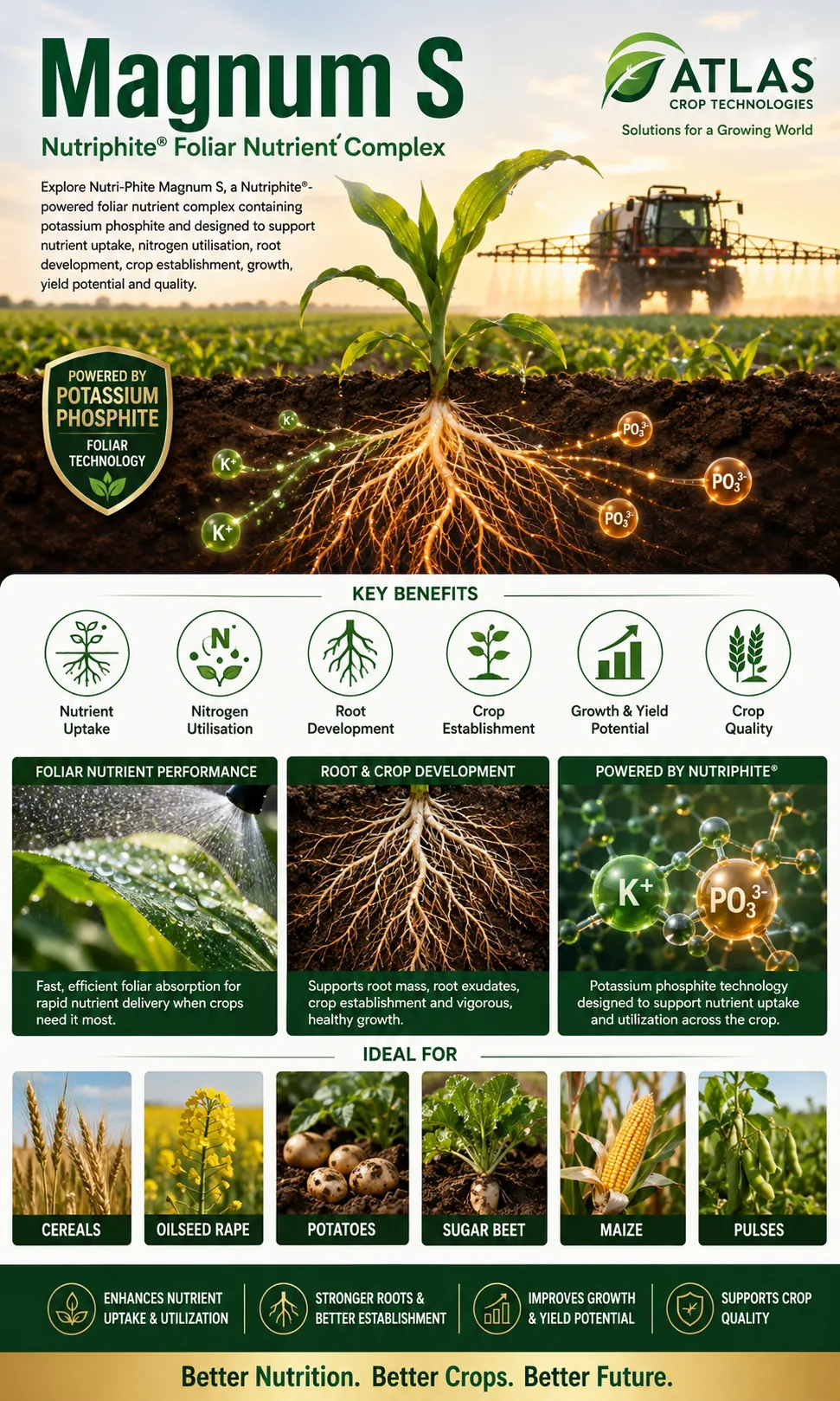
Nutri-Phite Magnum S is a foliar nutrient complex powered by Nutriphite® technology and containing potassium phosphite, developed to support nutrient uptake, nutrient synthesis and utilisation, root development, nitrogen metabolism, crop establishment, productive growth and quality.
Current Verdesian information associates Magnum S with increased nitrate-reductase production, increased root mass, a greater root surface-area-to-volume ratio and enhanced root-exudate production, positioning these responses as part of a more efficient nutrient-acquisition system.
Rates, crops, timings, guaranteed analysis, tank-mix compatibility, registration and pack configuration can differ by market. Always follow the current approved local Magnum S label.
A foliar nutrient-efficiency tool focused on roots and metabolism
Fertiliser performance depends on more than the quantity of nutrient applied to the field. Nutrients must remain accessible, reach active roots or leaves, enter plant tissue and then be assimilated into productive metabolism.
Magnum S is positioned within this nutrient-use-efficiency process.
Current manufacturer information describes the product as supporting nutrient uptake, synthesis and utilisation and links that physiology with improved establishment, growth, yield potential and quality.
It should be integrated with—not substituted for—an agronomically sound soil-fertility, nitrogen, phosphorus, water and crop-protection program.
Current manufacturer profile
Crop programs currently identified by Verdesian Europe
These crops are listed on the current European Magnum S product page. Local registration and crop-specific directions still take precedence.
Cereals
Foliar nutrient-efficiency strategies can support rooting, vegetative growth and nitrogen metabolism through major cereal development stages.
Oilseed Rape
Root establishment, nitrogen utilisation and balanced nutrition contribute to canopy development and reproductive potential.
Potatoes
Root and stolon development, nutrient capture and canopy activity influence tuber initiation, bulking and crop quality.
Sugar Beet
Early root establishment and efficient canopy nutrition support development of the harvestable storage root.
Maize
Strong early rooting and efficient nitrogen capture are major components of productive maize systems.
Pulses
Root development and balanced nutrition work alongside biological nitrogen fixation in well-managed pulse crops.
Confirm the Magnum S label supplied for your country before application.
Powered by Nutriphite®
Verdesian identifies Magnum S as part of its Nutriphite® crop nutrition platform.
The platform uses phosphite-containing nutrient technology designed around plant nutrient response and nutrient-use efficiency.
For Magnum S specifically, the manufacturer's current mechanism focuses on potassium phosphite, nitrate-reductase production, root development and root-exudate production.
Foliar application · below-ground response
Potassium phosphite
Current Verdesian Europe information states that Magnum S contains potassium phosphite.
Phosphite contains phosphorus in a different oxidation state from conventional phosphate fertilisers.
As a result, phosphite and phosphate should not be treated as nutritionally interchangeable.
Phosphite is not a direct substitute for phosphate
Magnum S should not automatically replace conventional phosphate fertiliser required to meet crop phosphorus demand. Base phosphorus applications on soil testing, crop requirement, yield target, field history and local recommendations.
Nitrate reductase · up to 10%
Verdesian states that studies at Nottingham and Kiel Universities showed potassium phosphite increasing production of the key enzyme nitrate reductase by up to 10%.
The manufacturer uses this research to explain part of Magnum S's nutrient-utilisation positioning.
The cited “up to 10%” response is not a guaranteed increase under every crop, rate, environment or management system.
Why nitrate reductase matters
Many crops absorb a substantial portion of their nitrogen as nitrate.
Before nitrate-derived nitrogen can be incorporated into amino acids and proteins, nitrate must undergo biochemical reduction.
Nitrate reductase catalyses an important early step in that assimilation pathway.
From applied nitrogen to plant protein
Nitrogen supply
Nitrogen first enters the production system through fertiliser, mineralisation, irrigation water or biological sources.
Root availability
Nitrogen must remain in the active root zone and in plant-available forms.
Root uptake
Plants commonly absorb nitrogen as nitrate and ammonium.
Nitrate reduction
Nitrate reductase participates in conversion of absorbed nitrate toward more reduced nitrogen forms.
Assimilation
Nitrogen enters amino-acid synthesis and related metabolic pathways.
Productive use
Nitrogen is incorporated into proteins, chlorophyll, enzymes and new crop tissue.
More root surface can expand resource capture
Current manufacturer information links Magnum S with increased root mass and increased root surface-area-to-volume ratio.
Verdesian positions that larger root system as increasing physical contact with soil water and improving the opportunity for nutrient uptake.
In general agronomic terms, more active root length and surface area can improve soil exploration when environmental conditions permit.
Roots do more than anchor the crop
Root exudates shape the root-soil interface
Plants release a wide range of compounds from living roots into the rhizosphere, including sugars, amino acids and organic acids.
These root exudates can influence microorganisms, mineral surfaces, local pH and nutrient chemistry immediately around roots.
Root exudation is therefore part of the way plants actively interact with their soil environment.
Magnum S increases root-exudate production
Verdesian states that Magnum S boosts production of root exudates.
The manufacturer describes this as helping make soil nutrition more available for effective plant uptake.
Root exudates do not create nutrient reserves. Nutrients still need to be present in the soil or fertiliser program, and availability remains influenced by pH, moisture, mineralogy, microbial activity and root condition.
0.3–1.5 litres per hectare
Current Verdesian Europe guidance states that Nutri-Phite Magnum S should be applied at rates from:
The correct rate within this range depends on crop, timing, intended objective and current label directions.
Do not choose rate by product concentration alone
The label rate per hectare and the concentration of the final spray solution describe two different aspects of application.
Both must be correct.
Current manufacturer concentration limits
≤ 2% solution
Current Verdesian guidance states that Magnum S should be applied at a solution concentration no greater than 2% when used alone.
Manufacturer example: 2 L in 100 L water.
≤ 1% solution
If Magnum S is applied with another product at low water volumes, Verdesian states that the solution concentration should not exceed 1%.
Manufacturer example: 1 L in 100 L water.
The final Magnum S dose must still remain within the crop-specific, label-approved rate. Adjust carrier water rather than exceeding product rate or concentration restrictions.
Understanding rate and spray concentration
The examples below illustrate calculation principles only. They are not crop recommendations.
1.0 L/ha in 100 L/ha
1.0 litre in 100 litres final spray volume is approximately a 1% volume concentration.
1.0 L/ha in 200 L/ha
1.0 litre in 200 litres final spray volume is approximately a 0.5% volume concentration.
1.5 L/ha in 100 L/ha
1.5 litres in 100 litres final spray volume is approximately a 1.5% solution, potentially within the manufacturer concentration ceiling when Magnum S is used alone, subject to the label.
Standard crop sprayers
Current Verdesian guidance states that Nutri-Phite Magnum S can be applied through standard crop sprayers using current best practices.
Application quality depends on correct sprayer setup, nozzle condition, calibration, travel speed and canopy coverage.
Before loading the tank
Recommended Magnum S tank preparation
Half-fill the tank
Begin with approximately half of the required spray-water volume.
Start agitation
Ensure the agitation system is operating before adding Magnum S.
Add required product
Measure the label-approved Magnum S quantity accurately.
Mix thoroughly
Allow sufficient circulation for even distribution in the carrier water.
Complete filling
Fill the tank to the required final water volume.
Maintain agitation
Verdesian recommends continuous agitation during spraying and while the sprayer is standing until the tank is emptied.
Spray immediately
Current manufacturer guidance says to spray immediately after mixing.
Manufacturer states compatibility with most common inputs
Current Verdesian information describes Magnum S as compatible with most agrochemical and plant-nutrition products.
This broad manufacturer statement should still be checked against the exact current Magnum S label, all tank-mix partner labels and local crop restrictions.
Add Magnum S last
When using Magnum S in a tank mixture, do not allow concentrated products to contact one another directly during mixing.
Add Nutri-Phite Magnum S as the final product.
Why concentrate-to-concentrate contact matters
Agricultural formulations are designed to disperse or dissolve at their intended use concentration.
Directly combining undiluted concentrates can create temporary local conditions of extremely high ionic strength, extreme pH or high ingredient concentration.
This can contribute to precipitation, gel formation or other physical incompatibility that may not occur once products are properly diluted.
Dilute through the carrier water
Consider a compatibility jar test
If all product labels permit a mixture but physical compatibility is uncertain, a small-scale compatibility test can help identify obvious problems before preparing a full spray tank.
Use the actual spray water and reproduce the intended relative concentrations and mixing sequence.
Signs of physical incompatibility
Water is an active part of the mixture
Spray water can influence the physical and chemical behaviour of foliar nutrient and crop-protection mixtures.
Water pH, hardness, alkalinity, salinity and suspended material may all be relevant when complex tank mixtures are prepared.
Check where tank-mix complexity warrants it
Product rate is only one part of a successful spray
Coverage
Spray droplets must reach enough of the intended canopy to create useful contact with plant surfaces.
Retention
Droplets must remain on leaves rather than bounce, drift or run off.
Drying time
Extremely rapid evaporation can shorten the hydrated contact period.
Crop condition
Actively growing plants may respond differently from severely wilted or damaged crops.
Canopy architecture
Leaf angle and canopy density influence spray penetration and interception.
Sprayer setup
Nozzle choice, pressure, speed and carrier volume all affect deposition.
Apply under crop-safe spraying conditions
High temperature
Heat can accelerate droplet evaporation and increase stress on the crop.
Low humidity
Very dry air can shorten droplet hydration and foliar contact time.
Wind
Excessive wind can reduce canopy deposition and increase off-target movement.
Rainfall
Rain soon after application may reduce retention before uptake occurs.
Severe drought stress
A severely wilted crop may respond differently to foliar treatment.
Frost or cold stress
Apply within label restrictions and avoid unnecessary application to physiologically compromised crops.
How a larger root system can influence crop nutrition
Root interception
Growing roots encounter nutrients directly as they enter previously unexplored soil.
Diffusion
Nutrients including phosphorus and potassium can move short distances toward roots along concentration gradients.
Mass flow
Dissolved nutrients move toward roots with water drawn by crop transpiration.
Root hairs
Fine root structures greatly increase the active soil-root interface.
Rhizosphere
Root-associated chemistry and microorganisms influence nutrient cycling.
Root depth
Deeper rooting can expand the volume of soil explored for water and nutrients.
Supporting nitrogen utilisation does not create nitrogen
Magnum S is positioned around nitrogen utilisation through its manufacturer-described relationship with nitrate reductase.
That positioning should not be interpreted as an automatic reason to reduce an otherwise agronomically justified nitrogen rate.
Total nitrogen supply should continue to be matched to crop demand, soil mineralisation, previous crop, organic inputs and realistic yield potential.
Manage every step
Maintain adequate phosphate fertility
Crops require phosphorus for ATP-driven energy transfer, nucleic acids, membranes, root development and multiple metabolic processes.
These core crop needs are normally managed through phosphate nutrition based on soil testing and crop demand.
Magnum S's potassium-phosphite technology should complement rather than automatically replace that base phosphorus strategy.
Build the P program from agronomy
No metabolic pathway operates on one nutrient alone
Phosphorus
Supports energy transfer, rooting and metabolism.
Potassium
Supports water regulation, enzyme function and transport processes.
Sulphur
Required for sulphur-containing amino acids and closely linked with nitrogen use.
Magnesium
Essential to chlorophyll and multiple enzyme systems.
Molybdenum
Relevant to enzymes involved in nitrogen metabolism.
Micronutrients
Zinc, manganese, boron, iron, copper and other micronutrients support specialised metabolic functions.
Root growth cannot fully overcome unsuitable soil chemistry
Soil pH strongly influences nutrient availability.
High-pH soils can restrict availability of phosphorus, zinc, manganese and iron, while very acidic soils create other nutrient imbalances and toxicity risks.
Magnum S should therefore complement appropriate soil-pH management.
Evaluate the root environment
Magnum S cannot replace correction of major physical problems
Compaction
Mechanically restricted soil can prevent roots from reaching deeper resources.
Waterlogging
Oxygen limitation can reduce root respiration and nutrient uptake.
Drought
Severe water limitation restricts root growth and nutrient movement.
Salinity
High soluble salts can reduce water acquisition and root growth.
Root disease
Pathogens can reduce functional root surface and nutrient uptake.
Cold soil
Low root-zone temperature can slow growth and nutrient acquisition.
Cereals
Cereal yield formation depends on establishment, tillering, productive shoot survival, canopy development, flowering and grain fill.
Rooting and nitrogen acquisition are particularly important during vegetative expansion and stem extension.
Magnum S is currently listed by Verdesian for cereals, but exact timing and rate must follow the crop-specific local label.
Review alongside
Oilseed rape
Oilseed rape produces substantial vegetative biomass and requires well-developed roots to support water and nutrient capture.
Nitrogen and sulphur management are central components of productive oilseed systems, alongside boron and other micronutrients where deficient.
Consider
Potatoes
Potato productivity depends on rapid canopy establishment together with healthy root and stolon development.
Nutrient supply must support the transition from vegetative growth into tuber initiation and bulking without creating excessive late vegetative growth.
Relevant measures may include
Sugar beet
Sugar beet must develop both an effective photosynthetic canopy and a large storage root.
Nutrient balance is important because excessive or poorly timed nitrogen can favour foliage rather than desired root quality late in the season.
Evaluate
Maize
Maize develops substantial nitrogen demand during rapid vegetative growth.
Root architecture, soil temperature, water supply, phosphorus and zinc availability can all influence early establishment and later nutrient capture.
Review Magnum S alongside
Pulses
Pulse crops combine mineral nutrient uptake with biological nitrogen fixation when compatible rhizobia form effective nodules.
Root development, phosphorus, potassium, sulphur and micronutrients remain important even when biological fixation supplies much of the crop's nitrogen.
Consider
Determine whether nutrition is actually limiting performance
Soil testing
Establish root-zone pH, nutrient status, salinity and other fertility conditions.
Tissue analysis
Measure the nutrients currently present in crop tissue at a defined stage.
Root inspection
Examine rooting depth, branching, disease and physical restriction.
Canopy assessment
Review plant population, vigour, chlorosis and spatial symptom patterns.
Water status
Drought or waterlogging can mimic or intensify nutrient problems.
Field history
Fertiliser, manure, lime, crop rotation and yield history provide important context.
Measure crop nutrient status directly
Soil analysis measures aspects of nutrient supply; tissue analysis measures nutrient concentration in the plant.
Tissue testing can help determine whether root-zone nutrients are actually entering the crop and can support foliar-program decisions.
Follow crop-specific protocols
Nutrient technology works within biological limits
Crop growth, foliar absorption and root nutrient uptake can all be affected by drought, heat, cold, salinity and waterlogging.
Maintaining balanced nutrition can help avoid adding nutrient deficiency to an already stressed crop.
Magnum S should not be presented as eliminating severe abiotic stress unless a specific local approved claim supports that positioning.
Correct underlying constraints where possible
Measure the response rather than relying on appearance alone
Root mass
Carefully excavate representative plants and compare root-system size and architecture.
Tissue nutrients
Repeat crop-stage-appropriate tissue analysis where useful.
Canopy development
Record plant height, biomass or other crop-appropriate growth metrics.
Yield components
Measure crop-specific components before final harvest where relevant.
Final yield
Use properly designed treated and untreated comparisons whenever possible.
Quality
Evaluate protein, dry matter, size, sugar, marketable grade or other crop-specific metrics.
Magnum S complements 4R nutrient management
Nutrient-use-efficiency products perform best when the underlying fertiliser program is technically sound.
The 4R framework—right source, rate, time and place—remains a useful foundation for both soil and foliar nutrition.
Integrate the complete program
Current manufacturer-listed pack size
Pack size may vary if different commercial or regional configurations are introduced.
Germany-specific documentation currently listed
Verdesian's current European label and SDS library includes Nutri-Phite® Magnum S documentation for Germany.
Protect formulation quality before application
Use original container
Maintain product identity and manufacturer labelling.
Follow storage temperature
Refer to the current product label and SDS for specific requirements.
Prevent contamination
Use clean measuring, pumping and transfer equipment.
Use appropriate PPE
Follow SDS and local occupational-safety requirements.
Manage spills
Contain and dispose of spilled product according to the SDS and local environmental requirements.
Maintain traceability
Record product lot, application date, field, rate and tank-mix partners.
Avoid common Magnum S application mistakes
Using phosphite as a phosphate replacement
Maintain an appropriate conventional crop phosphorus program.
Exceeding 1.5 L/ha
The current European manufacturer range is 0.3–1.5 L/ha. Always follow the local label.
Confusing concentration with rate
A 1% or 2% spray concentration does not independently determine the allowed product dose per hectare.
Exceeding concentration limits
Current manufacturer guidance states ≤2% alone and ≤1% in low-water-volume mixtures with another product.
Adding Magnum S too early
Current Verdesian compatibility guidance says to add Magnum S last.
Allowing concentrates to contact directly
Add products through carrier water rather than mixing undiluted concentrates together.
Stopping agitation
Maintain agitation during application and while the tank is standing.
Leaving mixed spray in the tank
Current manufacturer guidance says to spray immediately after mixing.
Automatically reducing nitrogen
Improved nitrogen utilisation does not justify an unvalidated reduction in nitrogen fertiliser rate.
Ignoring water quality
Water chemistry can influence complex spray mixtures.
Spraying under severe stress
Heat, drought or damaged foliage can affect crop response and spray safety.
Assuming universal registration
Verify Magnum S's current registration and permitted crops in the target market.
Information that helps us evaluate a Magnum S program
Country
Determines current registration, formulation and label requirements.
Crop
Identify cereal, oilseed rape, potato, sugar beet, maize, pulse or other locally registered crop.
Growth stage
Foliar timing should align with crop physiology and the local label.
Objective
Rooting, establishment, nutrient uptake, nitrogen utilisation, yield or quality.
Proposed rate
Provide intended Magnum S litres per hectare.
Water volume
Needed to calculate final spray concentration.
Tank-mix partners
List pesticides, foliar nutrients and adjuvants.
Water quality
Provide pH, hardness or other analysis where known.
Nitrogen program
Relevant where nitrogen utilisation is a primary agronomic objective.
Phosphorus program
Helps ensure phosphite is not being treated as a substitute for conventional phosphorus nutrition.
Soil / tissue data
Provides objective nutrient-status information.
Crop area
Supports commercial volume and logistical planning.
Magnum S product profile
Explore related technologies
MagnumPGA
A biostimulant nutrient complex intended to support plant metabolism, nutrient uptake and productive crop growth.
View Product → BroadcastMicroSync Pro®
A granular micronutrient fertiliser designed for blending with NPK programs to deliver broad-acre micronutrient nutrition.
View Product → InoculantN-Charge®
A premium peat legume inoculant formulated to support seed adhesion, nodulation and biological nitrogen fixation.
View Product →Build a technically sound Magnum S foliar program
Tell us your country, crop, growth stage, application rate, spray water volume, tank-mix partners, nitrogen and phosphorus program, soil or tissue analysis and technical objective. Atlas Crop Technologies can help evaluate Magnum S's fit within your crop nutrition program.
Frequently Asked Questions
Product-specific information below reflects current manufacturer guidance where identified. General explanations provide agronomic context. The current approved local label always takes precedence.
Nutri-Phite Magnum S is a Nutriphite®-powered foliar nutrient complex containing potassium phosphite and positioned by Verdesian to support nutrient uptake, synthesis and utilisation, root development, establishment, growth, yield and quality.
Nutriphite® is Verdesian's phosphite-based crop-nutrition technology platform. Magnum S is currently identified as being powered by Nutriphite®.
Yes. Current Verdesian Europe information states that Magnum S contains potassium phosphite.
No. They are chemically different phosphorus forms and have different behaviour in crop nutrition.
No automatic replacement should be assumed. Maintain the crop's conventional phosphorus program according to soil testing and crop requirements.
The current European product page lists cereals, oilseed rape, potatoes, sugar beet, maize and pulses. Local crop registration must still be confirmed.
Current Verdesian Europe guidance lists 0.3–1.5 L/ha. The exact crop rate and timing must follow the local label.
Current manufacturer guidance states a maximum solution concentration of 2%, with 2 L in 100 L water given as an example. The hectare rate must still remain within label limits.
If applying with another product at low water volume, current Verdesian guidance states a maximum 1% solution concentration, with 1 L in 100 L water given as an example.
No. Concentration describes the percentage of product in the final spray solution; L/ha describes how much product reaches one hectare. Both must comply with the label.
Half-fill the sprayer with water, begin agitation, add the required product, mix thoroughly, complete filling, maintain agitation and spray immediately after mixing, following current manufacturer instructions.
Current Verdesian guidance says Magnum S should be added as the final product in the mixture.
Direct concentrate contact can create temporarily extreme local chemistry and increase physical incompatibility risk. Current Verdesian guidance specifically says concentrates should not come directly into contact while mixing.
Verdesian states that it is compatible with most agrochemical and plant-nutrition products. The exact combination must still comply with all current labels.
Potentially, subject to current labels, product formulation, final concentration, water chemistry and mixing sequence.
Yes. Current manufacturer instructions state that agitation should continue during spraying and while the tank is standing until it is emptied.
Current Verdesian guidance says to spray immediately after mixing. Follow the current label rather than storing mixed spray.
Verdesian states that Magnum S can be applied through standard crop sprayers using current best practices.
Verdesian cites Nottingham and Kiel University studies in which potassium phosphite increased nitrate-reductase production by up to 10%.
No. It is a manufacturer-cited research finding and not a guaranteed response under all field conditions.
Nitrate reductase is a plant enzyme involved in the early steps of nitrate assimilation before nitrate-derived nitrogen can ultimately be incorporated into amino acids and proteins.
Current manufacturer information associates Magnum S with increased root mass and greater root surface-area-to-volume ratio.
Greater root surface can increase physical contact with soil water and create more opportunities for nutrient uptake.
Root exudates are compounds released by roots into the rhizosphere that can influence microbes and local nutrient chemistry.
Current manufacturer information states that Magnum S increases root-exudate production.
No. Nutrients must already be present in soil or fertiliser. Exudates may influence processes affecting nutrient availability.
No. Supporting nitrogen utilisation does not create nitrogen or remove the crop's nitrogen requirement.
Do not make an automatic nitrogen reduction. Any rate adjustment should be supported by locally validated agronomy, crop need and the current label.
Yes. Water pH, hardness, alkalinity and dissolved minerals can influence complex foliar mixtures.
If labels permit a new mixture but its physical compatibility is uncertain, a jar test can identify gross incompatibility. It does not prove crop safety or biological compatibility.
Follow label restrictions and apply under conditions supporting good deposition and crop safety. Avoid excessive wind, extreme heat and unnecessary application to severely stressed crops.
No. A root-development product cannot mechanically remove a compacted soil layer.
No. Correct substantial soil-pH problems through suitable soil management.
Tissue analysis can provide useful information on crop nutrient status and help place foliar nutrition within a diagnostic program.
Where practical, compare treated and untreated areas and evaluate root development, tissue nutrients, crop growth, yield and crop-specific quality measurements.
Current Verdesian Europe information lists a 10 L pack.
Do not assume so. Verdesian's current document library specifically lists Magnum S documentation for Germany. Registration elsewhere should be confirmed market by market.
No universal availability should be assumed. Registration, formulation, crop uses and approved claims can vary.
Include country, crop, growth stage, rate, spray-water volume, tank-mix partners, water quality, fertility program, soil or tissue data and your primary agronomic objective.
Include company, country, target crops, annual hectare potential, expected volume, season and distribution structure.
Current Verdesian Europe information identifies Nutri-Phite Magnum S as a Nutriphite®-powered foliar nutrient complex containing potassium phosphite and positions it around nutrient uptake, synthesis, utilisation and root development.
Current manufacturer information lists cereals, oilseed rape, potatoes, sugar beet, maize and pulses. Crop registration and legal use must nevertheless be verified on the current local label.
Current European manufacturer guidance lists an application rate of 0.3–1.5 L/ha.
When applied alone, current manufacturer guidance specifies a final solution concentration of no more than 2%, with 2 L product in 100 L water provided as an example. When applied with another product at low water volume, Magnum S should be used at a final solution concentration of no more than 1%, with 1 L product in 100 L water provided as the manufacturer example.
Spray concentration and product rate per hectare are different parameters. Both must comply with the current label.
Current mixing instructions state that Magnum S should be added to a half-filled tank with agitation running, mixed thoroughly, diluted to final tank volume, continuously agitated and sprayed immediately after mixing.
Verdesian states that Magnum S is compatible with most agrochemical and plant-nutrition products. However, concentrated products should not directly contact one another during mixing, and current manufacturer instructions say to add Magnum S as the final product in the mixture.
Product labels for every tank-mix partner remain authoritative. Physical compatibility does not automatically prove crop safety, biological compatibility or pesticide efficacy.
Verdesian cites Nottingham and Kiel University studies in which potassium phosphite increased production of nitrate reductase by up to 10%. This is a manufacturer-cited research result rather than a guaranteed field response.
The manufacturer also associates Magnum S with increased root mass, greater root surface-area-to-volume ratio and increased root-exudate production. These statements describe manufacturer product positioning, not guaranteed responses under all conditions.
Nitrate-reductase activity does not create nitrogen. Magnum S should not automatically be used to reduce crop nitrogen fertiliser rates.
Phosphite and phosphate are chemically different. Magnum S should not automatically replace conventional phosphate fertiliser required for crop phosphorus nutrition.
Current Verdesian Europe information lists a 10 L pack, and the company's current label/SDS library identifies Germany-specific Magnum S documentation. This does not establish registration in every European, Middle Eastern or African country.
Foliar performance depends on product rate, final spray concentration, water volume, canopy coverage, crop stage, weather, water quality, tank-mix chemistry and crop physiological condition.
Magnum S complements rather than replaces balanced soil fertility, nitrogen and phosphate management, soil-pH correction, irrigation, drainage, root-health management and crop protection.
Product formulation, guaranteed analysis, rates, timing, crops, registration, pack size and permitted claims may vary by country.
Always read and follow the current approved local Magnum S label and Safety Data Sheet. Consult a qualified agronomist, crop adviser or Atlas Crop Technologies representative for crop-specific rate, concentration, timing, compatibility and program integration.