Nutri-Phite® PGA
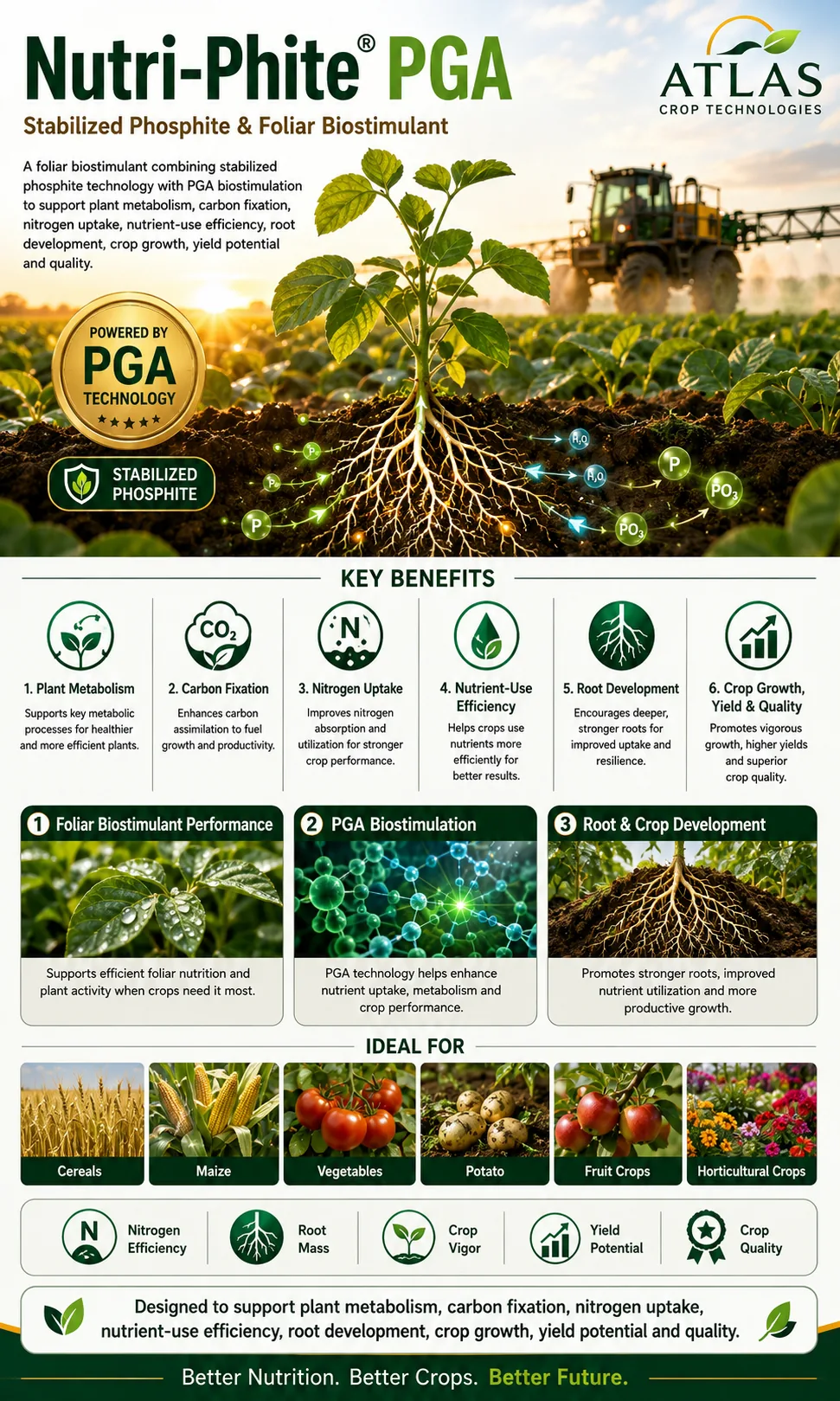
A foliar biostimulant combining stabilized phosphite technology with PGA biostimulation to support plant metabolism, carbon fixation, nitrogen uptake, nutrient-use efficiency, root development, productive crop growth and final crop quality.
Nutri-Phite® PGA is positioned around two complementary concepts: stabilized phosphite for reliable foliar delivery and a patented PGA biostimulant that the manufacturer associates with increased CO₂ fixation, faster plant metabolism and greater nitrogen uptake and metabolism.
Registration, formulation, analysis, crop uses, rate, timing, number of applications, compatibility and claims may vary by market. Always read and follow the current approved local label.
Linking foliar nutrition with whole-plant metabolism
Crop performance depends not only on how much nutrition is supplied to the field, but also on the plant's ability to absorb, transport, assimilate and use that nutrition efficiently.
Nutri-Phite® PGA is designed as a foliar technology that operates within this broader nutrient-efficiency system.
Manufacturer positioning combines stabilized phosphite with PGA biostimulation to support nutrient uptake, nitrogen efficiency, carbon fixation, plant metabolism, root development and crop growth.
The result is a product positioned not simply as a conventional foliar fertiliser, but as a technology intended to influence how actively the crop captures and processes available nutrition.
Technical positioning
Stabilized phosphite + PGA biostimulation
Current Verdesian positioning combines two distinct technology concepts within the Nutri-Phite® PGA product.
Stabilized phosphite
Phosphite is a reactive phosphorus-containing form. In tank mixtures, unstable phosphite can interact with other dissolved elements and undergo oxidation or undesirable reactions.
Verdesian describes Nutri-Phite® as using patented stabilization technology that helps keep phosphite stable in solution.
Current Nutri-Phite® PGA information states that stabilized phosphite is designed to avoid oxidation in the spray tank so the intended phosphite reaches the crop for utilization.
PGA biostimulation
Current manufacturer information describes PGA as a patented biostimulant that increases carbon fixation and boosts plant metabolism.
Verdesian links this metabolic response with increased nitrogen uptake and nitrogen metabolism.
PGA is therefore positioned around the crop's physiological use of resources rather than only around adding another mineral nutrient.
Phosphite is not the same as phosphate
Phosphite and phosphate are related phosphorus-containing chemical forms, but they are not identical.
Phosphate is the conventional form used in crop phosphorus fertilisation and central plant phosphorus metabolism.
Phosphite has a different oxidation state and different chemical behaviour. It is generally more reactive and should not automatically be treated as a direct replacement for conventional phosphate nutrition.
Nutri-Phite® PGA should therefore be integrated alongside — rather than assumed to replace — the crop's agronomically required phosphorus fertiliser program.
Maintain the base phosphorus program
Phosphorus recommendations should remain based on soil analysis, crop demand, nutrient removal, yield target, fertiliser source, placement and locally appropriate agronomic guidance.
Why solution stability matters
Foliar tank mixtures frequently contain several dissolved nutrients, crop-protection products and water containing calcium, magnesium or other ions.
Verdesian states that generic, unstabilized phosphites can react with cations such as zinc, iron, manganese and calcium.
The Nutri-Phite® technology uses proprietary stabilization to help keep phosphite in solution and reduce unwanted oxidation or reaction before it reaches plant tissue.
Tank stability supports consistent application
Carbon fixation and crop growth
Carbon fixation is the process through which photosynthetic plants convert atmospheric carbon dioxide into organic carbon compounds.
Those carbon compounds provide the structural and metabolic foundation for new leaves, roots, stems, reproductive tissues and storage products.
Current Verdesian information associates the PGA component of Nutri-Phite® PGA with increased CO₂ fixation.
The manufacturer positions this increase in carbon assimilation as part of the mechanism supporting faster plant metabolism.
Plant growth requires both carbon and mineral nutrition
Nitrogen metabolism and carbon metabolism are tightly connected within plant growth.
Carbon skeletons generated from photosynthesis are required for synthesis of amino acids and many other nitrogen-containing compounds.
A crop must therefore coordinate carbon capture with nitrogen uptake and assimilation rather than treating either process independently.
From available nitrogen to productive plant growth
Nitrogen-use efficiency requires more than simply applying nitrogen.
Nitrogen must be supplied
The crop first requires an adequate nitrogen source from soil, fertiliser, organic matter, biological fixation or irrigation water.
Nitrogen must remain available
Nitrogen availability depends on nitrogen form, soil processes, moisture, temperature, timing and loss pathways.
Roots must capture it
Active roots absorb nitrate and ammonium from the root-zone environment.
Nitrogen must be transported
Absorbed nitrogen moves to tissues where metabolic demand is present.
Nitrogen must be assimilated
Mineral nitrogen is converted into amino acids, proteins and other nitrogen-containing compounds.
Growth must utilise it
Efficient crop growth requires nitrogen metabolism to remain coordinated with photosynthesis, water supply and other nutrients.
More root surface means more opportunity to access resources
Manufacturer information links Nutri-Phite® PGA with increased root mass and a larger root surface-area-to-volume relationship.
Greater soil exploration
A larger root system can explore a greater volume of soil and potentially encounter more nutrient-rich microsites.
Increased water contact
Greater root surface can increase contact with soil water that carries dissolved nutrients toward active roots.
Improved nutrient interception
Expanding roots create additional locations at which nutrient uptake can occur.
Better establishment
Strong root development provides a physical and physiological foundation for later canopy growth.
Root exudates and nutrient interaction
Roots release a range of carbon-containing compounds into the narrow soil zone immediately surrounding the root.
These root exudates may include organic acids, sugars, amino acids and other metabolites.
They can influence nutrient chemistry, microbial activity and interactions between soil minerals and plant roots.
Increased root exudation
Current Verdesian information states that Nutri-Phite® PGA increases root-exudate production.
The manufacturer positions these exudates as helping make nutrition in the root environment more accessible for plant uptake.
Soil or fertiliser nutrients must still be present. Nutrient availability is also influenced by soil pH, moisture, mineralogy, biological activity and root health.
Designed for whole-plant nutrient efficiency
Plant Metabolism
Manufacturer positioning associates the PGA component with faster plant metabolism and increased carbon fixation.
Nitrogen Uptake
Nutri-Phite® PGA is positioned to help crops take up and utilise more nitrogen from the nutrition already available to them.
Nutrient-Use Efficiency
Greater root activity and plant metabolism can improve the opportunity to convert available nutrients into productive biomass.
Root Development
Manufacturer information associates the product with larger root mass and increased root-zone interaction.
Crop Growth
Verdesian positions Nutri-Phite® PGA to help crops grow faster and stronger as part of a complete agronomic program.
Yield & Quality Potential
The manufacturer positions the product toward maximizing final yield and quality potential, although field response remains dependent on the entire production system.
Broad agricultural and horticultural fit
Current Verdesian Europe information positions Nutri-Phite® PGA for agricultural and horticultural crops. Local labels determine the exact registered crop list.
Cereals
Foliar metabolic and nutrient-efficiency strategies may be integrated around key vegetative or reproductive stages where locally registered.
Oilseed crops
Nitrogen and photosynthetic efficiency are important in crops developing substantial biomass and reproductive demand.
Maize and field crops
Root expansion and efficient nitrogen capture are important as canopy development accelerates.
Potatoes
Nutrient-management strategies may be coordinated with canopy, root and tuber development according to crop-stage recommendations.
Vegetables
Intensive vegetable production frequently requires close coordination of nitrogen, micronutrients, irrigation and foliar programs.
Orchard crops
Perennial fruit systems can integrate foliar nutrient-efficiency technologies at crop-specific phenological stages.
Vine crops
Grapes and other vine crops require balanced canopy development, reproductive nutrition and root-zone management.
Protected horticulture
High-value protected systems often use detailed tissue analysis, irrigation management and precisely timed foliar nutrition.
Broad manufacturer positioning does not establish legal use on every crop in every country. Confirm the current local Nutri-Phite® PGA label before application.
Foliar delivery through standard crop sprayers
Current manufacturer guidance states that Nutri-Phite® PGA can be applied through standard crop sprayers.
Foliar application allows the technology to be delivered directly to active above-ground plant surfaces during selected stages of crop development.
Appropriate nozzle selection, pressure, carrier volume, crop canopy, weather and application speed all contribute to spray coverage.
Application quality matters
Spray-solution concentration
Current Verdesian European instructions provide specific concentration limits for the spray solution.
The manufacturer illustrates 2% as 2 litres in 100 litres of water and 1% as 1 litre in 100 litres of water.
Concentration is not the same as hectare rate
Crop-specific Nutri-Phite® PGA application rates must come from the current local label. The concentration guidance describes how concentrated the spray solution should be, not the agronomic dose for every crop.
Current manufacturer-recommended mixing sequence
Start with a clean sprayer
Confirm the tank, lines, filters and nozzles are clean and suitable for the intended crop application.
Half-fill the tank
Manufacturer instructions specify beginning with the sprayer tank approximately half-filled.
Start agitation
Activate the agitation system before adding Nutri-Phite® PGA.
Add the required amount
Measure the crop- and label-specific Nutri-Phite® PGA quantity accurately.
Mix and fill
Mix thoroughly, then continue filling the sprayer to the required final volume.
Maintain agitation
Manufacturer instructions state that agitation should continue during spraying and while the sprayer is standing.
Spray immediately
Verdesian recommends spraying immediately after preparing the mixture.
Designed for practical tank-mix programs
Current Verdesian Europe information describes Nutri-Phite® PGA as compatible with most agrochemical and plant-nutrition products.
The broader Nutri-Phite stabilization technology is specifically positioned to reduce undesirable phosphite reactions with cations found in many micronutrient solutions.
Compatibility with most products does not mean universal compatibility with every formulation, concentration or water source.
Add Nutri-Phite® PGA last
Water chemistry is part of the formulation in the tank
Carrier water can affect foliar applications through pH, hardness, bicarbonates, dissolved salts and interactions with tank-mix ingredients.
Stabilized phosphite technology is designed to improve reliability in the presence of common dissolved cations, but water quality should still be considered when preparing a complex spray mixture.
Review where relevant
Avoid unnecessary extremes in spray-solution chemistry
The broader Nutri-Phite product line is designed around stabilized phosphite chemistry, but individual tank-mix partners can still influence solution pH and compatibility.
Verdesian's general Nutri-Phite guidance cautions against certain products or adjuvants that strongly reduce spray-solution pH.
For Nutri-Phite® PGA, always use the product-specific current label rather than assuming that instructions for another Nutri-Phite formulation automatically apply.
Verify before application
Align application with crop physiology
Exact registered timings must come from the local label. The stages below illustrate the agronomic logic commonly used when considering metabolic and nutrient-efficiency foliar products.
Early vegetative growth
Root and canopy development establish the crop's capacity to capture light, water and nutrients later in the season.
Rapid biomass development
Accelerating canopy growth increases demand for nitrogen, photosynthetic carbon and supporting mineral nutrition.
Pre-reproductive development
Maintaining efficient crop metabolism before flowering or reproductive transition can support later yield components.
Yield-building stages
Certain registered programs may integrate foliar nutrient technologies during reproductive development to support continued nutrient utilization.
Weather and canopy conditions influence spray performance
Temperature
Extreme heat can shorten droplet life, increase evaporation and increase crop-safety concerns for concentrated foliar mixtures.
Relative humidity
Humidity influences drying time and the period during which spray deposits remain hydrated on the leaf.
Wind
Excessive wind reduces spray accuracy and can increase off-target movement.
Rainfall
Rain shortly after application may remove or dilute foliar deposits before sufficient interaction with the crop occurs.
Crop condition
Severely wilted, heat-stressed or damaged crops may not respond to foliar treatments in the same manner as actively growing plants.
Canopy coverage
Nozzle choice, pressure, travel speed and carrier volume should provide appropriate coverage for the crop canopy.
Greater nitrogen efficiency does not eliminate nitrogen requirement
Nutri-Phite® PGA is positioned to help the crop acquire and metabolise nitrogen more efficiently.
It does not create nitrogen where the production system is deficient and should not automatically be used as justification to reduce the crop's agronomically required nitrogen supply.
Nitrogen rate should remain based on crop demand, soil supply, realistic yield target, previous crop, organic sources, irrigation water and local recommendations.
Consider the whole nitrogen pathway
Metabolism requires more than nitrogen
Nitrogen metabolism interacts with phosphorus, potassium, sulphur, magnesium and multiple micronutrients.
Increasing crop metabolic activity cannot overcome a severe deficiency in another essential nutrient.
Nutri-Phite® PGA should therefore be integrated into a complete fertility program rather than used as a substitute for balanced nutrition.
Review the complete program
Metabolism changes under environmental stress
Drought, heat, cold, salinity, waterlogging and other stresses can reduce photosynthesis, root activity, nutrient uptake and crop growth.
Maintaining adequate nutrition can help prevent nutrient deficiency from compounding an environmental problem.
A biostimulant should not, however, be described as eliminating severe abiotic stress unless such a claim is specifically supported by the applicable local registration.
Address the underlying limitation
Identify the true limitation before changing the program
Soil analysis
Soil testing can identify nutrient supply, pH, salinity and other root-zone characteristics.
Plant analysis
Tissue analysis provides a snapshot of plant nutrient status at a defined growth stage.
Root inspection
Root architecture, disease, compaction and waterlogging can reveal nutrient-uptake constraints that foliar application alone cannot solve.
Spatial patterns
Field patterns associated with soil type, drainage or irrigation can help separate nutritional symptoms from other stresses.
Tissue analysis can sharpen foliar decisions
Tissue testing can be particularly useful when planning foliar nutrition because it assesses the crop rather than only the soil.
Representative sampling can help identify whether nitrogen or micronutrient status is adequate before a major developmental stage.
Results should be interpreted using crop-specific sampling protocols and growth-stage standards.
Good data requires consistent sampling
Measuring the response to Nutri-Phite® PGA
Root development
Carefully excavated plants can be compared for root distribution, branching and overall root mass.
Tissue nutrient status
Representative tissue analysis may provide context on nitrogen and mineral nutrient uptake.
Biomass
Crop height, canopy development and biomass can be useful intermediate measurements where appropriate.
Yield components
Crop-specific yield components can indicate whether early physiological differences persist into reproductive development.
Final yield
Use properly designed treated and untreated comparisons where practical rather than relying only on visual observations.
Quality
Depending on the crop, quality measurements may include size, solids, protein, maturity, colour, marketable yield or other commercially relevant parameters.
Nutri-Phite® PGA in intensive wheat management
Verdesian has historically highlighted the use of Nutri-Phite® PGA within an intensive nutrient-management program associated with a world-record wheat crop.
According to that manufacturer case study, an autumn Nutri-Phite® PGA application was used to promote rooting as part of a broader program that also included tissue-guided micronutrients, split nitrogen applications, crop protection and favourable soil moisture.
The case is useful as an illustration of integrated crop management, but it should not be interpreted as evidence that any one input alone produced the final yield.
High performance is a system outcome
Current manufacturer-listed pack size
Current Verdesian Europe information lists Nutri-Phite® PGA in a 10-litre pack.
Pack availability can differ between countries, distribution channels and product registrations.
Maintain product traceability
Protect product quality before application
Keep original identification
Retain the manufacturer container, label and lot information for product traceability.
Follow storage requirements
Use the current label and Safety Data Sheet for storage temperature and handling requirements.
Prevent contamination
Keep measuring and transfer equipment clean and avoid introducing foreign materials into the container.
Use appropriate PPE
Follow the Safety Data Sheet and local workplace requirements for personal protective equipment.
Manage spills correctly
Follow current label, SDS and local environmental procedures for containment and disposal.
Dispose responsibly
Container and residual-product disposal should follow applicable national and local regulations.
Avoid common program mistakes
Treating phosphite as phosphate fertiliser
Nutri-Phite® PGA should not automatically replace the crop's conventional phosphorus requirement.
Assuming nitrogen efficiency replaces nitrogen
A more efficient crop still requires an adequate nitrogen supply.
Exceeding spray concentration
Follow manufacturer concentration limits and the crop-specific label rate.
Mixing concentrates directly
Manufacturer instructions specifically caution against allowing tank-mix concentrates to contact each other before dilution.
Adding Nutri-Phite® PGA too early
Current manufacturer instructions specify adding Nutri-Phite® PGA as the final tank-mix product.
Stopping agitation
Current Verdesian instructions call for continued agitation during spraying and while the mixture is standing.
Storing mixed spray overnight
Manufacturer instructions state that the prepared spray should be applied immediately after mixing.
Using another country's rate
Crop registration, formulation and application rates may vary by market. Always use the current local label.
Information that helps us evaluate program fit
Detailed crop and spray-program information allows a more useful technical discussion.
Country
Determines local product registration, label, formulation and permitted claims.
Crop
Include crop, variety where relevant, production system and target yield.
Growth stage
Foliar timing should be matched to crop development and label directions.
Nitrogen program
Include total nitrogen rate, source, timing and current crop nitrogen strategy.
Soil analysis
Soil pH, phosphorus, potassium, salinity and other parameters provide important nutritional context.
Tissue analysis
Current plant-analysis data can help define the nutritional objective.
Spray volume
Carrier volume is essential for checking concentration and canopy coverage.
Tank-mix partners
Identify all pesticides, foliar nutrients, adjuvants and other products intended in the spray.
Water quality
Provide pH, hardness or other water information where available.
Nutri-Phite® PGA product profile
Explore related technologies
Combine foliar metabolic technologies with nitrogen-efficiency and complementary nutrient-management solutions according to crop requirements and local registration.
NutriSphere-N®
A nitrogen fertiliser enhancer for urea-based fertilisers, designed to keep more nitrogen available for crop uptake and reduce common nitrogen-loss pathways.
View Product → Liquid NitrogenNutriSphere-NL®
A nitrogen-management technology for liquid nitrogen fertilisers such as UAN, developed to improve nitrogen retention and nitrogen-use efficiency.
View Product → FoliarPhorce
A foliar nutrient complex positioned to support root development, nutrient uptake, nutrient utilization and overall crop quality.
View Product →Build Nutri-Phite® PGA into your foliar strategy
Tell us your country, crop, growth stage, nitrogen and nutrient program, spray volume, intended tank mix and technical or commercial objective. Atlas Crop Technologies can help evaluate how Nutri-Phite® PGA may fit your crop program.
Frequently Asked Questions
These answers combine current manufacturer information with general crop-nutrition context. The current approved local label remains the definitive source for product use.
Nutri-Phite® PGA is a foliar biostimulant combining stabilized phosphite technology with PGA biostimulation. Current manufacturer positioning includes nutrient uptake, nitrogen efficiency, plant metabolism, root development, crop growth, yield potential and quality.
Current Verdesian information describes PGA as a patented biostimulant that increases carbon fixation and boosts plant metabolism, leading to increased nitrogen uptake and nitrogen metabolism.
Phosphite is a phosphorus-containing chemical form that differs from conventional phosphate. Its chemical behaviour makes stabilization important in foliar nutrient formulations and tank mixes.
No. Phosphite and phosphate differ chemically and should not automatically be treated as equivalent phosphorus fertiliser sources. Maintain the crop's conventional phosphorus program according to soil testing and agronomic requirements.
Verdesian states that unstable phosphite can oxidise or react with dissolved cations such as zinc, iron, manganese and calcium. Nutri-Phite technology uses proprietary stabilization intended to keep phosphite more stable in solution.
Current Verdesian Europe information states that the PGA biostimulant increases CO₂ fixation. The manufacturer links this response with faster plant metabolism and increased nitrogen uptake.
Manufacturer positioning links PGA-driven carbon fixation and faster plant metabolism with greater nitrogen uptake and nitrogen metabolism. Actual response still depends on adequate nitrogen supply and growing conditions.
No. Increased nitrogen efficiency does not eliminate crop nitrogen requirement. Nitrogen recommendations should remain based on crop demand, soil supply and local agronomic guidance.
No universal replacement should be assumed. Phosphite is not the same as phosphate, and conventional phosphorus recommendations should continue to be based on soil testing and crop demand.
Current manufacturer information associates Nutri-Phite® PGA with increased root mass. A larger root system can create more contact with soil water and nutrients.
Root exudates are compounds released by active roots into the rhizosphere. They can influence soil microorganisms, nutrient chemistry and root-zone nutrient availability.
Yes, current manufacturer information states that Nutri-Phite® PGA increases root-exudate production and positions this response as helping make root-zone nutrition more accessible.
Verdesian Europe broadly positions Nutri-Phite® PGA for agricultural and horticultural crops. Exact registered crops must be confirmed on the current local product label.
Current Verdesian information identifies foliar application through standard crop sprayers. Use the current local label for crop-specific rates and timings.
The current manufacturer product page directs users to the label for crop-specific application rates. Do not use a rate taken from another market or another Nutri-Phite formulation.
Current European manufacturer instructions state that Nutri-Phite® PGA should be used at no more than a 2% spray concentration when applied alone. At low water volume with another product, the manufacturer states that concentration should not exceed 1%.
No. Spray concentration describes the ratio of product to spray solution. The actual crop dose per hectare must come from the crop-specific product label.
Current manufacturer instructions specify starting with the spray tank half-filled, running agitation, adding the required product quantity, mixing thoroughly, filling to final volume and maintaining agitation.
Yes. Verdesian instructs users to maintain agitation during spraying and while the sprayer is standing until the tank is emptied.
Yes. Current manufacturer instructions state that Nutri-Phite® PGA mixtures should be sprayed immediately after mixing.
Verdesian states that Nutri-Phite® PGA is compatible with most agrochemical and plant-nutrition products. The labels of every proposed tank-mix partner should still be checked.
Current manufacturer instructions state that Nutri-Phite® PGA should be added as the final product in the mixture.
No. Verdesian specifically advises that concentrates should not be allowed to come into direct contact during tank preparation. Products should be properly diluted into the spray water.
For a new and label-permitted mixture, a small physical compatibility test may help identify precipitation or separation. It does not prove crop safety or biological compatibility, so all labels must still be followed.
Yes. Water pH, hardness, bicarbonates, salinity and dissolved minerals can influence complex foliar mixtures. Stabilized phosphite technology is designed to improve reliability, but water quality should still be considered.
Current Verdesian Europe information lists a 10-litre pack for Nutri-Phite® PGA. Availability can differ by country.
No. Manufacturer positioning includes maximizing yield and quality potential, but final crop performance depends on genetics, soil, fertility, weather, water, pests, disease and overall agronomic management.
A biostimulant can form part of a crop-management program, but it should not be described as eliminating severe drought, waterlogging, heat, salinity, disease or other stresses unless the current local registration specifically supports such a claim.
Where practical, compare treated and untreated areas and monitor root development, tissue nutrient status, biomass, crop uniformity, yield components, final yield and relevant quality parameters.
No. Registration, crops, formulation, application rate, timing, claims and pack size may differ by country. Confirm local availability before sale or use.
Include your country, crop, variety where relevant, crop stage, nitrogen and fertility program, soil and tissue analysis if available, spray volume, water quality and proposed tank-mix partners.
Include your country, company, target crops, customer segment, anticipated annual requirement, season, distribution structure and technical-support requirements.
This page provides general product, plant-physiology and crop-nutrition information only.
Nutri-Phite® PGA formulation, guaranteed analysis, registration, approved crops, application rates, application timing, number of applications, tank-mix directions, spray concentration, pack size and permitted claims may vary by country.
Manufacturer statements relating to stabilized phosphite, carbon fixation, plant metabolism, nitrogen uptake, nitrogen metabolism, root mass, root exudation, crop growth, yield potential and crop quality describe the manufacturer's product positioning and should not be interpreted as guarantees of performance in an individual field.
Current European manufacturer guidance states that Nutri-Phite® PGA should be used at a spray-solution concentration no greater than 2% when applied alone and no greater than 1% when used with another product at low spray volumes. These concentration guidelines do not replace crop-specific label rates.
Current manufacturer instructions specify beginning with a half-filled spray tank, using continuous agitation, adding Nutri-Phite® PGA as the final tank-mix component, preventing direct contact between concentrated products and spraying immediately after preparation.
Phosphite and phosphate are chemically different phosphorus forms. Nutri-Phite® PGA should not automatically be considered a substitute for the crop's conventional phosphate-fertiliser requirement.
Likewise, improved nitrogen uptake or nitrogen-use efficiency should not automatically be interpreted as justification for reducing the crop's agronomically required nitrogen supply.
Crop response depends on nutrient supply, soil fertility, root development, water, temperature, crop genetics, growth stage, application quality, pests, disease and many other environmental and management factors.
Always read and follow the current approved local product label and Safety Data Sheet. Consult a qualified agronomist, crop adviser or Atlas Crop Technologies representative where crop-specific rates, timings, tank-mix compatibility, nutrient-program integration or local registration confirmation is required.