NutriSphere-N®
A nitrogen fertiliser enhancer for urea-based fertilisers, designed to keep more applied nitrogen within the productive crop system, improve nitrogen-use efficiency and reduce exposure to common nitrogen-loss pathways.
NutriSphere-N® is applied to nitrogen fertiliser before field use so the technology remains associated with the nutrient as it enters the soil. Current manufacturer positioning focuses on protecting fertiliser nitrogen, maintaining more nitrogen in crop-accessible forms and reducing nitrogen movement to the atmosphere and water.
Product registration, formulation, rate, approved fertiliser sources, claims, crops and regulatory classification can vary between countries. Always follow the current approved local label.
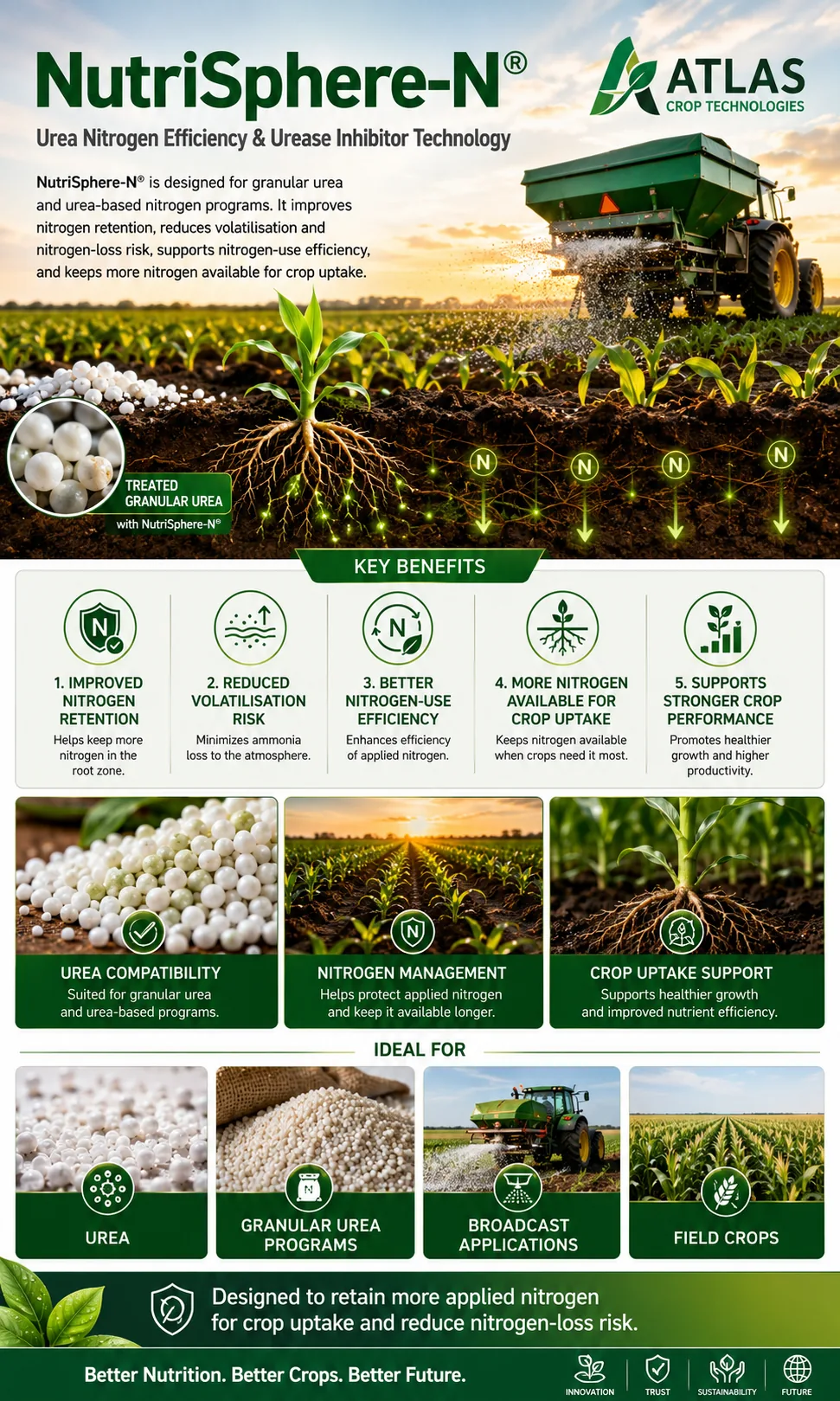
Protecting nitrogen before the crop can capture it
Nitrogen is essential for chlorophyll, amino acids, proteins, enzymes, nucleic acids and many of the metabolic processes that determine crop growth.
It is also one of agriculture's most dynamic nutrients. After fertiliser is applied, nitrogen may change chemical form rapidly, move through the soil profile or leave the crop-production system altogether.
NutriSphere-N® is designed to help growers manage this period between fertiliser application and crop uptake.
Current manufacturer information positions the technology for urea-based fertilisers and describes it as shielding nitrogen at a molecular level, inhibiting enzymatic processes and helping keep more nitrogen in the less-mobile ammonium form for longer.
Technical positioning
Why nitrogen efficiency matters
Applying nitrogen does not guarantee that every unit of fertiliser nitrogen will reach the crop.
Crop demand changes through the season
Nitrogen demand is often relatively modest during early establishment and increases rapidly during periods of canopy expansion and biomass accumulation.
Nitrogen continually changes form
Urea, ammonium and nitrate behave differently in soil and are exposed to different chemical, enzymatic and biological processes.
Environment changes loss risk
Rainfall, temperature, soil moisture, drying conditions and drainage can strongly influence nitrogen transformations and losses.
Uptake depends on active roots
Nitrogen retained in soil contributes to productivity only if crop roots and crop physiology can capture and utilise it.
Why urea requires nitrogen-management attention
Urea is a concentrated and widely used nitrogen fertiliser.
Once urea reaches moist soil or residue, naturally occurring urease enzymes catalyse its hydrolysis. This begins the conversion of urea nitrogen into ammonium forms.
During this process, conditions around the dissolving fertiliser can temporarily favour formation of ammonia.
When urea is surface applied and not sufficiently incorporated into soil, part of this nitrogen may escape into the atmosphere as ammonia gas.
Factors affecting urea performance
From granular urea to crop uptake
Urea is broadcast
Granular urea is applied according to the crop's nitrogen program.
Granules dissolve
Moisture dissolves the fertiliser and makes urea available to naturally occurring urease enzymes.
Urea hydrolysis occurs
Urease catalyses conversion of urea and eventually produces ammonium nitrogen.
Ammonium enters the soil N pool
Ammonium can be held on negatively charged soil exchange sites and absorbed by plant roots.
Nitrification produces nitrate
Soil microorganisms can convert ammonium through nitrite into nitrate.
Crop roots capture nitrogen
The nitrogen-management objective is to keep enough fertiliser nitrogen accessible for crop uptake before significant loss occurs.
Where fertiliser nitrogen can leave the productive system
Ammonia volatilisation
Surface-applied urea may lose nitrogen as ammonia gas when conditions around the dissolving fertiliser favour volatilisation.
Nitrate leaching
Once nitrogen has become nitrate, it can move with drainage water below the active crop root zone.
Denitrification losses
Under oxygen-limited conditions, microorganisms can convert nitrate into gaseous nitrogen compounds including nitrous oxide and dinitrogen.
Surface movement
Heavy rainfall or irrigation can move dissolved or particulate nitrogen away from its intended application area.
Nitrification itself is not direct nitrogen loss
Nitrification is the biological conversion of ammonium nitrogen into nitrate.
During nitrification, nitrogen remains in the soil system. However, the resulting nitrate is far more mobile than ammonium and may subsequently become vulnerable to leaching and denitrification.
Nitrogen-management discussions therefore often include nitrification because of the loss risk associated with the nitrate produced, even though the transformation itself is not equivalent to nitrogen leaving the field.
Why ammonium retention can matter
NutriSphere-N® nitrogen protection
Current manufacturer information describes NutriSphere-N® as shielding fertiliser nitrogen at the molecular level.
Verdesian states that the technology inhibits enzymes and helps keep more nitrogen in the less-mobile ammonium form for a longer period.
The product is applied to urea fertiliser so that the technology is positioned directly around the fertiliser granule and subsequently around the transforming nitrogen.
The overall objective is to retain a larger proportion of the fertiliser nitrogen in the crop-production system until plant roots can capture it.
Protect · retain · utilise
Maleic-itaconic acid copolymer technology
Current Verdesian European technical literature describes NutriSphere-N® as a 40% w/w aqueous solution of maleic-itaconic acid copolymer.
Manufacturer materials describe the technology as a polymer exchange resin with exchange characteristics around fertiliser nitrogen.
Verdesian also describes the technology as influencing the microenvironment around nitrogen, helping maintain nitrogen in ammonium form and limiting biological processes associated with nitrogen conversion and loss.
Always use current technical documentation
The current product label, specification and Safety Data Sheet supplied with NutriSphere-N® in the intended market should be treated as the definitive formulation and handling references.
Managing the first major urea-loss opportunity
Urease is the enzyme responsible for catalysing urea hydrolysis.
This reaction is necessary for urea nitrogen to enter the soil nitrogen cycle, but a rapid reaction at the soil surface may create conditions favourable to ammonia loss.
Delaying or moderating urease-driven transformation can provide more time for rainfall, irrigation or other processes to move urea-derived nitrogen into the soil where ammonia-volatilisation risk is lower.
CE-marked urease inhibitor
Current Verdesian European information states that NutriSphere-N® has been assessed by conformity-assessment bodies under the EU Fertilising Products Regulation framework.
According to the manufacturer, the product meets the applicable PFC 5C urease-inhibitor criteria and carries a CE mark under that regulatory positioning.
EU conformity status, mutual-recognition provisions and national registrations should be confirmed for the country where the product is marketed or used.
French ANSES authorisation
Verdesian announced that NutriSphere-N® obtained a French Marketing Authorisation from ANSES, the French National Agency for Food, Environmental and Occupational Health & Safety.
Manufacturer information describes recognised claims relating to limitation of nitrogen loss by volatilisation and improved nitrogen availability for the plant.
Verdesian has positioned this authorisation as supporting recognition pathways in additional European markets.
Market-specific wording matters
Claims accepted in France or under an EU conformity pathway may still require specific commercial wording, documentation or local registration in another market.
Designed to protect the nitrogen investment
Nitrogen Retention
NutriSphere-N® is designed to help retain more fertiliser nitrogen within the active crop-production system.
Nitrogen-Use Efficiency
Greater nitrogen retention creates more opportunity for crop roots to capture nitrogen before it leaves the field system.
Volatilisation Management
The technology is positioned to reduce ammonia volatilisation associated with surface-applied urea.
Nitrate-Loss Management
Maintaining more nitrogen in ammonium form for longer can reduce the amount immediately exposed to nitrate leaching and denitrification pathways.
Fertiliser Investment
Protecting a greater proportion of the applied nitrogen investment can improve the opportunity for fertiliser spend to contribute to productive crop uptake.
Environmental Stewardship
Reducing unnecessary movement of nitrogen into the atmosphere or water supports more responsible nutrient management.
Current manufacturer-listed treatment rate
Current Verdesian European product information lists the NutriSphere-N® treatment rate as:
This is a fertiliser-treatment rate rather than a hectare rate.
The amount of NutriSphere-N® ultimately associated with one hectare therefore depends on the amount of treated urea applied per hectare.
Do not convert the rate without the local label
Product concentration, approved fertiliser sources and treatment rates may differ elsewhere. Always verify the current local label before commercial treatment.
Building a uniform NutriSphere-N® urea treatment
Commercial performance begins with accurate and uniform treatment of the fertiliser.
Confirm the fertiliser
Identify the urea source, physical condition, batch size and intended downstream blends before treatment.
Calculate product requirement
Calculate NutriSphere-N® quantity from actual fertiliser mass and the current approved treatment rate.
Calibrate application equipment
Spray or metering equipment should deliver the intended quantity consistently across the fertiliser flow.
Apply uniformly
Consistent product distribution across the urea granules is preferable to localised over-treatment and untreated fractions.
Verify handling characteristics
Confirm that treated fertiliser maintains suitable flowability, handling and blending performance.
Document the batch
Record fertiliser lot, NutriSphere-N® lot, treatment date, rate, treated mass and customer or field destination.
Practical checks for commercial coating operations
Meter calibration
Periodically verify liquid-delivery rate against actual fertiliser throughput.
Treatment uniformity
Inspect the treatment process for even distribution and consistent contact with the moving fertiliser.
Granule condition
Monitor excessive dust, fines, moisture or degraded granules that could interfere with treatment quality.
Flowability
Confirm treated urea continues to move reliably through storage, blending, transport and spreading equipment.
Batch traceability
Keep sufficient records to trace treated fertiliser back to the NutriSphere-N® batch and treatment operation.
Equipment hygiene
Maintain treatment equipment according to manufacturer and site procedures to minimise contamination or inaccurate dosing.
Manufacturer-listed storage life
Current Verdesian European technical material states that NutriSphere products and treated fertilisers demonstrate good stability when stored as recommended.
Storage-life statements apply under recommended storage conditions and should be checked against current product documentation.
Blend and storage considerations
Manufacturer technical literature reports no deterioration during the referenced storage period when NutriSphere-N® treated granular urea was blended with phosphate- or sulphur-based fertilisers.
Storage stability in manufacturer tests does not prove compatibility with every fertiliser blend, coating, micronutrient, additive or storage condition. Verify commercial blends before large-scale use.
Current European pack size
Current Verdesian European product information lists 946 litres in an IBC.
Bulk IBC packaging is suited to fertiliser manufacturers, distributors and commercial coating operations treating significant quantities of granular urea.
Information to retain
Nitrogen retention and emissions observations
The figures in this section are current manufacturer-reported values from referenced research and should not be interpreted as guaranteed results for an individual field.
85% less ammonia emissions
Current Verdesian Europe product information reports an 85% reduction in ammonia emissions in the manufacturer's referenced research comparison.
61% less nitrous oxide emissions
The same manufacturer page reports a 61% reduction in nitrous oxide emissions under the cited research conditions.
21% less nitrate leaching
Current manufacturer information reports 21% less nitrate leaching in its referenced comparison.
Up to 4× more ammonium
Verdesian reports up to four times more usable nitrogen as ammonium compared with untreated urea in its referenced data.
Manufacturer percentages describe specific trial or experimental conditions. Nitrogen loss and crop response vary with soil, rainfall, temperature, drainage, fertiliser rate, timing, crop uptake, application quality and other factors.
Extensive commercial and trial history
Current Verdesian US information states that NutriSphere-N® has been used on tens of millions of acres and evaluated across hundreds of trials.
The manufacturer currently references more than 500 trials in its overall product positioning.
Large datasets can provide useful commercial context, but they should not replace local validation under relevant crops, soils and weather.
Trial averages reported by Verdesian
These figures come from Verdesian's current US product-performance presentation and may involve formulations, rates, crops and conditions that differ from the intended EMEA market.
Ammonia volatilisation from surface-applied urea
Volatilisation risk becomes important when urea dissolves at or near the soil surface and hydrolysis creates conditions favourable to gaseous ammonia formation.
The amount lost depends on interacting factors rather than a single soil characteristic.
Nitrogen-management technology can reduce risk, but cannot make the fertiliser completely independent of environmental conditions.
Conditions to evaluate
Nitrate leaching
Once fertiliser nitrogen becomes nitrate, it is highly mobile in soil because nitrate is negatively charged and is not strongly retained by most negatively charged soil exchange surfaces.
Water moving below the active crop root zone can therefore carry nitrate with it.
Leaching risk is particularly relevant when substantial nitrate is present during periods of high drainage and low crop uptake.
Factors to assess
Denitrification and nitrous oxide
When soil becomes oxygen-limited, certain microorganisms use nitrate as part of their respiratory metabolism.
This denitrification process can generate gaseous nitrogen compounds, including nitrous oxide and ultimately dinitrogen.
Nitrogen leaving the soil as gas is no longer available to crop roots.
Conditions favouring gaseous loss
Nitrogen risk changes from season to season
Dry conditions
Drought may reduce crop nitrogen uptake while surface-applied urea can still experience volatilisation risk under suitable surface conditions.
Heavy rainfall
Strong drainage can move nitrate deeper into the soil profile and potentially below active roots.
Waterlogging
Saturated conditions restrict oxygen and may increase denitrification risk where nitrate is present.
Warm weather
Temperature can accelerate biological and enzymatic nitrogen transformations.
Cool soil
Low temperatures may reduce root activity and crop nitrogen demand, changing the balance between nitrogen supply and uptake.
Variable seasons
Nitrogen stabilisation can help manage risk, but cannot remove the influence of weather on crop growth and nutrient uptake.
Soil properties influence nitrogen behaviour
Soil texture
Texture influences drainage, water-holding capacity and the movement of nitrate through the profile.
Cation exchange capacity
Higher exchange capacity generally provides more negatively charged surfaces capable of retaining ammonium.
Soil pH
Soil pH influences ammonia chemistry, microbial activity and several transformations within the nitrogen cycle.
Organic matter
Organic matter contributes to mineralisation, immobilisation, microbial activity and soil water dynamics.
Drainage
Excessive drainage can increase leaching risk while poor drainage may increase denitrification risk.
Crop residue
Surface residue affects moisture, temperature and biological activity around surface-applied urea.
Synchronise nitrogen supply with crop demand
Early nitrogen exposure
Nitrogen applied long before peak crop demand remains exposed to weather and soil transformations for a longer period.
Establishment nutrition
Early nitrogen can support crop establishment, but crop uptake may initially be modest compared with later vegetative growth.
Closer to peak demand
In-season nitrogen application can reduce the time between fertiliser supply and crop uptake where the production system allows split application.
Risk distribution
Splitting nitrogen can distribute weather risk and allow later applications to reflect crop condition or expected demand.
Broadcast fertiliser application
Broadcast is the application method listed on the current Atlas Crop Technologies and Verdesian European product pages.
Broadcast granular urea can provide efficient field coverage and operational simplicity, but surface placement creates potential ammonia-volatilisation exposure until the fertiliser is moved into the soil.
NutriSphere-N® is intended to reduce that risk while maintaining more nitrogen for subsequent crop uptake.
Before field application
Nitrogen stabilisation does not replace rate planning
NutriSphere-N® is intended to improve the efficiency of fertiliser nitrogen, not to create nitrogen that has not been supplied.
Crop nitrogen requirement must therefore still be determined from the complete nutrient-management program.
Applying excessive nitrogen remains potentially inefficient and may increase residual nitrogen and environmental risk even when a nitrogen stabiliser is used.
Account for every significant N source
Should nitrogen rates automatically be reduced?
No automatic rate reduction should be assumed simply because NutriSphere-N® is used.
Improving retention and nitrogen-use efficiency can make more of the existing nitrogen program available to the crop, but the amount of nitrogen required still depends on crop demand and the existing nitrogen supply.
Any reduced-rate strategy should be supported by locally validated research, professional agronomic advice and the current approved product label.
Review these factors
More than yield alone
Nitrogen-use efficiency describes how effectively the crop and production system convert available nitrogen into useful plant uptake, yield, protein or other productive output.
Different research programs use different NUE metrics, including nitrogen recovery efficiency, agronomic efficiency and partial-factor productivity.
Results should therefore always be interpreted using the actual calculation method and experimental design.
Efficiency combines several decisions
Keeping nitrogen in the crop system benefits more than yield
Ammonia emissions
Nitrogen lost as ammonia no longer contributes to crop nutrition and becomes part of the atmospheric nitrogen cycle.
Nitrous oxide
Nitrous oxide can be produced from soil nitrogen transformations, particularly under conditions favouring nitrification and denitrification processes.
Nitrate movement
Nitrate moving beyond the active root zone can enter groundwater or drainage systems instead of contributing to crop uptake.
Resource utilisation
Retaining more nitrogen for crop use can improve the efficiency of the fertiliser, energy and economic resources invested in nitrogen production.
Use NutriSphere-N® within a complete nitrogen strategy
Nitrogen stabilisation is most effective when it complements sound fertiliser-management decisions.
It should not be used as a substitute for correcting poor rate, timing, placement, irrigation or drainage management.
Right source · rate · time · place
Nitrogen performance depends on other nutrients
Additional nitrogen cannot compensate indefinitely for deficiencies in phosphorus, potassium, sulphur or essential micronutrients.
Crop uptake and conversion of nitrogen into yield also depend on adequate water, root activity and balanced plant nutrition.
Review alongside nitrogen
Nitrogen retention only matters if roots can access it
A fertiliser enhancer can help retain nitrogen in the soil system, but healthy roots are still required for crop uptake.
Compaction, drought, waterlogging, root disease, low soil temperature or salinity may reduce nitrogen acquisition even when fertiliser nitrogen remains present.
Diagnose uptake limitations
Situations where urea stabilisation may warrant evaluation
Surface-applied granular urea
Surface placement can create ammonia-volatilisation exposure before fertiliser nitrogen is incorporated into the soil.
High-value nitrogen investment
Protecting a substantial fertiliser investment may be particularly relevant where nitrogen-loss risk is significant.
Delayed incorporation
Where rainfall, irrigation or physical incorporation cannot be relied upon immediately after urea application, volatilisation management may warrant additional attention.
High-residue systems
Crop residue can influence moisture and urease activity around surface-applied urea.
High rainfall environments
Where nitrogen becomes nitrate before crop capture, strong drainage can increase the risk of nitrogen movement below the root zone.
Sustainability programs
Nitrogen-efficiency technologies can form one component of strategies focused on reducing avoidable nutrient losses.
Measure the complete nitrogen response
Crop biomass
Compare crop development between appropriately designed treated and untreated areas where possible.
Tissue nitrogen
Tissue analysis can provide useful context on crop nitrogen status at defined growth stages.
Soil nitrogen
Where locally appropriate, ammonium and nitrate testing can help characterise residual or available soil nitrogen.
Yield
Harvest measurements should use comparable field areas and appropriate replication where possible.
Protein
Grain-protein concentration can provide useful nitrogen-status context in cereal systems.
Economic return
Evaluate product cost, nitrogen value, yield response, quality response and operational cost rather than yield alone.
What NutriSphere-N® does not replace
Nitrogen recommendations
Product use does not replace professional nitrogen-rate planning.
Correct timing
Nitrogen still performs best when supply is appropriately synchronised with crop demand.
Correct spreading
Uneven fertiliser distribution cannot be corrected by a stabiliser.
Drainage management
Severe waterlogging and poor drainage remain agronomic problems requiring physical or management solutions.
Irrigation management
Excessive irrigation can still move nitrate below crop roots.
Balanced nutrition
Nitrogen response still depends on other essential nutrients and overall crop health.
Information that helps us evaluate NutriSphere-N®
Providing detailed fertiliser and field information enables a more useful technical recommendation.
Country and market
Determines product registration, label rate and permitted claims.
Crop
Include crop, variety where relevant and expected yield potential.
Fertiliser source
Identify the exact urea or other proposed nitrogen fertiliser.
Fertiliser quantity
Provide tonnes of fertiliser requiring treatment and expected seasonal volume.
Nitrogen rate
Provide the crop nitrogen recommendation in kg N/ha, lb N/ac or the locally used unit.
Application timing
Identify whether urea is applied pre-plant, at planting or in-season.
Soil conditions
Soil texture, pH, organic matter and drainage are useful nitrogen-management inputs.
Weather risk
Rainfall, irrigation and temperature around application can influence nitrogen-loss pathways.
Commercial process
For fertiliser manufacturers, provide coating equipment, throughput, storage and downstream blending information.
NutriSphere-N® product profile
Explore related technologies
Combine nitrogen-efficiency technology with liquid-nitrogen, phosphorus and crop-development tools according to crop, fertiliser source and local registration.
NutriSphere-NL®
A nitrogen-management technology for liquid nitrogen fertilisers such as UAN, developed to improve nitrogen retention and reduce nitrogen-loss risk.
View Product → FoliarPhorce
A foliar nutrient complex powered by Nutriphite® and positioned to support root development, nutrient uptake and nutrient utilization.
View Product → Phosphorus EfficiencyPhree-Up®
A phosphorus-efficiency technology designed to help protect applied phosphorus and improve phosphorus availability in the root zone.
View Product →Build a more efficient urea nitrogen program
Tell us your country, crop, nitrogen rate, urea source, treated fertiliser volume, application timing, soil conditions or fertiliser-manufacturing requirement. Atlas Crop Technologies can help evaluate how NutriSphere-N® may fit your agronomic, distribution or fertiliser-treatment program.
Frequently Asked Questions
These answers combine current manufacturer information with general nitrogen-management context. Always follow the locally approved NutriSphere-N® label.
NutriSphere-N® is a nitrogen fertiliser enhancer designed for urea-based fertilisers. It is positioned to retain more fertiliser nitrogen for crop uptake, improve nitrogen-use efficiency and reduce exposure to common nitrogen-loss pathways.
Current European manufacturer information specifically positions NutriSphere-N® for urea-based fertilisers. Always confirm the approved fertiliser sources on the current local label.
NutriSphere-N® is positioned on this page for urea-based fertilisers, while NutriSphere-NL® is the Atlas Crop Technologies product page dedicated to liquid nitrogen fertilisers such as UAN. Their application rates and handling instructions are not interchangeable.
NutriSphere-N® is applied as a treatment to the fertiliser before the treated nitrogen fertiliser is broadcast. Exact commercial treatment procedure should follow current product and equipment instructions.
Current Verdesian European information lists 2.1 litres of NutriSphere-N® per tonne of fertiliser. This figure should not automatically be transferred to another formulation or market.
Current European manufacturer information lists a 946-litre IBC. Pack size can differ by market and commercial channel.
Current Verdesian European technical literature describes NutriSphere-N® as a 40% w/w aqueous solution of maleic-itaconic acid copolymer. The current local Safety Data Sheet and label remain the definitive formulation references.
Current Verdesian Europe information states that NutriSphere-N® has been assessed under the applicable EU Fertilising Products Regulation requirements and CE-marked as a urease inhibitor.
Urease is an enzyme naturally present in soil and crop residue that catalyses urea hydrolysis. This reaction initiates conversion of urea nitrogen into ammonium forms but can also create conditions favourable to ammonia volatilisation when urea remains near the soil surface.
Ammonia volatilisation occurs when nitrogen leaves the fertiliser or soil surface as ammonia gas. Surface-applied urea is especially relevant to this loss pathway when environmental conditions favour rapid hydrolysis and ammonia formation.
Nitrification is the microbial conversion of ammonium into nitrate. It is a transformation rather than a direct loss, but nitrate produced by nitrification is more mobile and can subsequently be lost by leaching or denitrification.
Nitrate leaching occurs when nitrate moves with drainage water below the active crop root zone. Risk increases with factors such as high drainage, coarse-textured soil, heavy rainfall or irrigation and low crop nitrogen uptake.
Denitrification is a biological process in which microorganisms can convert nitrate into gaseous nitrogen compounds under oxygen-limited soil conditions. This can result in loss of fertiliser nitrogen from the field.
No nitrogen-management technology can eliminate all nitrogen loss in every field or weather condition. NutriSphere-N® is designed to reduce loss risk and improve retention, but nitrogen behaviour still depends on soil, weather, fertiliser rate, timing and crop uptake.
Current Verdesian European product information reports an 85% reduction in ammonia emissions in the manufacturer's referenced research. This is a trial result rather than a guaranteed reduction for every field.
Current manufacturer information reports a 61% reduction in nitrous oxide emissions under the cited research conditions. Individual field results can differ.
Current manufacturer information reports 21% less nitrate leaching in its referenced comparison. Leaching response depends heavily on soil, drainage, rainfall, nitrogen timing and crop uptake.
Verdesian currently reports up to four times more usable nitrogen retained as ammonium compared with untreated urea in referenced testing. The wording describes a specific manufacturer comparison and should not be interpreted as a universal field result.
No. Verdesian reports positive average yield responses in multiple trial datasets, but crop response depends on nitrogen status, soil, weather, genetics, other nutrients and management. No specific yield increase should be guaranteed.
Current manufacturer technical material lists a two-year shelf life for NutriSphere-N® when stored as recommended. Always verify the current label and SDS for storage conditions.
Verdesian's current European technical brochure reports up to 12 months of storage stability for granular urea treated with NutriSphere-N® when stored according to recommendations.
Manufacturer technical literature reports no deterioration during the referenced storage period when treated granular urea was blended with phosphate-based fertilisers under recommended conditions. Verify the exact commercial blend before use.
Manufacturer technical literature similarly reports no deterioration in the referenced storage tests when treated urea was blended with sulphur-based fertilisers. Exact compatibility remains blend-specific.
No. NutriSphere-N® is a nitrogen-efficiency technology. It does not create nitrogen and should not replace the crop's agronomically justified nitrogen requirement.
No automatic rate reduction should be assumed. Any nitrogen-rate adjustment should be supported by crop need, soil nitrogen, local recommendations, validated research and the approved label.
Surface-applied urea may still face volatilisation risk during dry weather under suitable soil-surface conditions. However, NutriSphere-N® cannot correct the reduced crop growth and nitrogen uptake caused by severe lack of water.
Wet conditions can increase nitrate-leaching or denitrification risk. Nitrogen stabilisation may reduce exposure to some loss pathways, but it cannot eliminate nitrogen losses caused by severe flooding or prolonged saturation.
Sufficient rainfall after urea application can reduce volatilisation risk by moving nitrogen into the soil, but later nitrogen transformations and nitrate-loss pathways may still be relevant. The complete field and weather situation should be considered.
Verdesian has announced a French ANSES Marketing Authorisation for NutriSphere-N® with recognised claims relating to limitation of nitrogen loss by volatilisation and improved nitrogen availability for the plant. Current registration documentation should be verified before commercial use.
Current Verdesian information states that NutriSphere-N® carries CE-mark urease-inhibitor positioning under the applicable EU fertilising-product framework. Commercial availability and documentation should still be confirmed for each intended market.
NutriSphere-N® is marketed in multiple regions, but formulations, labels, rates and claims may differ. European product directions must not automatically be transferred to another country.
Include your country, crop, urea source, nitrogen rate, application timing, soil type, soil pH, rainfall or irrigation conditions, expected fertiliser volume and the specific agronomic objective.
Include urea specification, annual tonnes treated, treatment equipment, fertiliser throughput, intended blends, storage period, packaging, market and required technical or regulatory support.
Use the contact form on this page or email contact@fertilizercoatingproducts.com with your company, country, annual fertiliser volume, customer segment and distribution or fertiliser-treatment requirement.
This page provides general product, fertiliser-treatment and nitrogen-management information only.
NutriSphere-N® formulation, concentration, registration, approved fertiliser sources, application rates, treatment instructions, crops, pack sizes, storage requirements, CE status and permitted claims may differ between jurisdictions.
The rate of 2.1 litres per tonne of fertiliser and the 946-litre IBC pack size reflect current European manufacturer information and should not automatically be transferred to another market.
References to a 40% w/w aqueous maleic-itaconic acid copolymer formulation, two-year product shelf life and 12-month treated-urea storage stability are based on current Verdesian European technical literature. The current locally supplied label, specification and Safety Data Sheet remain the definitive sources.
Manufacturer-reported figures relating to ammonia, nitrous oxide, nitrate leaching, ammonium retention, yield or return on investment describe specific research or commercial datasets. They are not guarantees of performance under an individual farm's conditions.
NutriSphere-N® should not be interpreted as an automatic replacement for nitrogen fertiliser or as universal justification for reducing nitrogen rate.
Nitrogen requirements should continue to be based on crop demand, realistic yield potential, soil nitrogen supply, previous crop, organic amendments, local research, weather risk, environmental regulation and qualified agronomic advice.
Nitrogen-loss pathways remain influenced by soil texture, pH, temperature, rainfall, irrigation, drainage, crop uptake, timing, fertiliser placement and other environmental factors. No nitrogen stabiliser can eliminate every nitrogen loss in every condition.
Always read and follow the current approved local product label, Safety Data Sheet and applicable fertiliser regulations. Consult a qualified agronomist, crop adviser, fertiliser specialist or Atlas Crop Technologies representative where product-rate, compatibility, treatment, nitrogen-rate or registration guidance is required.